
“Exterminate all rational thought.”
Creating the fantastic and hallucinatory creatures for David Cronenberg’s Naked Lunch was a task for Chris Walas Incorporated. The two had already collaborated to resounding success on The Fly, but this time the creature effects roster would have a different purpose — representations conjured by main character William Lee’s tortured psyche and drug-infested mind.
“We were very excited by the script,” said project supervisor James Isaac at CWI. “Most of the effects in the movie were things that had never been seen before. We took the project because it was unique; and, also because we love working with David. We had had a great time on The Fly and we really respect him as a director.” In seven months of pre-production, CWI built hundreds of creature puppets, including beetles, typewriter bugs, Mugwumps, and a Sex Blob.
Isaac’s goal was to give Cronenberg creative freedom and the possibility to treat the creatures as actual performers. He related: “part of the fear when you’re doing this many effects is that the film could really bog down. Filmmakers think it’s going to delay the shooting, that nothing is going to work right. We made doubly sure that nothing ever broke down and that there would be few problems in dealing with the puppets. Before each scene, David and I would discuss how the creature should act, what it would be doing, just like he would with an actor. Then we’d block the scene and do an actual take. I’d be in contact with the puppeteers below, while David was able to focus on directing, without worrying about the creature. Afterwards, David would add refinements like,’let’s make sure the Mugwump starts this line looking at Peter Weller’, or ‘turn his head a little quicker on that line’.”
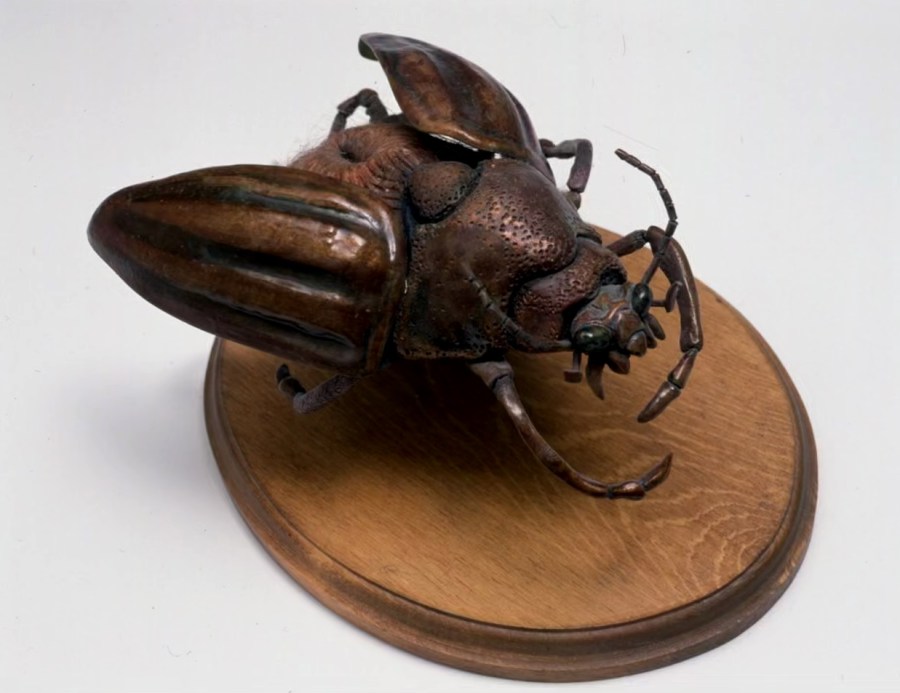
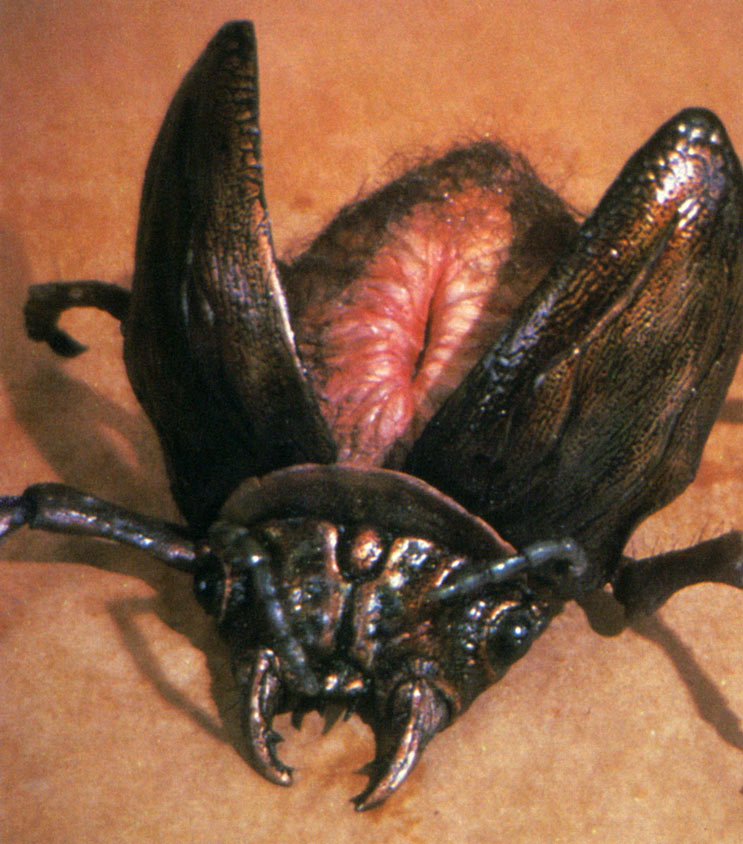
It is a beetle that first appears in the film, in the police headquarters sequence, engaging William Lee in conversation through a pulsating sphincter on its abdomen. After a long design process, the beetle design by Chris Walas was refined in sculptural form by Harold Weed. “I sculpted it in six body sections,” said Weed, “the main body, the sphincter, the head, the mandibles, the wings and the legs. Each part had to be sculpted and mechanized individually.”
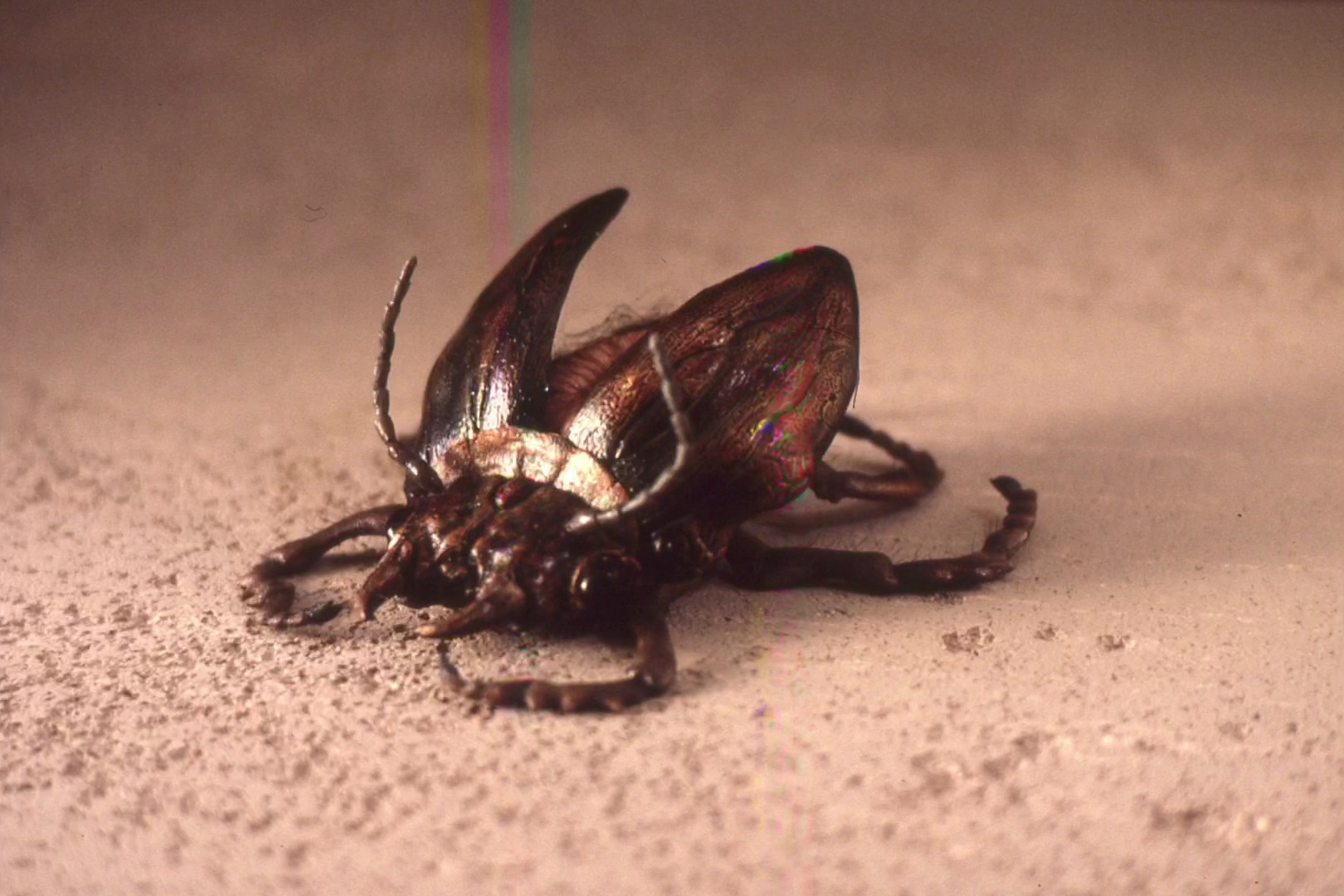
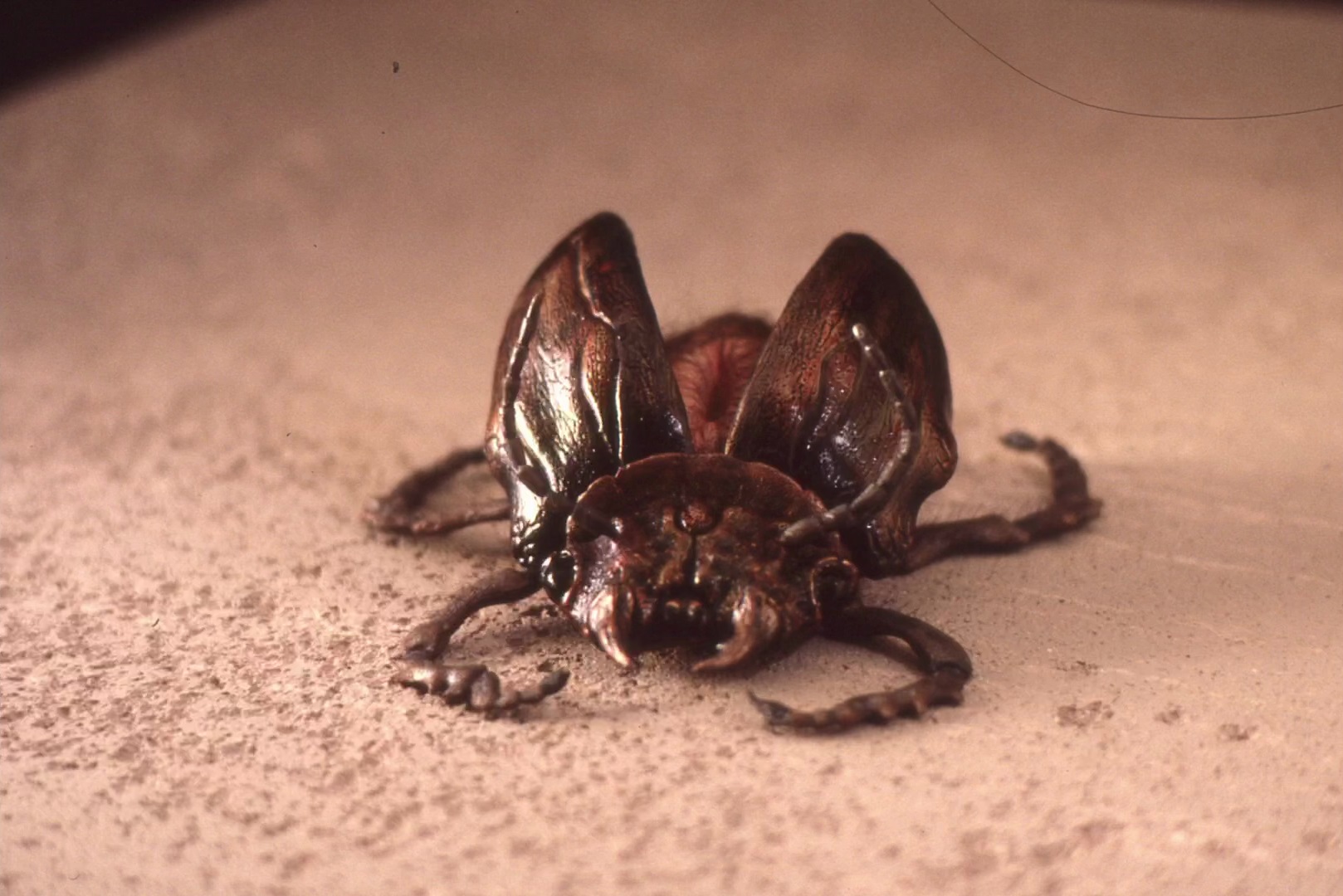
The sculpture was the basis for five different beetle puppets with different purposes during the sequence. A motor-driven, cam-operated rig could scurry across the table; another version was magnet-operated; another was fully mechanical, able to move its various parts, including the sphincter; another served for close-ups of the talking sphincter, and also featured four-way movement on the head and antennae; finally, the last version was a series of breakaway stunt puppets that were to be crushed by Lee’s shoe.
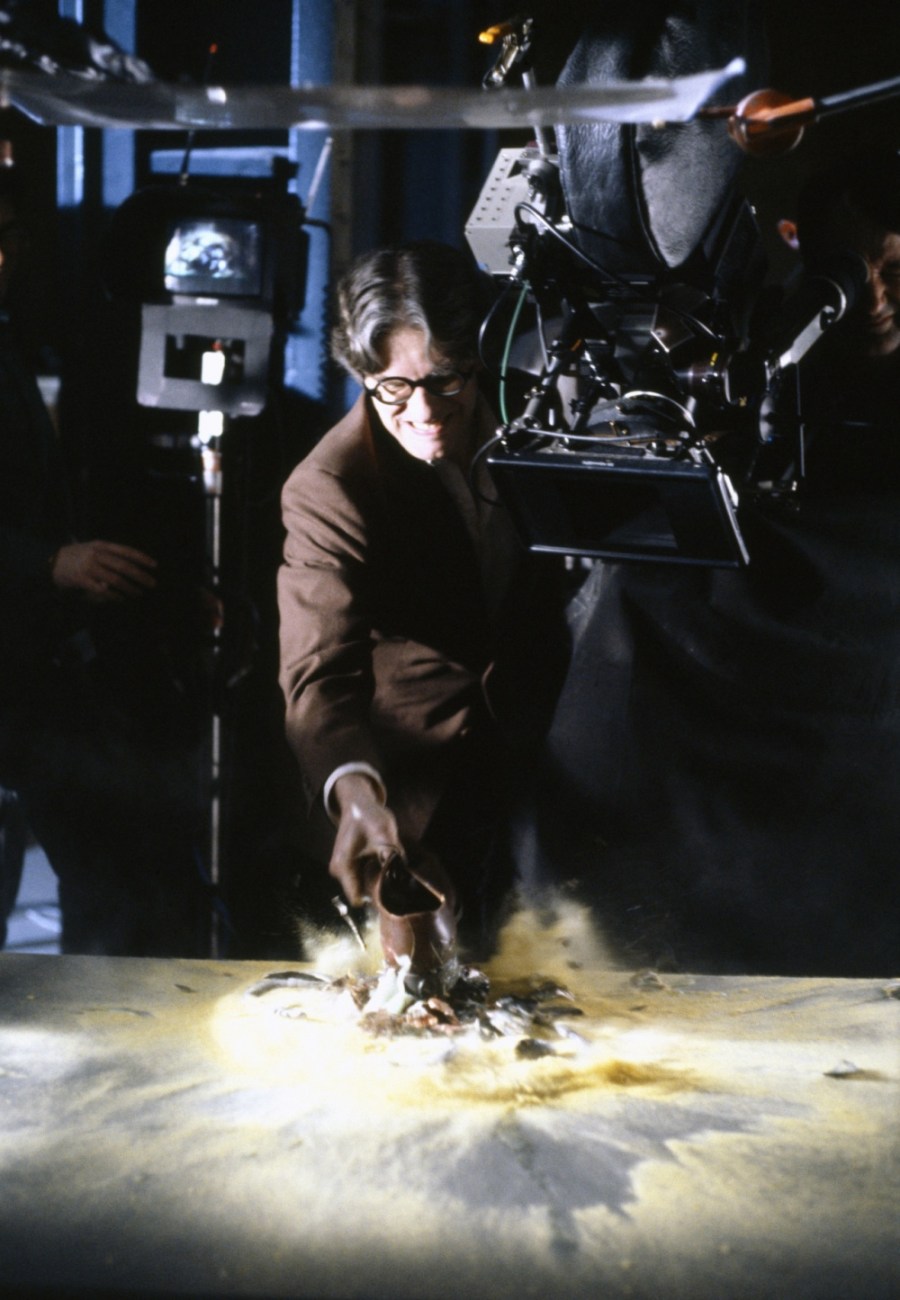
“I made thin, shell-like duplicates of the beetle out of a very brittle urethane plastic,” said Weed. “We airbrushed the inside so that once it shattered, any inside pieces that showed would look like flesh and veins and so forth. We experimented with different kinds of ‘guts’ for it — tapioca and butterscotch pudding and different consistencies of methocel that were tinted either with acrylic paint or food coloring. We put the goop in sealed bags and then stuffed those bags inside the body. David smashed it in close-up — and when he did, stuff flew everywhere.”
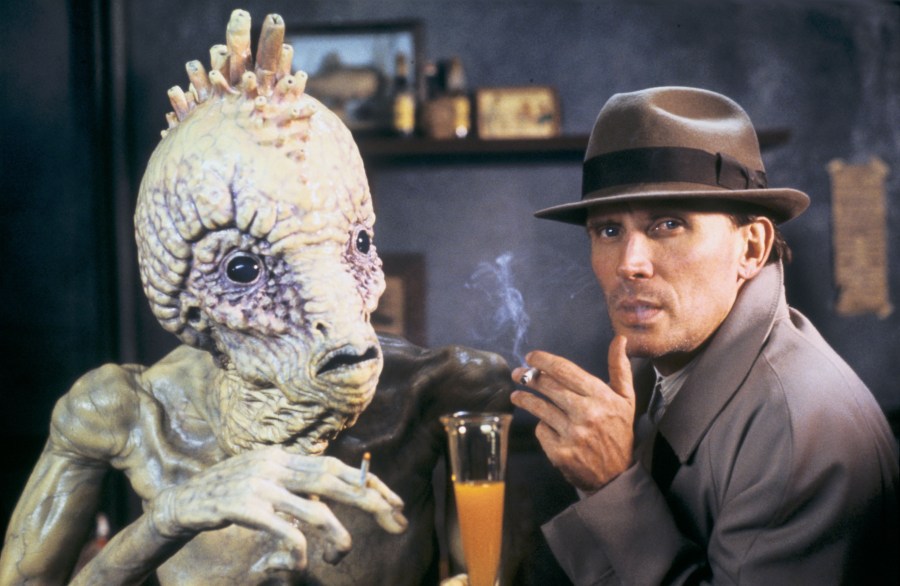
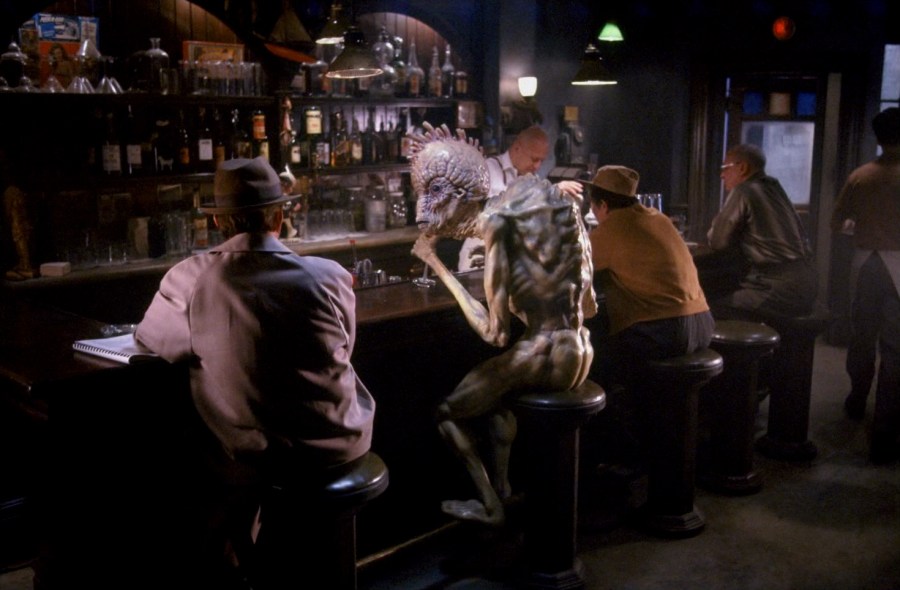
In a bar, Kiki introduces Lee to a Mugwump, who “specializes in sexual ambivalence”. The Mugwumps appear across the film in more or less prominent roles. In William S. Burroughs’ novel, they are vaguely described as humanoids with “thin, purple-blue lips” over”a razor-sharp beak of black bone with which they frequently tear each other to shreds in fights over clients.” In addition, they have the skin of a junkie and black insect-like eyes. They also secrete an addictive fluid from their penile appendages.
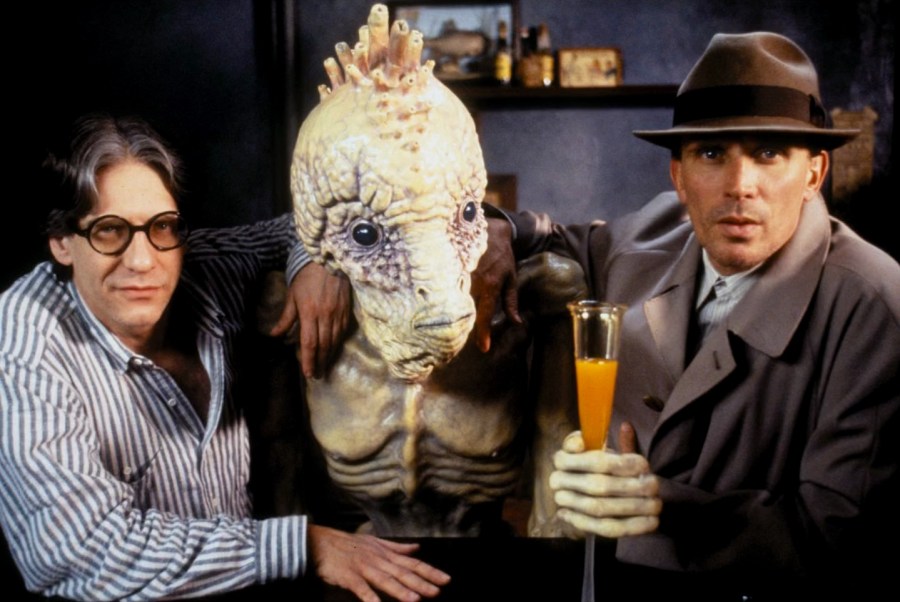
Cronenberg’s Mugwump would differ slightly from Burroughs’ concept, even though it would maintain the basic core idea. “Burroughs talks about the Mugwump in the book as a demure beast,” said Cronenberg. “I think that it represents all of the seductive monsters we run into that have some kind of addictive element — whether it is money or power or sex or whatever.”
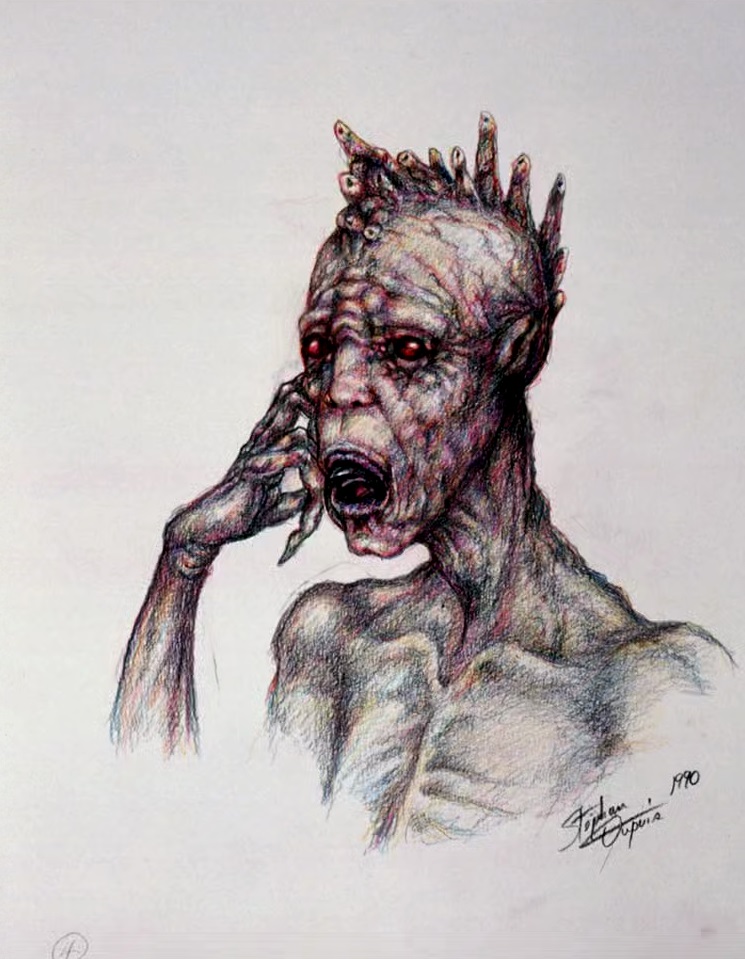
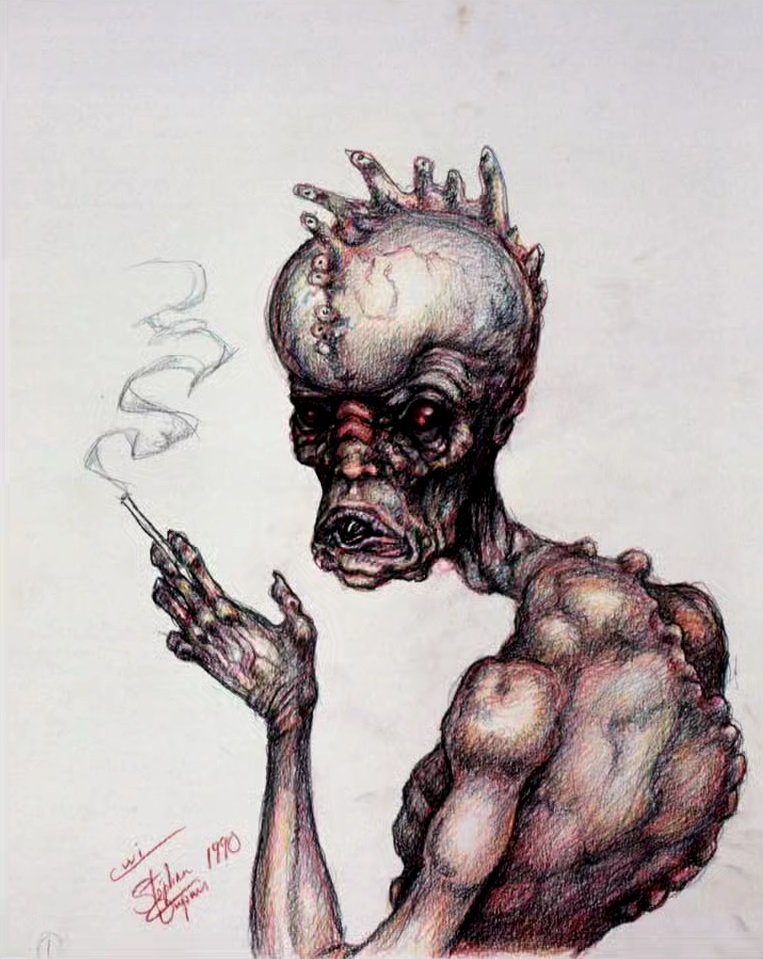
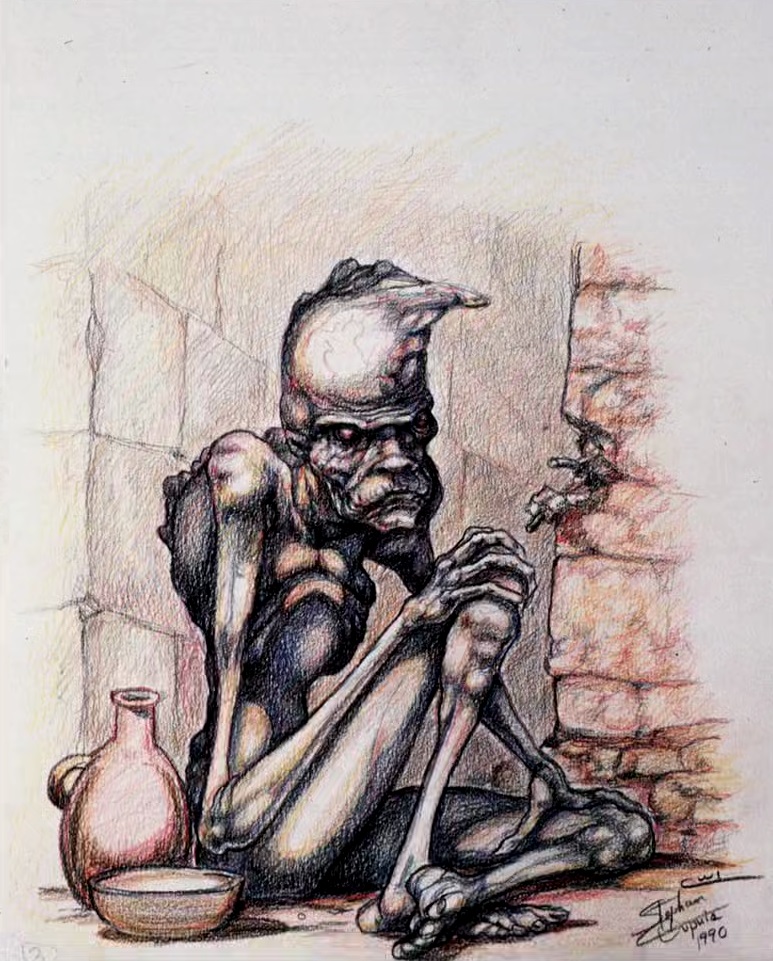
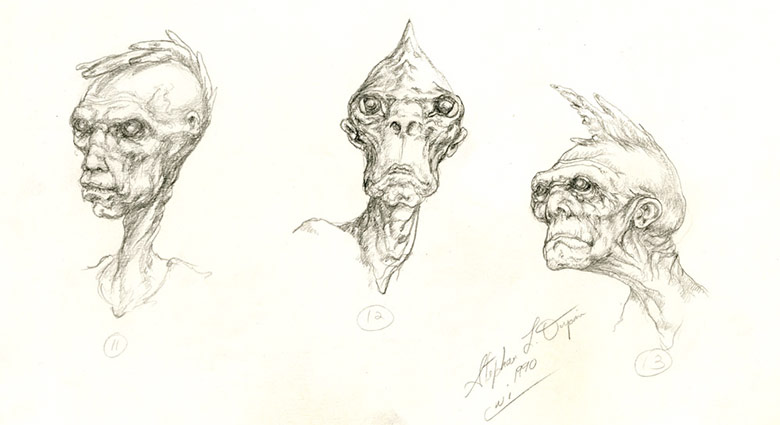
Under Cronenberg’s supervision, Chris Walas drew early concepts, and Stephan Dupuis took the design forward as an emaciated, pale creature that would bear sculptural resemblance to Burroughs himself. “To design the Mugwump of course was a major struggle,” Cronenberg said in his commentary for the film, “because he’s not described in great detail in the book, and yet he looms very large in the people who are fans of Burroughs. So, of course I used Burroughs himself as a model for the Mugwump, but of course had to get the Venusian interplanetary feel of him and at the same time have him be able to sit at a bar, smoke a cigarette, have the drink and talk to you, as the Mugwumps do tend to do.” In another interview, the director added: “the Mugwump is William Burroughs. [We thought] this creature should look somehow [like him], his chest, his posture, his something about his face.”
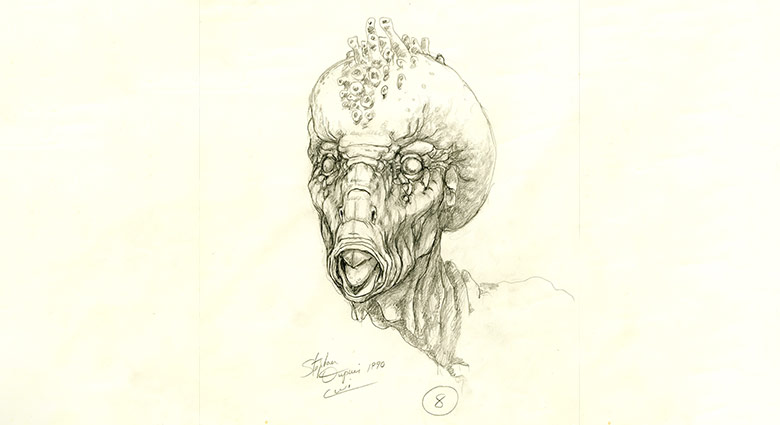
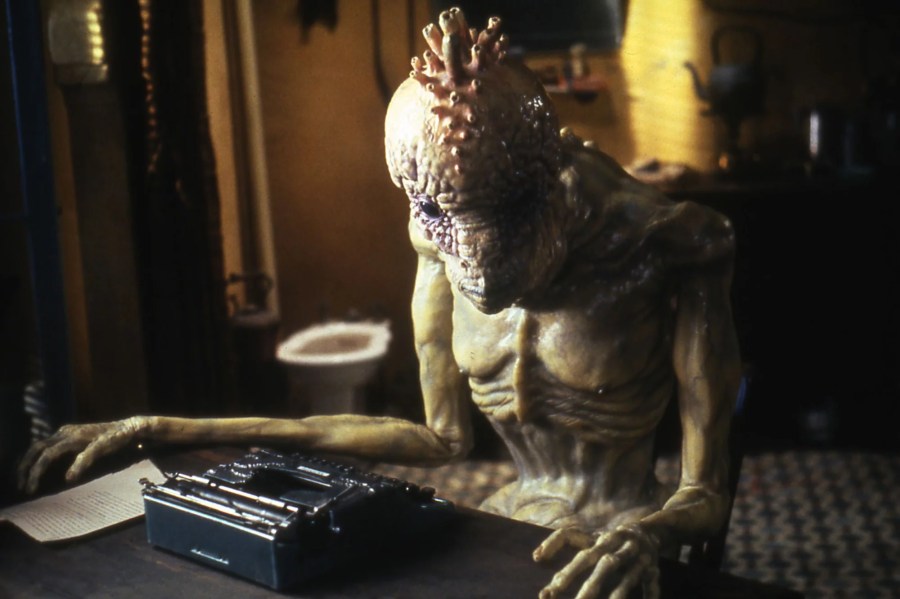
Burroughs’ likeness was brought over to the sculpting phase. Isaac weighed in: “we pretty much nailed the Mugwump from the beginning. David wanted something that was very powerful and had a strong presence on the screen — not a monster, but a person. He also wanted him to have William Burroughs qualities. So, we got some old photos of Burroughs and played around with those and eventually we sculpted the jaw of the Mugwump to look like Burroughs’ jaw. Aside from that, it had black lips and a black beak and a tongue that was round as opposed to flat — like a parrot’s tongue. Its body was very spindly, with long arms and long legs. We also gave it a lizard-like colouring with a lot of veining underneath and very pasty-looking skin — David likes that unhealthy look in his characters.”
Otherwise, Cronenberg recalled that “I thought his body should be like that of an old junkie — emaciated and with the ‘look of borrowed flesh’ that Burroughs describes in the book. I also wanted the Mugwump to be basically humanoid, but with characteristics that would emphasize its nonhumanness.”
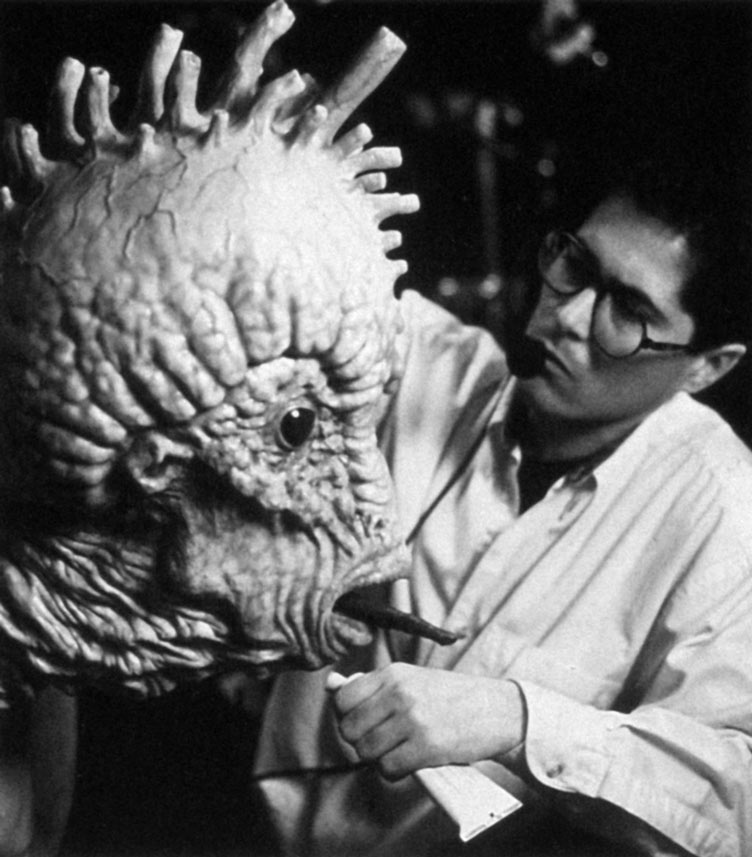
The addictive fluid would not be secreted by the Mugwump’s penile appendage, but rather from somewhere else on the body. Initially, this secreting organ — dubbed the ‘teat’ — was to be placed on the creature’s stomach, forcing addicts to kneel in front of the Mugwump and suck from it. Isaac recalled: “it was very sexual. There was no getting around it. We really tried to make the teats do what they had to do for the movie, but not so blatantly that David would be trapped by it. We shaped them as little like phalluses as possible — but it was tricky. David would come in to see our tests and say, ‘oh, man, how am I going to get a rating on this movie?’ And we were saying, ‘well, David, that was our question from day one’.”
In order to desexualize this trait, Cronenberg eventually decided to move the teat on the Mugwump’s head. Isaac continues: “the idea of the teat on the head made sense in terms of the story. The Mugwump was supposed to be almost worshipped. With the teat on his head, he could bend down — like a king extending his ringed hand to be kissed — and as the characters sucked, it was as if they were worshiping this creature. We also realized that having just one teat on the head might look silly, so we came up with the idea of placing several sea-anemone-type organs in the crest and having this teat grow out from among them.”
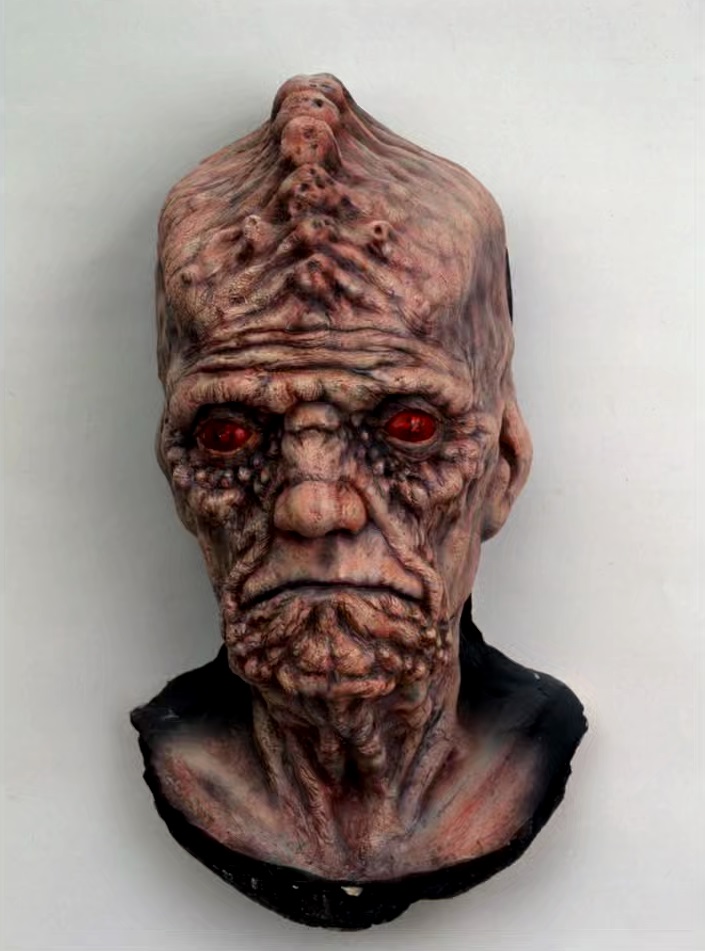
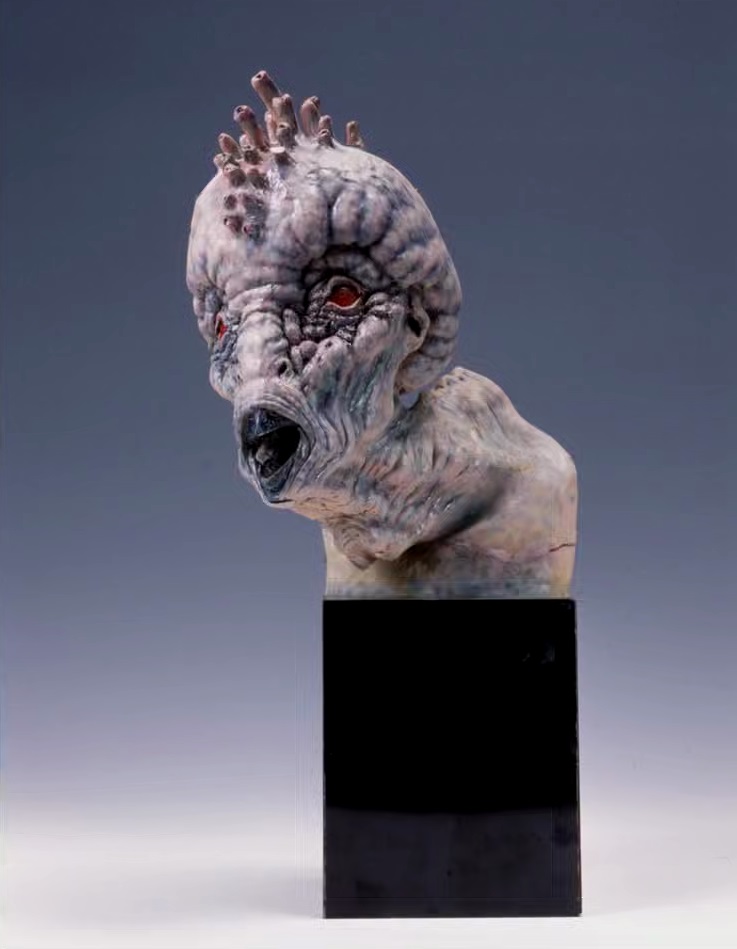
The Mugwump design was translated in three dimensions by Walas and Dupuis in a series of maquettes depicting its head and full body. Earlier designs depicted a more humanoid face, bearing striking likeness to Burroughs’. Eventually, the head became more reptilian. “We built a foot-tall maquette,” Isaac related, “and showed that to [Cronenberg], and he said: ‘that’s it. That’s the Mugwump’.” Its thin and gangly proportions dictated that a performer in a suit could not be employed; a series of puppets was delivered instead.
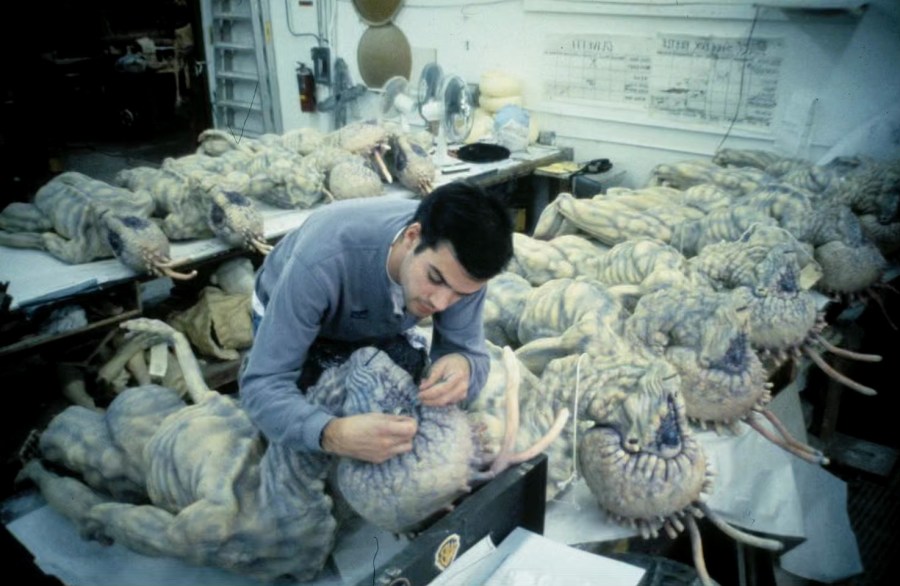
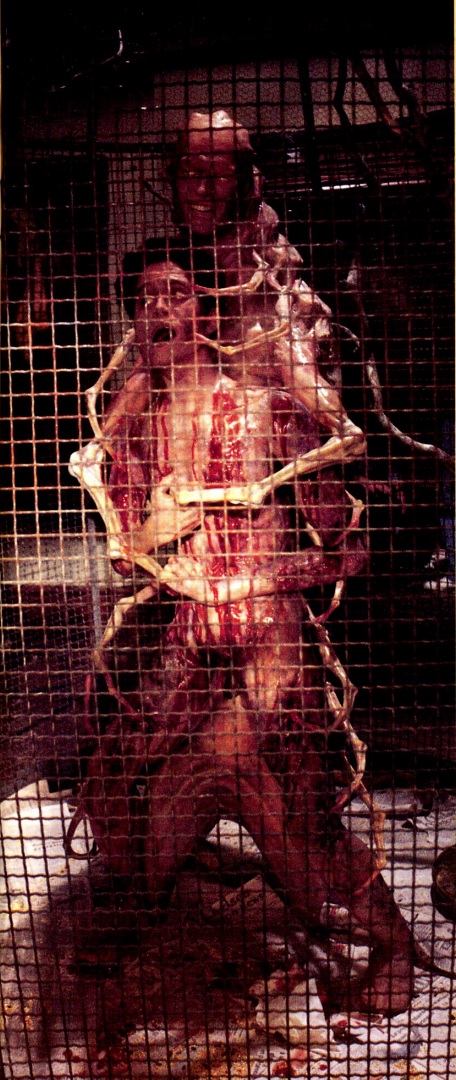
In total, two fully mechanical puppets (among which a hero version with close-up duty) and more than fifty dummies were constructed — a major undertaking for CWI. Based on a full-size sculpture by Dupuis and other sculptors, foam latex skins were produced en masse. “We were very careful with the first mould to get all the detail and the fit right,” said mould supervisor Wim Van Thillo. “The master mould was made in about 25 separate pieces because the Mugwump was such an odd shape. We injected silicone in a stone case for the master mould, then we took one good copy and made five additional two-piece fiberglass moulds from it. After that, it was a simple matter of painting in latex and foaming them up, five at a time. It took only about 10 or 15 minutes for the foam to set up, so it was a quick approach.”
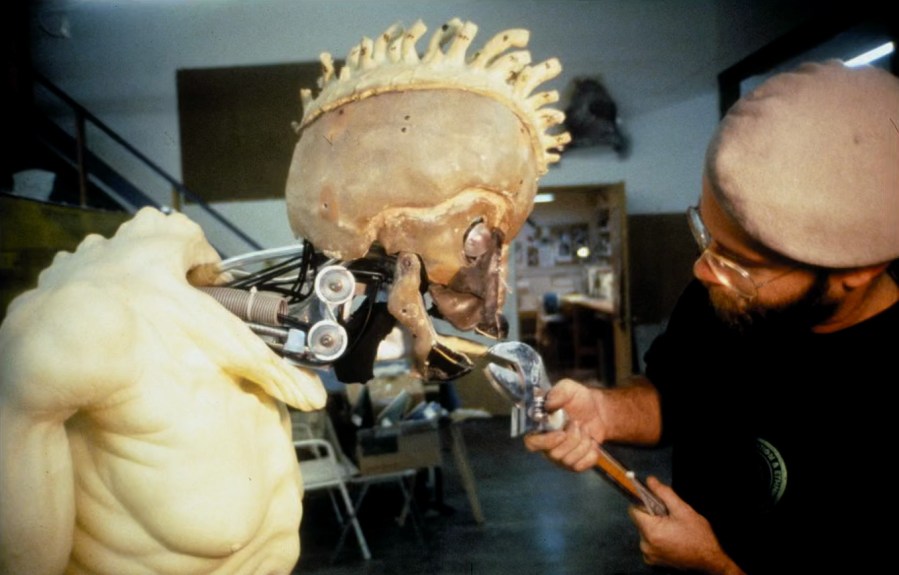
The hero Mugwump featured a fiberglass understructure with the necessary complexity of mechanisms to articulate it, such as the cable-controlled facial movements that included four-way eye motion, upper and lower lips, and four-way tongue movement. The latter was most challenging to mechanize, as noted by mechanical supervisor Kelly Lepkowski: “we were asked to build a tongue that would be able to extend about seven inches out of his head and be totally movable; but for it to move out seven inches, there had to be seven inches of blank space behind it for it to go back into. We ended up putting the tongue on the end of a flex shaft — and that is what pushed it in and out of the mouth.” Motion of the cheeks was achieved with bladders.
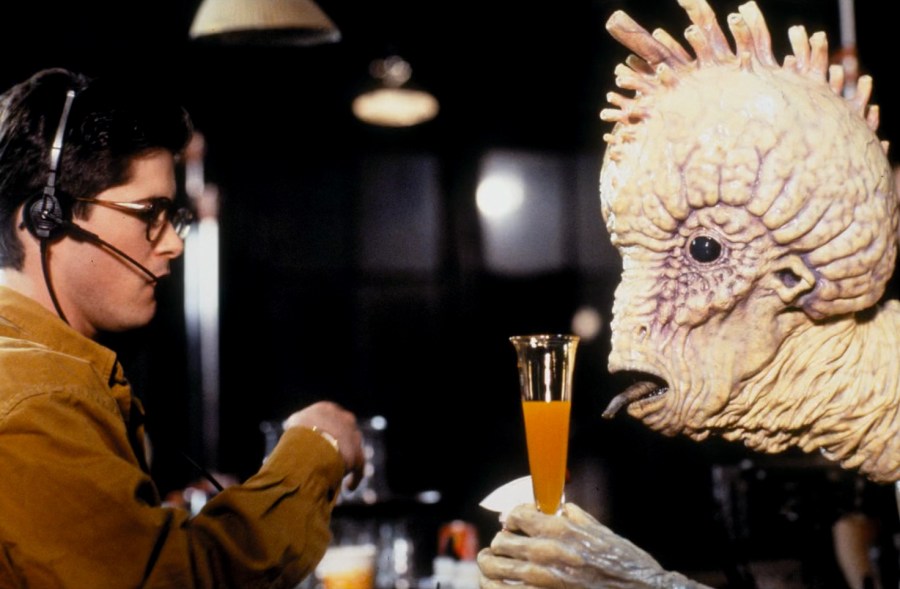
Since the Mugwump had to speak pages of dialogue, the mouth and tongue had to be especially well-mechanized. “He had a great deal of dialogue,” Lepkowski said, “which is very unusual for an effects creature. We had to concentrate on the lips and make sure that we had some really good lip movement, along with simple up-and-down jaw movement, to get something that would read as speech. The beak-shaped mouth allowed us to get a lot of variation in the lips just by putting two cables in the top lip and two in the bottom. Each one of those cables was on a separate lever and the two levers were joined together with a bar. By pulling that bar, we could make both sides of the lips move in the same way.”
Animatronics engineer Bryan Dewe also weighed in about the lip synchronization: “I spent about four weeks rehearsing the lip-syncing. I got a tape of someone reading the lines and I practiced and practiced with that. When I felt as if I was getting close, I videotaped it to see what was working and what was not. The ‘P’s and ‘B’s were the hardest sounds to make.”
A series of pulleys and joints inside the neck enabled twisting and tilting from side to side. Lepkowski said: “the neck was very complex. It had five axes of movement on it. It turned back and forth at the base, with the head turning in sync with it; and the head also tilted, in addition to rotating. We used a ‘three-way’ for the neck — a universal joint pulled with three cables. The neck came out almost perpendicular to the body; so the head, instead of being on top of the body, stuck out like it was on a stalk. It was very difficult to get organic movement from something like that.”
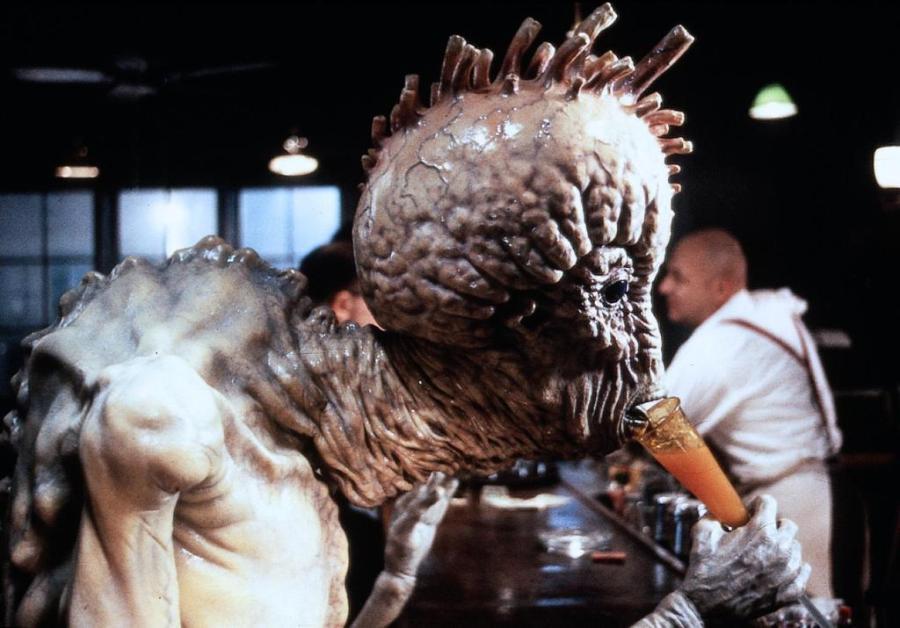
Isaac added: “David really liked how that looked, but from a mechanical standpoint, it was a nightmare. The head was a good two feet from the shoulders, so we had to use very long cables to operate it. The cables ran down through the body and then underneath the set. Generally, the longer the cable, the more difficult it is to operate the puppet — and we had cables that were up to 15 feet long in some scenes. One person would operate the head turn — which was a compound move — and then another person would operate the head tilt.”
While the arms and legs could be moved via wires (attached to elbows and knees), gross body movements were rod-operated, with a pole running the length of the Mugwump’s body and extending through the bottom. Isaac continues: “there was a T-handle at the bottom — like a submarine periscope — and we could twist it so the puppet pivoted at the butt, or we could twist it so the shoulders would twist alone. One person would do those two moves to keep the puppet alive. The body was all jointed so that the legs could move even though the puppet couldn’t walk. To simulate breathing, a tube was connected to the chest which had big balloon bladders in it. Someone below would keep that going with a foot pump.”
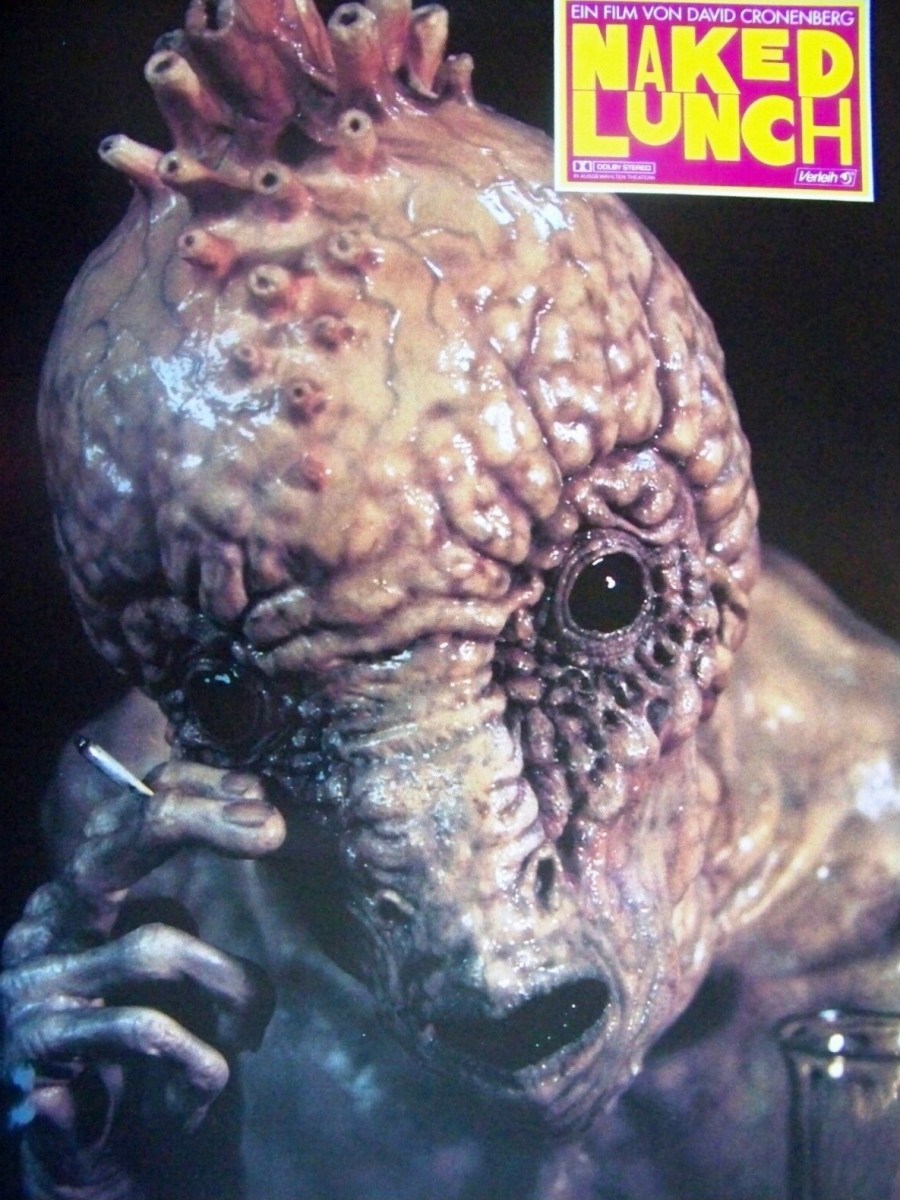
The multiple appendages composing the crest on the Mugwump’s head were originally thought of as stationary; Cronenberg eventually decided to have them able to fluidly move in sequence. Lepkowski recalled: “it was difficult because they were on a head that was mechanized through this very thin neck. Obviously, we couldn’t have forty cables going through that small a space. So we put a miniature cam controller device inside the head to pull the independent cables. It was driven externally by a motor that was fitted in the Mugwump’s body. We couldn’t have a motor in the head because it was sitting on the end of this two-foot-long neck and every ounce of weight that we put on the end of that translated to ten pounds to the cable in the back that was trying to lift it. So we ran a flex shaft up there and built a really lightweight cam mechanism that drove all the organisms in the crest.” The motor that drove the cam controller was linked to a rheostat, which enabled the rate of motion speed could be adjusted as desired.
The biggest of the appendages was an extending latex teat. Lepkowski commented: “the growing teat had us guessing for quite a while. Because it didn’t have any seams, we couldn’t do the typical thing with a fold that it could grow out of. David wanted to see it blend very evenly into the top of the head and then grow to two or three times its length. It was asking a lot.” Air pressure was the ultimate solution for the effect, but finding the right material took sometime. Lepkowski continues: “one of the problems we had in the early tests was that materials would balloon out rather than growing lengthwise. I ended up using nylon that was like parachute material. It was very lightweight, finely woven cloth which was slick and moved easily against itself. I sewed that into the right shape and covered it with eighth-inch-thick foam latex. We built up a nipple on the end and then painted some veining on it. There were no moulds, so each teat had to be built individually.”
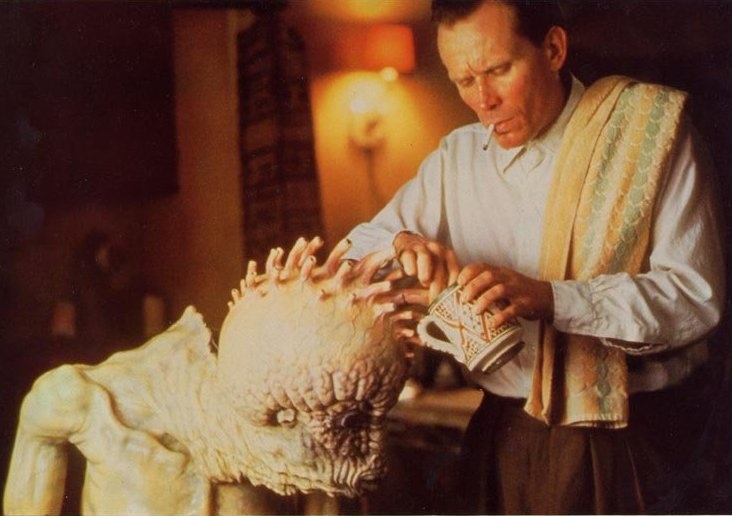
Once extended, the teat also had to emit fluid (in most cases, coloured methocel mixed with egg white). This was solved with a thin nylon tube, affixed to the tip and running down its length, which also held the entire apparatus in place. “The tube actually served two purposes,” said Lepkowski. “One was to hold the teat in place and let it out slowly. If there had been nothing to hold it, once the air pressure was turned on, the lightweight material would have shot out too fast. The tube was also used to pump the fluid through. Someone would push a syringe-full of this stuff as hard as they could to get it through that small passageway.”
On set, the lip synchronization was most challenging, as noted by Isaac: “we had to find a way to coordinate the lip syncing and the puppeteering and the performances once we got on the set. If we had just had our puppeteers read the lines, that could have been distracting to Peter Weller because our people are not actors and they would most likely not do justice to them. So David auditioned actors and hired one to read all of our characters’ lines in the proper rhythm and cadence. Then we taped that and rehearsed our puppeteering with it. On the set, the actor was miked so that our puppeteers below could hear him — and Peter could hear him live. So Peter had a real voice to play off of while the puppet was mouthing the words.”
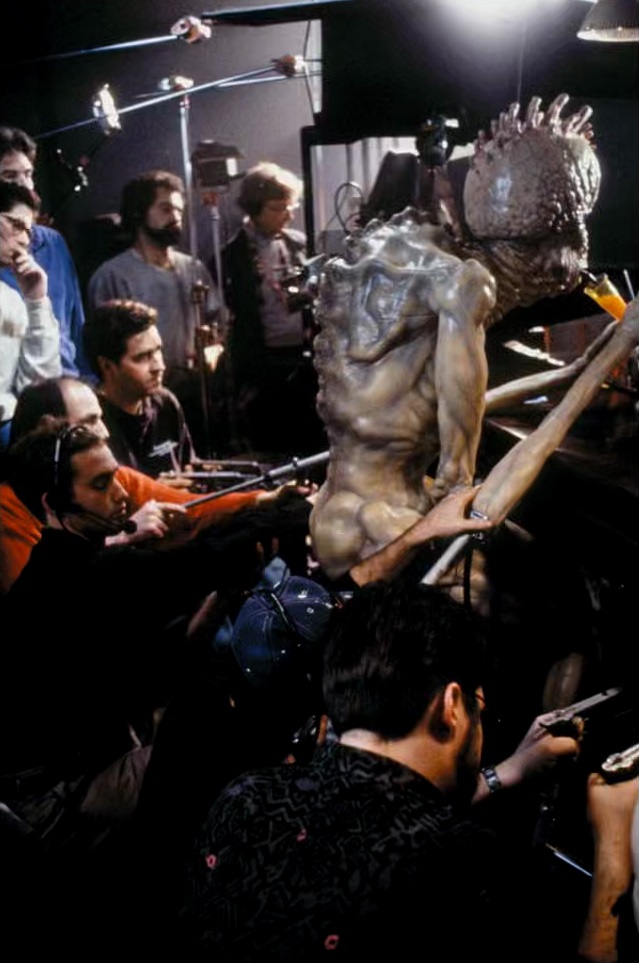
Since the animatronic Mugwump’s arms were only wire-operated, insert arms were built for shots that demanded more complex actions, and used either by themselves or in tandem with the puppet. They featured movable fingers and wrists, could twist and move up and down. Shots involving these arms included those with the Mugwump smoking a fake cigarette glued to the fingers. Puppeteering here was also challenging. Isaac related: “The trick in the puppeteering was to get the timing right because we had the cheek bladders going and the cigarette had to come up to the mouth and the lips had to move a little bit to accept the cigarette. The cigarette didn’t actually go into the lips, but the hand covered the mouth to hide that.” Using a pump, and a tube within the puppet, smoke could be emitted through the Mugwump’s nostrils or mouth, depending on the demands of the shot.
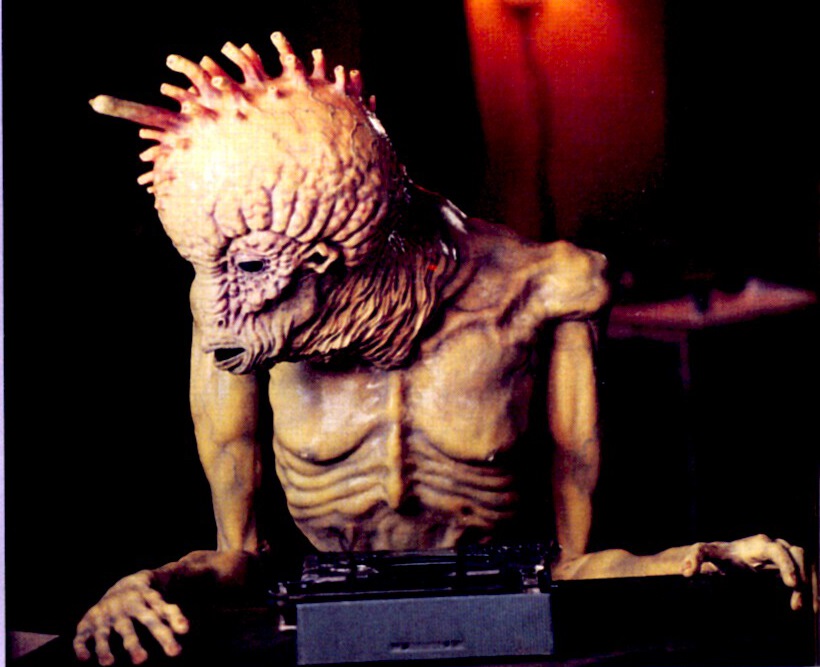
The hero Mugwump was again employed in the Interzone hotel room scene, this time accompanied by a less sophisticated version designed by Guy Hudson for scenes where the creature bends down to offer the teat on its head. “Its main function was to bend over,” said Isaac, “and it had a functional, growing teat. We found that it was also useful for other specific shots because it had a steel frame and, unlike the hero Mugwump, could stand on its own.”
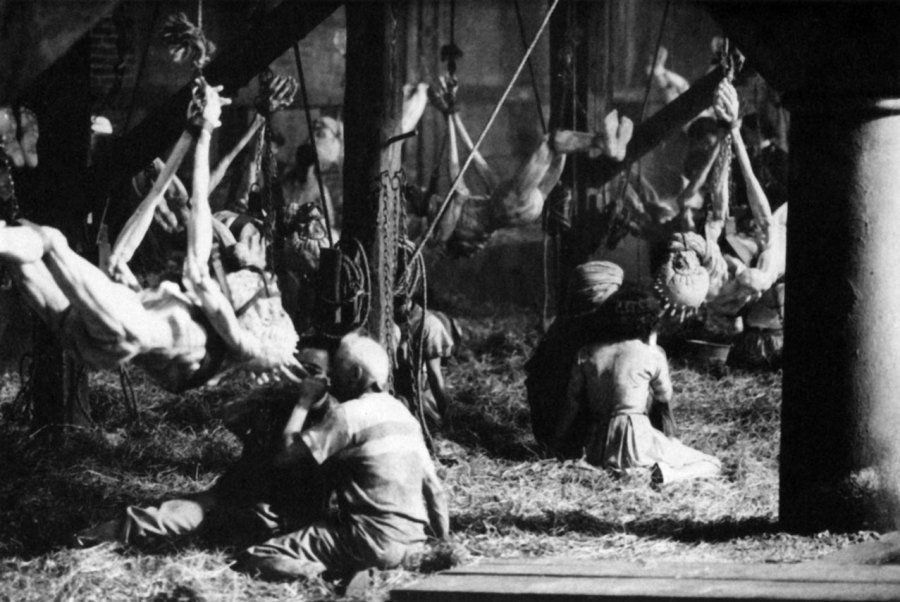
Towards the end of the film, Lee discovers the Mugwump dispensary — wherein numerous of the creatures are chained and hung upside down at the addicts’ disposal. About 50 Mugwump dummies were constructed, divided in three groups according to the quality and finish of their skin. Isaac explained: “the best ones were placed nearest the camera, and the less desirable ones were put in the back. Then, for closer shots, we had two mechanical Mugwumps with teats that actually dripped. There were no facial movements or anything on those. We did armature a few of them — some with steel, some with wood — so that we could pose them. Since they were all harnessed, there was only limited movement we could get from them anyway.”
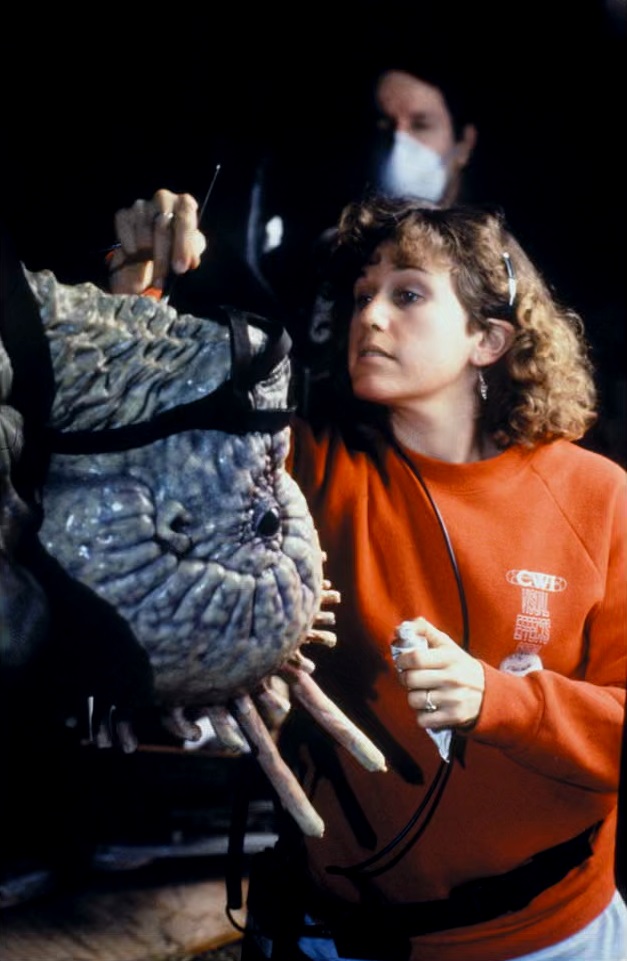
The “bend-over” puppet was also recycled for close-up duties. Isaac continues: “we also used our bend-over Mugwump for a shot in which one of the characters is sucking the teat and talking to Bill. Because it was a close-up and the Mugwump was supposed to be alive, there was a fair amount of head movement. We didn’t have time to build a whole new puppet from scratch, so we just flipped our bend-over guy upside down and hung him on a special rig so we could put him in any stall we wanted.”
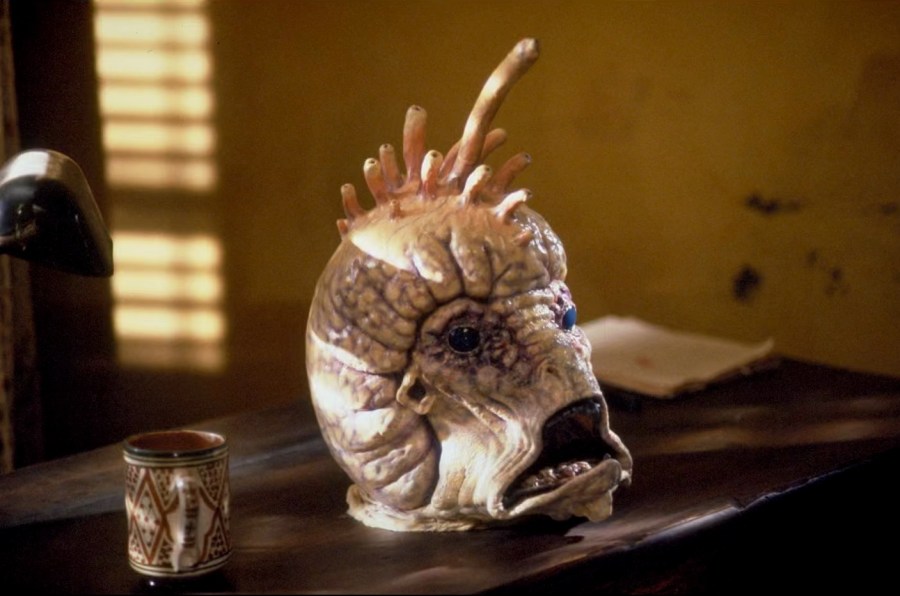
Out of the remains of the Martinelli typewriter, a new device is forged — the Mugwriter, a half-organic, half-mechanical Mugwump head with a keyboard in its gaping mouth; another manifestation of the Mugwump itself. The design process was lengthy, as noted by Isaac: “we designed very strange looking heads with keyboards and rollers. Some were organic looking and some were more mechanical. One thing that David knew was that he wanted Lee’s hands to be able to fit inside the mouth as he typed — the rest was up to us. So we came up with some wild stuff. But the more we played with it, the sillier it started to look; and eventually we went back to the Mugwump head. In the story, the Mugwriter is basically the Mugwump, just appearing at a different level.”
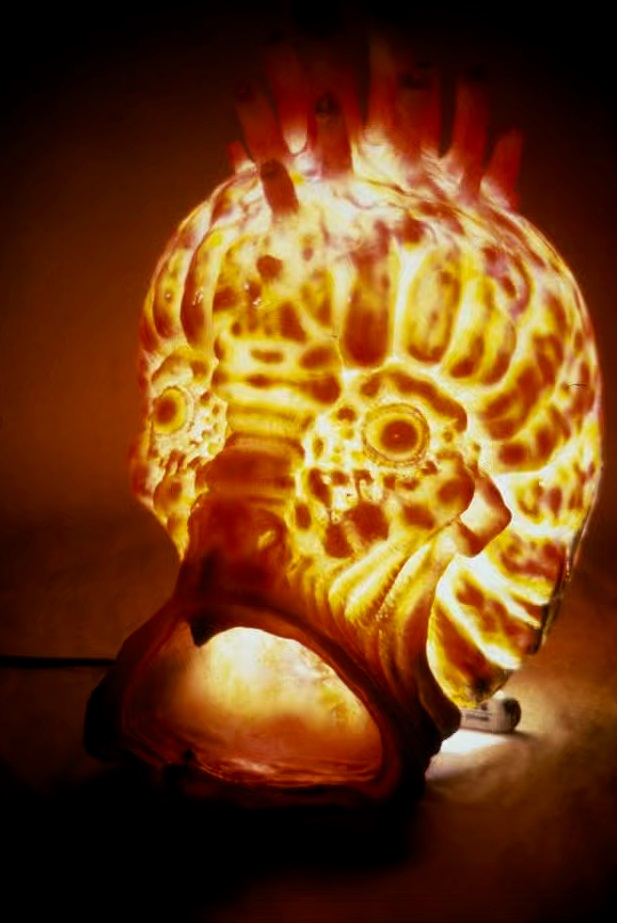
Two versions of the Mugwriter were built; the first, a static prop, was only used in the forge sequence, whereas the second was a fully animatronic character. The Mugwriter was mechanized similarly to the hero Mugwump’s head, but with a larger mouth to accommodate Weller’s hands. The wide mouth became a problem during lip synchronization because of its proportions, and another replaceable jaw with the original Mugwump’s proportions was devised for speaking scenes, accompanied by the full-size Mugwump puppets. Isaac commented: “the wide mouth just looked too silly when it talked, and we figured, since it was a hallucination anyway, that the Mugwriter could transform itself in the course of the scene. David and I brainstormed and came up with the idea of reducing the size of the mouth when it talked and then, ultimately, replacing it with a full Mugwump in the scene. That way, we were able to have the Mugwump, rather than the Mugwriter, deliver ninety percent of the lines.”
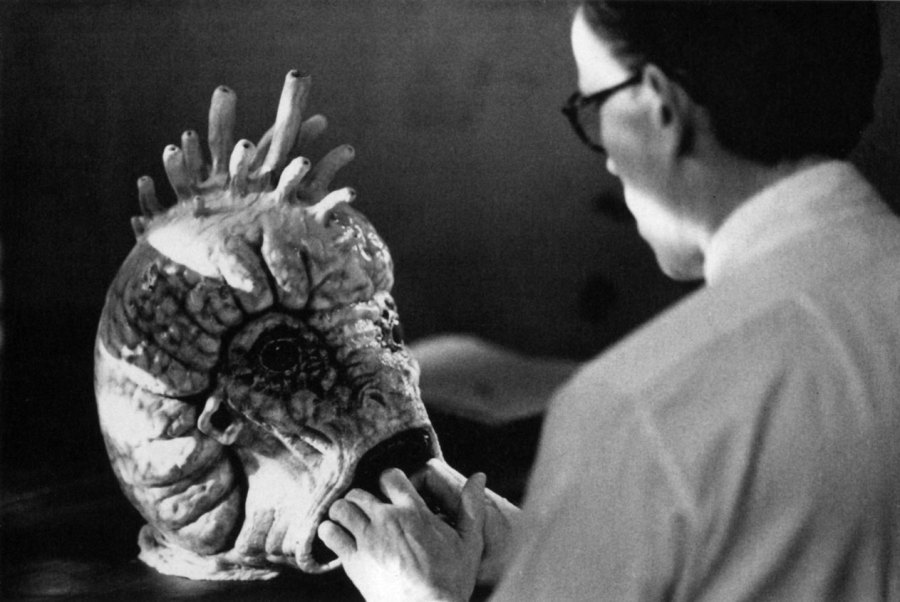
The Mugwriter featured hand-cranked cam controllers to operate the head appendages. Isaac continues: “we didn’t need motors because, since it was only a head as opposed to an entire body, we could easily bring cables out through the bottom and they would only have to be about four feet long. The Mugwriter had the same four-way eye movement as the Mugwump. On the wide-mouthed version, the lips moved independently and the mouth opened and closed. For the talking scenes, we would just remove the wide mouth and replace it with the smaller mouth by cutting into the jaw area and then gluing the face back on like a prosthetic.”
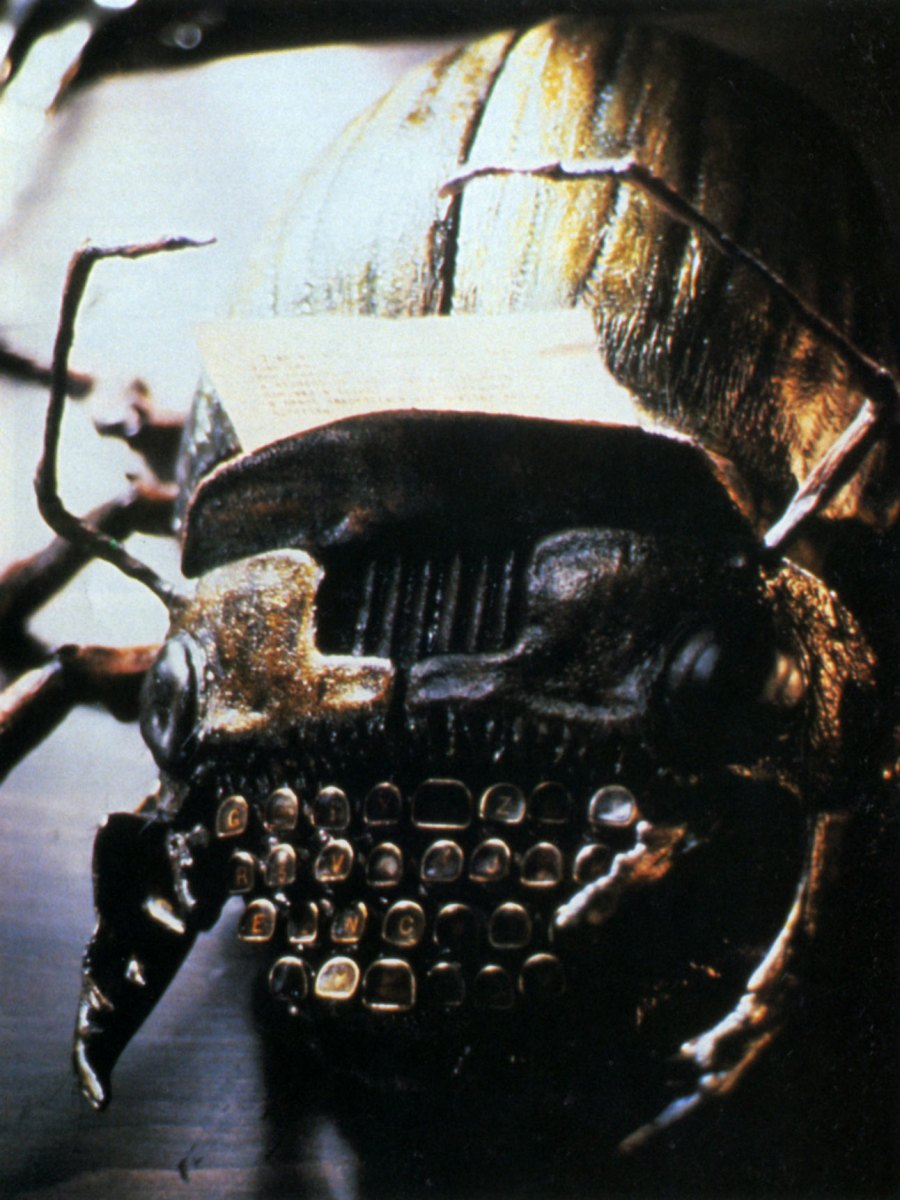
Another creature prominently featured in the film is the Clark-Nova typewriter beetle — in part similar to the case officer bug, with the same kind of talking sphincter, but this time with a keyboard-head. “The insect typewriters were my trick to get the audience inside the writing experience,” said Cronenberg, “where your writing machine and your experience of writing and the characters that you are writing all blend together into one. Also, Burroughs uses insect imagery a lot, and I’ve always been fascinated with the insect world.”
Cronenberg thought of the Clark-Nova as a sort of tragic hero, and this influenced the creature design. “He’s a good guy — or at least as close to a good guy as you’re going to get in Interzone,” said the director. “So Clark-Nova had to have some charm, which made his design somewhat difficult. We went through a lot of debate over this guy. How big should he be and how much expression should he have? How much could we rely on real insect anatomy and still get something that would work dramatically? There was a lot of trial and error before we came up with a successful design.”
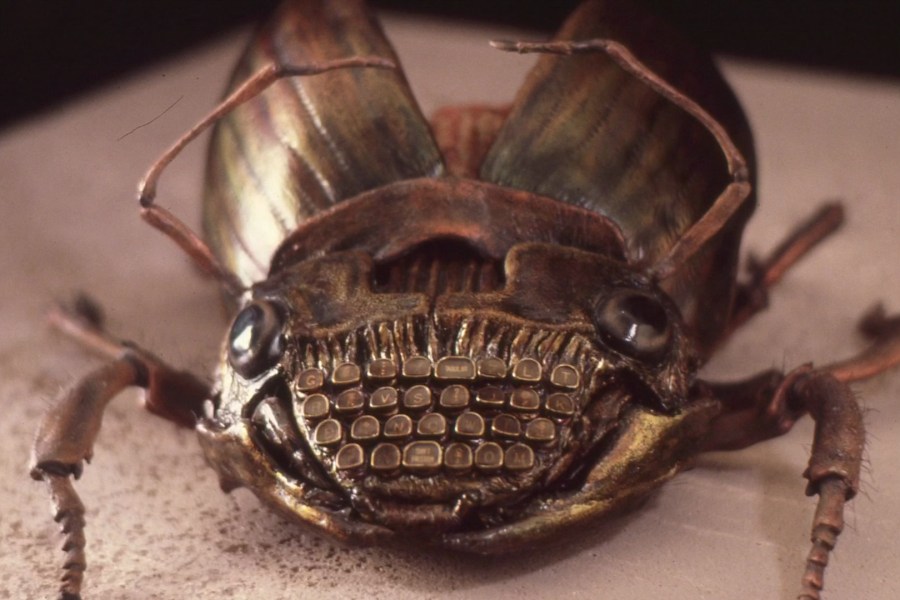
Of course, the creature had to look authentic, and research into the insect world was essential. Isaac related: “David knows what bugs look like, so we really had to do our research to make this thing look real. It had mandibles in the front that were like claws, and then legs that were more beetle-like. The front was flat-faced with a keyboard and the wings came up from that. In the back — which is where the body would be — was a talking sphincter like the one on the case officer bug.”
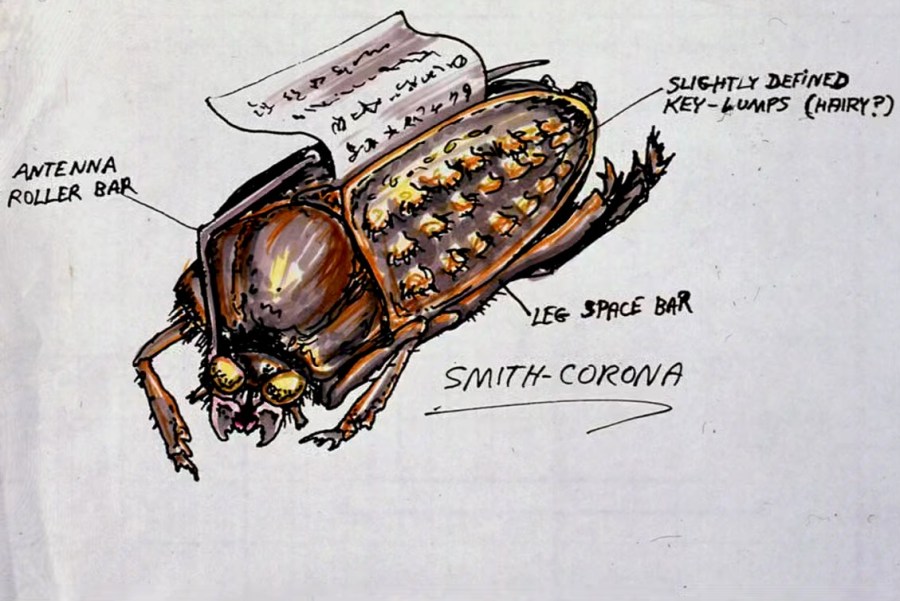
Originally, the Clark-Nova was a Smith-Corona, and the keyboard was on its elytrae, but was later moved to the front of its head. Once this change was made,the Clark-Nova was sculpted by Randy Ottenberg and Harold Weed, aided by Stephan Dupuis and Joel Friesch. “When Randy left, there was a big push on the Clark-Nova,” said Weed. “I sculpted the wings and the legs and most of the head. Joel sculpted the mandibles — over and over again. For some reason, they were always being changed. Even after we started to mold the head and make pieces, the mandibles got changed three or four times.”
Previous research at CWI for Arachnophobia proved essential for the mechanization of the Clark-Nova. Lepkowski said: “luckily, we had had time on Arachnophobia to develop devices that would allow us to make insect movements. We had built cam devices that pulled cables in a sequence to get the repeating motion of a spider’s walk. So the technology we developed there made it easier for us to build the insects for Naked Lunch.“
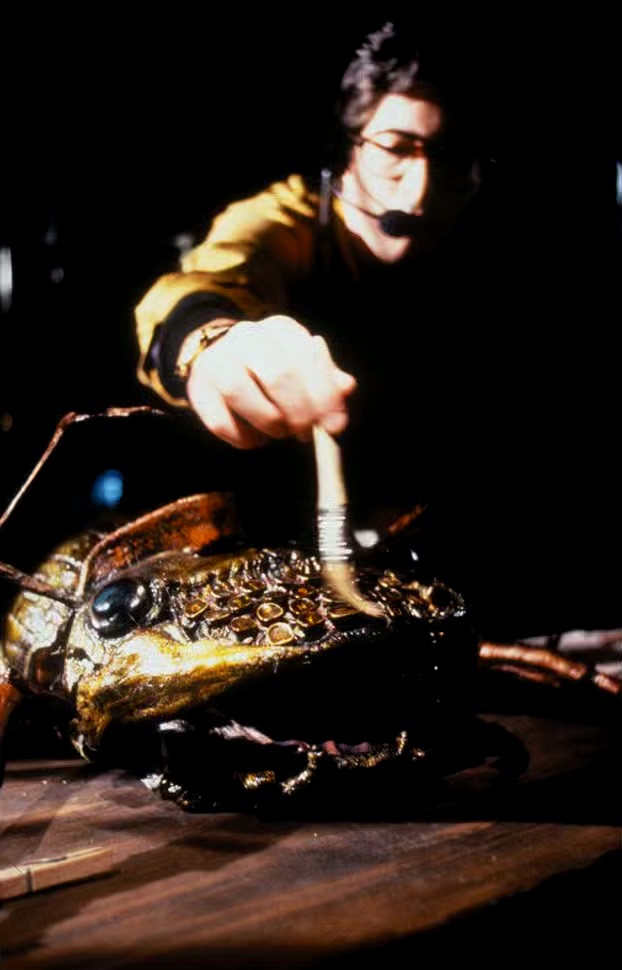
To perform the various actions demanded by the script — talking, diving off a desk and running, as well as devouring another typewriter insect — a total of 13 Clark-Nova puppets were built, with various purposes. All had to be puppeteered according to a series of quirks that the crew developed. Isaac related: “because it’s in the movie so much, you get a real feeling for its character. It’s Weller’s typewriter, but it talks to him, giving him advice, telling him what to do. It becomes his buddy. We had to give it a consistency of movement. We had to make sure the puppeteers did the wings, the mandibles, the same way every time. It had to be imbued with its own little quirks. We wanted to get more into it than simple movement.”
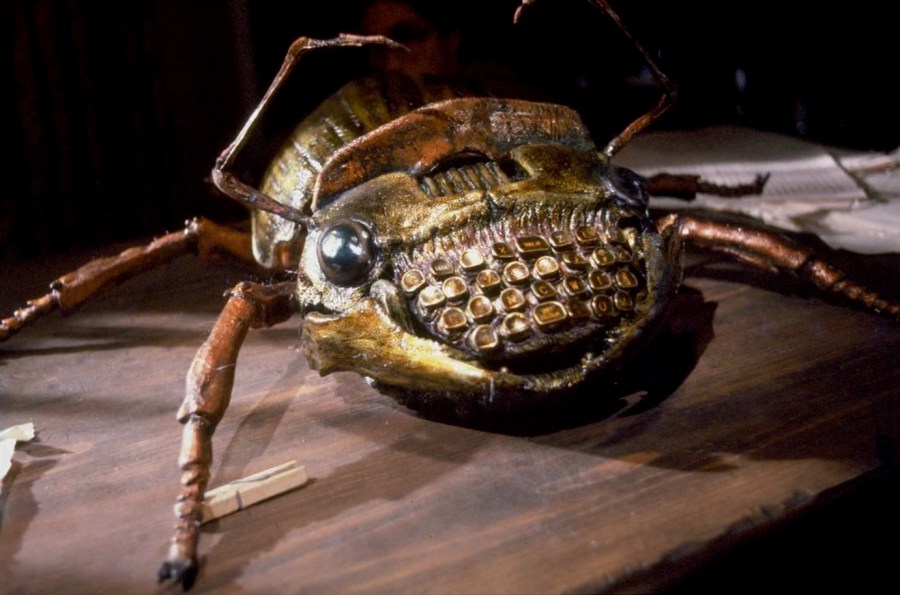
Two hero puppets were devised for the talking scenes. One was a rod puppet for close-ups of the head, able to move the jaw, wings, mandibles and antennae. It also had cam controller-operated legs to scurry across Lee’s desk. For shots showing the talking sphincter, the second hero puppet — a hand puppet — was used. Dewe once again performer lip synchronization. He said: “because there was no armature in this particular rig, we glued little finger cups inside to give the sphincter more definition. We had started out with an armature built into it; but David didn’t really like the way it moved, so we took the armatures out and started to do the hand technique — which worked fine. We cut a hole in the floor and I would stand underneath the desk. My arms would get tired, holding them up over my head all day, but David was really good about letting me rest. There was a monitor there to watch while I was puppeteering. I would read the lines on the page while the actor on stage was reading them aloud and then glance at the monitor from time to time to see how I was doing.”
A walking puppet, set upon wheels, was constructed for scurrying shots. When pulled by a wire, its legs would rotate in sequence. “It was really a frantic motion,” Lepkowski said, “so it didn’t have to be that controlled. In one scene it had to slam into a door, so that puppet was built like a tank. It had huge aluminum girders in it and the head was solid fiberglass with big bumpers all along the front. We used the mandibles themselves, cast out of urethane rubber, to absorb the shock.”
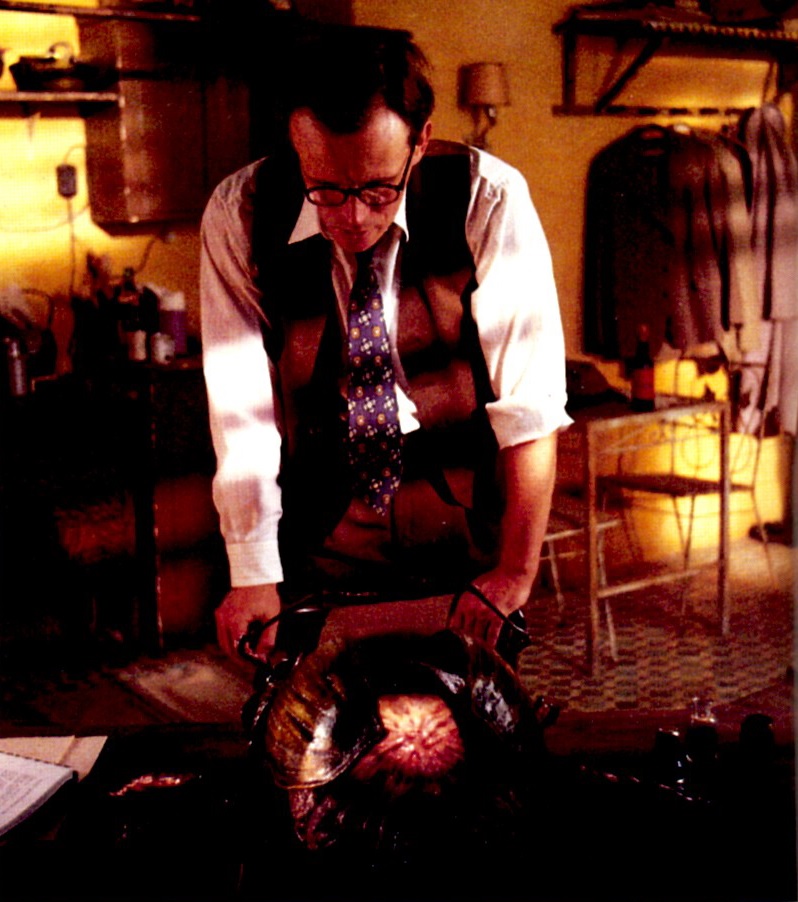
Another less-detailed puppet could flail about, with a battery-powered motor inside. “It moved off-center and made the whole puppet flail and shake,” said Isaac. “We used it for quick wide shots. It was self-contained — we’d just turn on the switch and it would go.”
In one scene, the Clark-Nova jumps off Lee’s desk and scuttles on the floor in an attempt to escape its captors. Originally, it was the flailing puppet that leaped off the desk, but the approach — involving a wire to pull it from off-camera — proved unsuccessful. The hero puppet and the runner puppet ended up being used instead in a Texas switch shot. “The trouble was that all the other rigs looked so good that we couldn’t quite get away with the flailer for that one shot,” Isaac said. “So instead we designed a shot where our hero puppet jumped off the table with the wings and everything moving — it dove right off and left frame. Then, hidden underneath was our runner puppet which would take off. So you see one dive off and then a
split second later you see the other one running.”
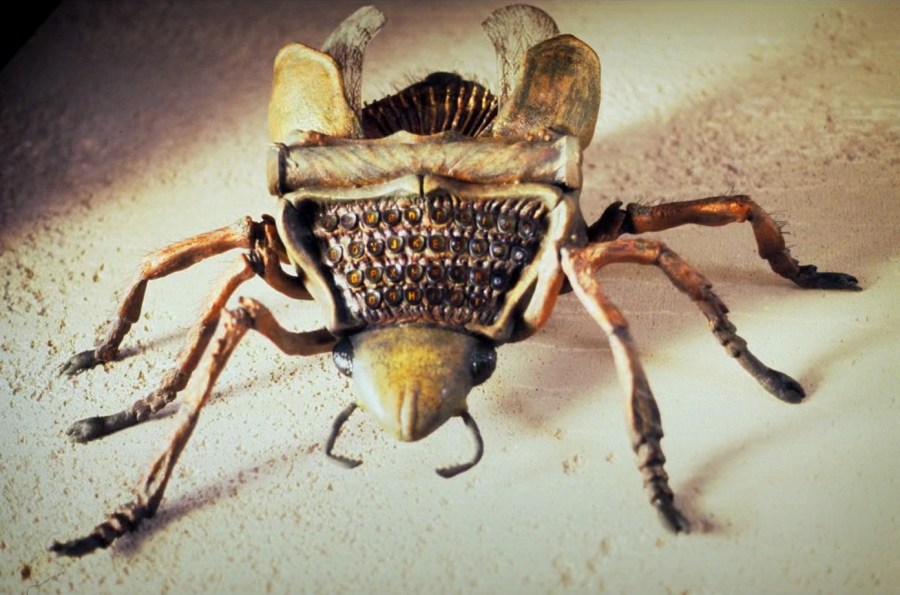
Tom Frost’s Martinelli — originally an Olivetti — typewriter becomes another insect, which is quickly dispatched by the Clark-Nova — the sequence involving both being the most complex effect to achieve during production. The Martinelli was initially sketched by Walas, but ended up being a Weed design. “It was originally drawn to be much more mechanical,” said Weed. “Chris had done a sketch early on and the legs were very squarish and the body was angular — almost like a robot version of some insect. But in the end, David decided that it should integrate more with the other designs. The Martinelli turned out to be the most complex of any of the bugs.”
Four versions of the Martinelli were built. A pristine Martinelli, unseen in the film, was built mostly for reference. For its jump off the table, a breakaway puppet was devised. Isaac commented: “we made a rig that was like one of those old springloaded cars that crack up, the kind that hit and then fly apart. That particular rig was loaded with different flesh and mechanical pieces so that when it hit they went all over the place.”
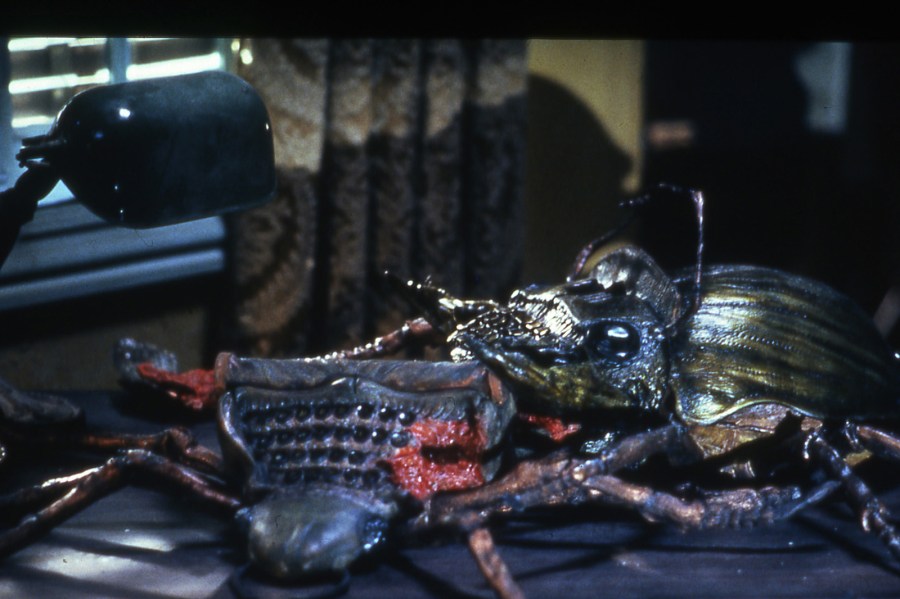
After landing, the Martinelli scuttles across the floor; for this sequence, a mechanized hero puppet was used. Isaac continues: “the hero had cam-controlled legs and cable-controlled head movement. It also had two sets of wings — one that was mechanical and moved up and down, and another that was meant to be ripped off during the fight.” The hero puppet also featured breakaway pieces that would simulate its flesh being ripped off by the Clark-Nova’s attacks. Sections of foam latex were cut out, covered on one side with hot-pour vinyl to create a slimy interior, and then adhered back into place. Breakaway wings were made for shots of the Clark-Nova biting the Martinelli’s wings.
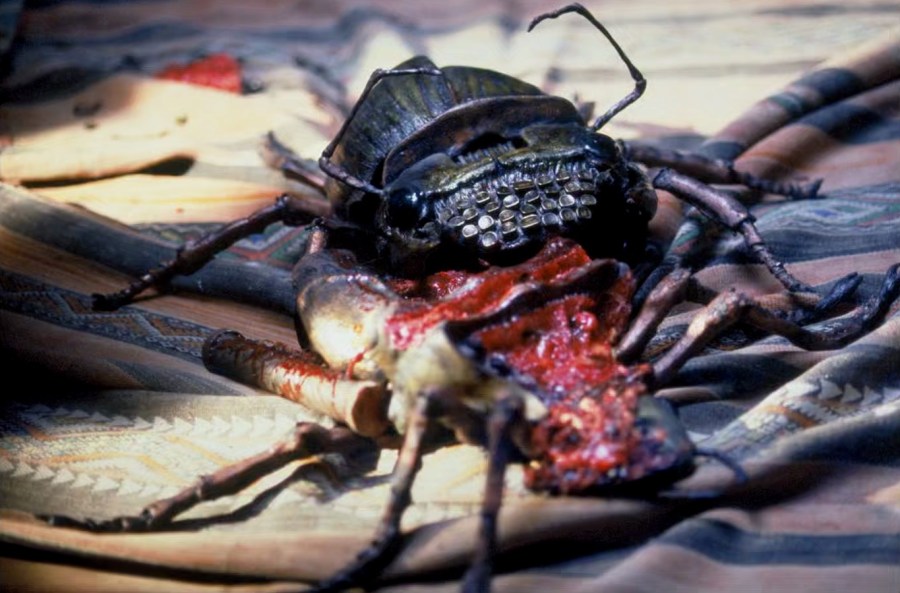
15 puppeteers in total operated the insects during the complex sequence of the Clark-Nova chasing and devouring the Martinelli. Isaac related: “it was very complicated. We actually shot the whole thing on the set. We blocked out the scene, figured out where the puppets should move on the floor and then slotted the floor accordingly. The Martinelli had to travel something like two-and-a-half feet. There was a bar down the middle of its body and we moved that bar through the slots in the floor. A rug helped hide the track — when the Martinelli traveled, it pulled the rug along with it.”
A dead, rotting Martinelli dummy was the final version made for the character. Likewise, for the Clark-Nova’s death later in the film, a specific puppet of the creature was made. Isaac commented: “it was filled with bladders and tubes that had all kinds of green goop inside. It took nine people to operate that rig. We also modified a puppet to be used in shots of him after he dies. We took the head off and the sphincter section and resculpted them with slash marks and the eyes punched out.”
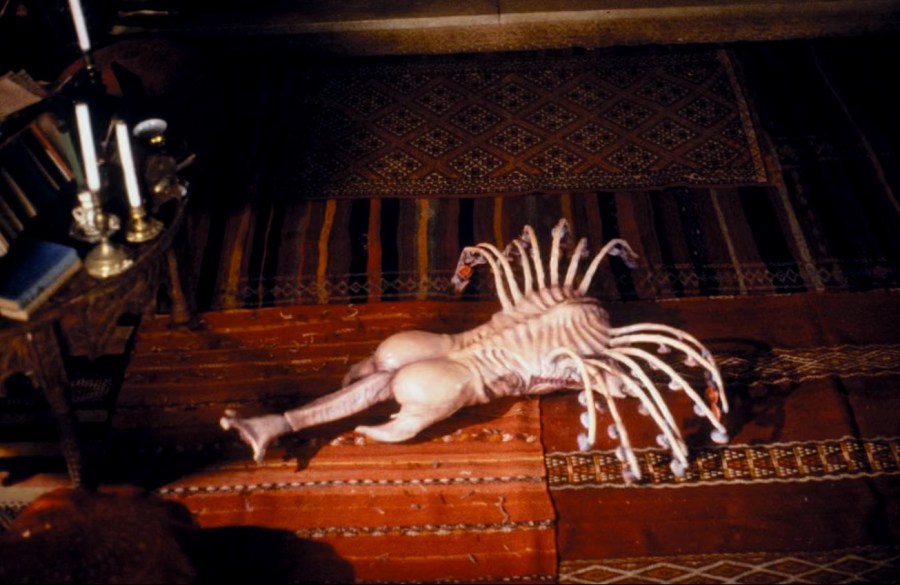
In Joan Frost’s apartment, Lee and Frost engage in passionate acts, and as they do, the Mujahaddin typewriter gradually transforms into the so-named Sex Blob. “In a sense,” said Cronenberg, “the Sex Blob is another metaphorical trick. Instead of Joan and Lee being sexy, this blob is sexy. It is general lust incarnate in a twenty-five pound package that flops around the room. It wasn’t in Burroughs’ literature, but I think it’s a Burroughsian concept.”
A customized English typewriter was the starting point of the sequence. The transformation begins with the keyboard turning over, revealing pulsating organs underneath. Cast in foam latex, the first stage Blob was painted by Gregg Olsson, who had to experiment with paints that would keep their integrity as the foam latex ballooned. He said: “we had to create a surface on the skin of the blob that would read as metal but would expand with bladder work. We ended up using a combination of real keys and some metal chrome tape on the edges, but most of it had to be soft to accommodate the bladders.”
The pulsation was indeed achieved with bladders. Isaac said: “we could suck those bladders in with a suction mechanism, and then expand them so that the fleshy part would balloon out and start to pulse. We also had bladders around the entire rim of the typewriter so that it would bulge and begin to change shape. Then, in the back, there was a phallic appendage that grew between the two ‘cheeks’ of the typewriter. It was basically a half-man, half-woman Sex Blob. It had all the right organs for both.”
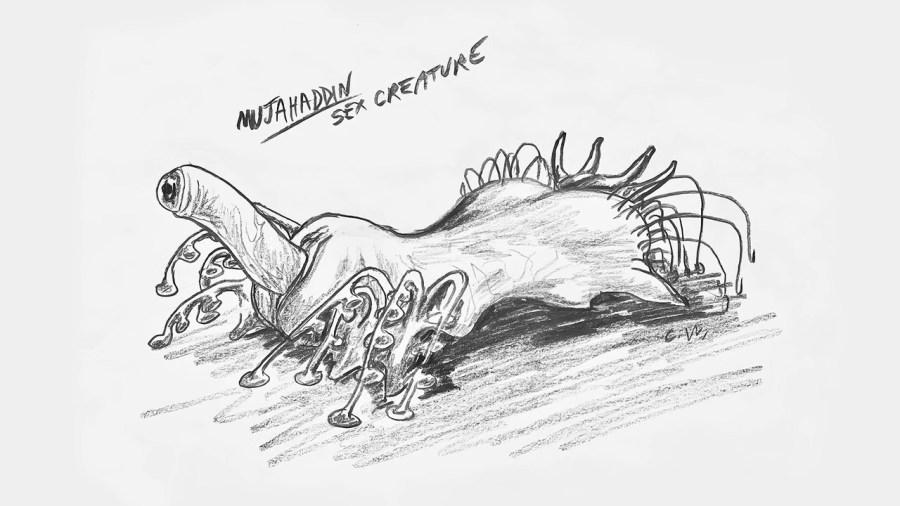
Fully transformed, the Sex Blob unfolds. This last transformation stage was designed by Walas before anything else was on the table, based on an Arabic typewriter. Isaac said: “he spent a couple of days building a maquette that was about a foot long and David really liked it. Then it was up to us to figure out the transformation, stage to stage, from the original typewriter to what Chris had designed.”
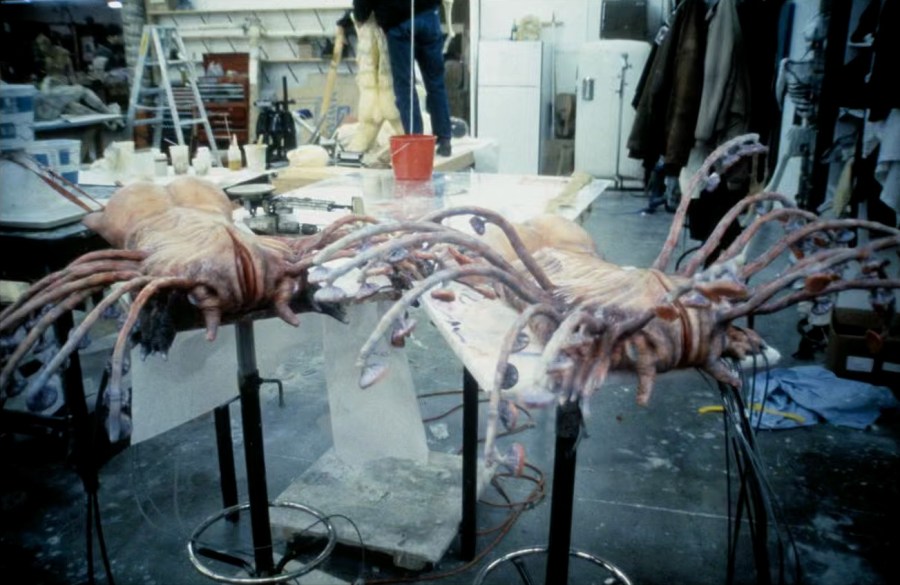
Three final-stage Blob puppets were built for the sequence where the creature leaps onto the lovers, is chased away by Fadela, and then jumps off the balcony. “We had one that jumped,” said Isaac, “and then another that travelled across the floor as Fadela chased it with the whip. It was self-contained and motorized; we could turn it on by radio control to control its speed. We also got a lot of good movement out of it just by pulling it with wires. Then we had a third one that was a hand puppet with cam-controlled appendages that flailed around.”
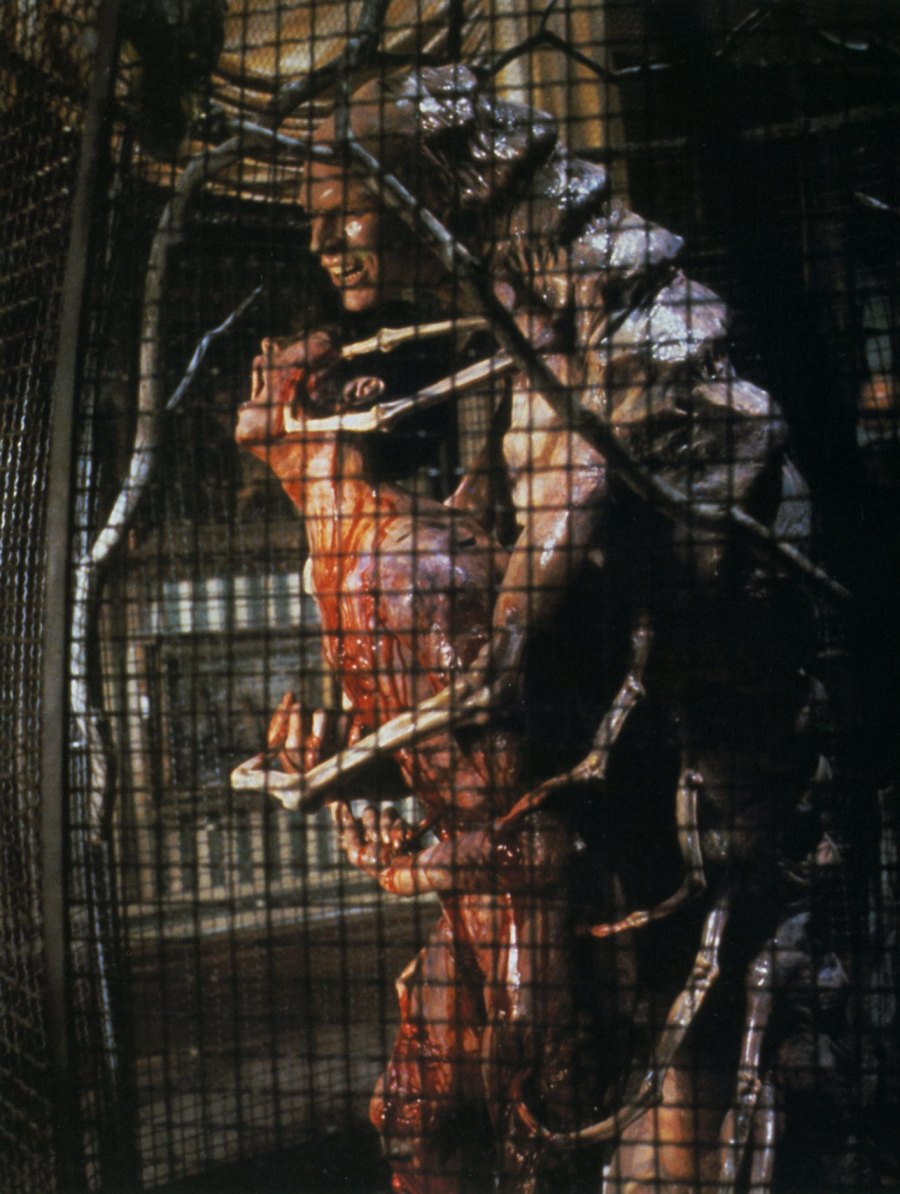
At Yves Cloquet’s house, Lee witnesses the former — transformed into a centipede-like being — draining fluids and flesh from Kiki. This sequence was inspired by the research done at CWI for Arachnophobia about spiders’ feeding methods. “When we described it to David,” Isaac said, “he really liked the idea of incorporating that same feeling into the scene. It was sexual and horrific at the same time.”
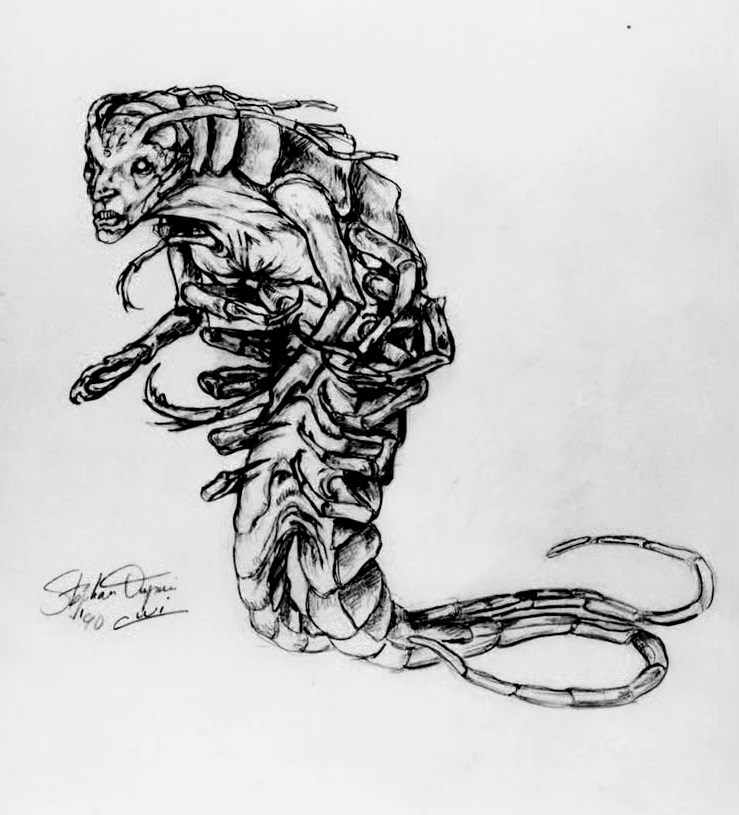
For the sequence, a puppet of the Cloquet-centipede was devised after a lengthy design period meant to establish exactly what Cloquet would be turning into. “We spent a fair amount of time doing drawings,” Isaac said. “It was a difficult look to capture and we went through a real evolutionary process. We brainstormed for a couple of weeks and David finally decided he wanted Cloquet to look as though he was transforming into a centipede — although his face was still recognizable as the actor Julian Sands.”
The ensuing puppet — based on a lifecast of the actor — was only capable of minimal movement, and was pole-operated from below alongside a puppet of Kiki. Isaac related: “David assured us that he didn’t intend to linger on that scene for long. He just wanted something to give the audience an impression quickly. So we concentrated on the look of the characters more than trying to make them mechanical marvels.” He also added: “it was a cumbersome thing to operate. There was just two-way movement on each body and both of the heads were mechanical, with eyes and necks and jaws that moved.”
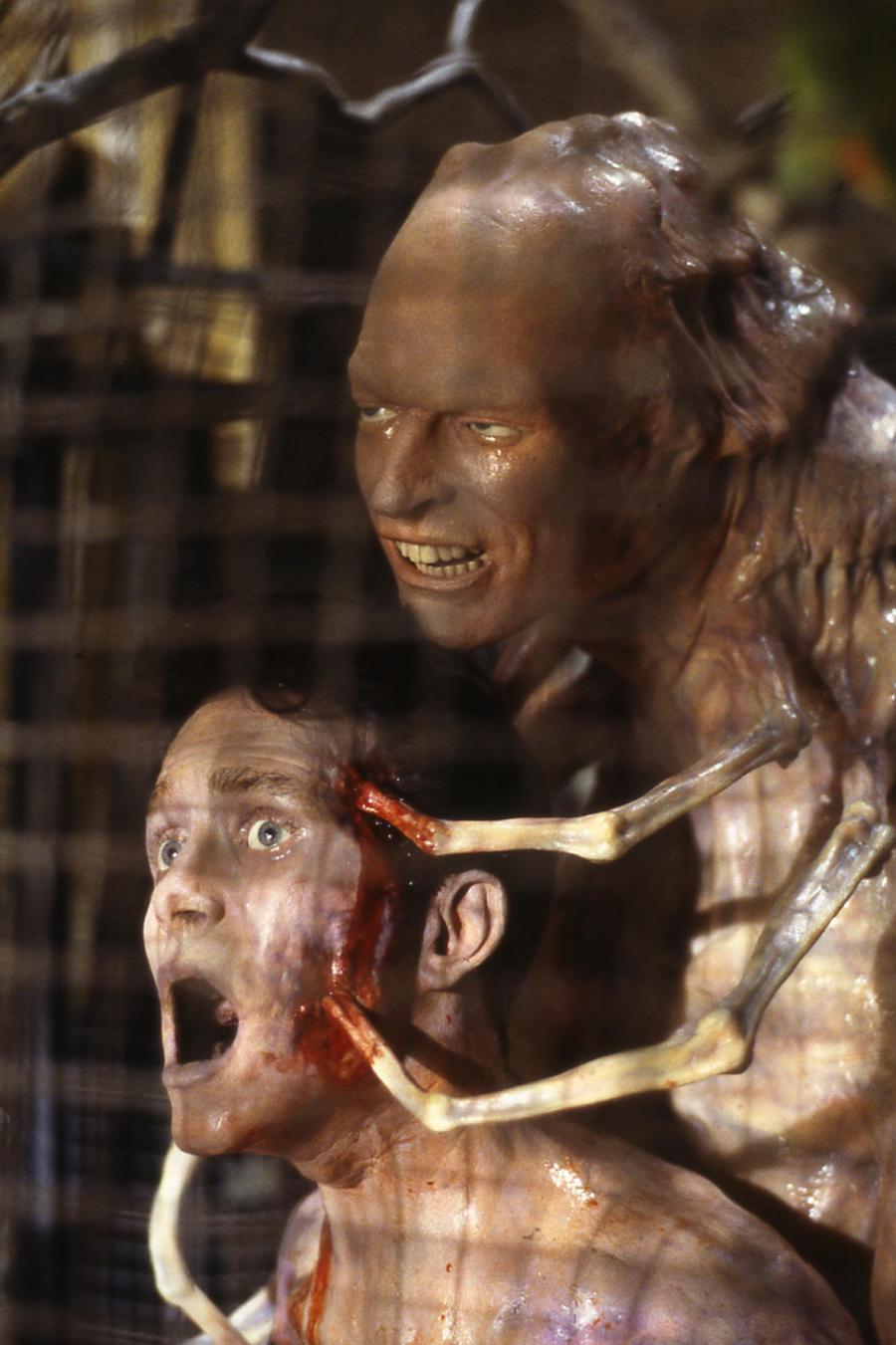
For the flesh-draining effect, the Kiki puppet was rigged with texture underneath the skin, which could be highlighted through a vacuum. Isaac explained: “by laying texture underneath the skin, we could put a vacuum on it and make it look like flesh was being eaten away. We put two patches on him — one on the side of his face and another up on his head — that got sucked into big crevices. The patch on the top of his head also traveled inward — we could pull on a cable and make it look as though his face was starting to collapse and disfigure. It was a quick shot so we only had to time out two or three seconds of action for that.”
Isaac concluded on the experience: “Naked Lunch was the first script we’d read in a long time that had everyone excited, and that is the deciding factor for us as a company whenever we choose to do a show or not. We don’t really make decisions based on how big an effects movie it is or how good we are going to look. We try to pick projects that we can be enthusiastic about, with scripts and directors that we like. That has been very important to Chris from the beginning. We were really glad that we took this particular project because it was exciting to be involved with something that was not just an effects movie.”
For more pictures of the Denizens of the Interzone, visit the Monster Gallery.

