
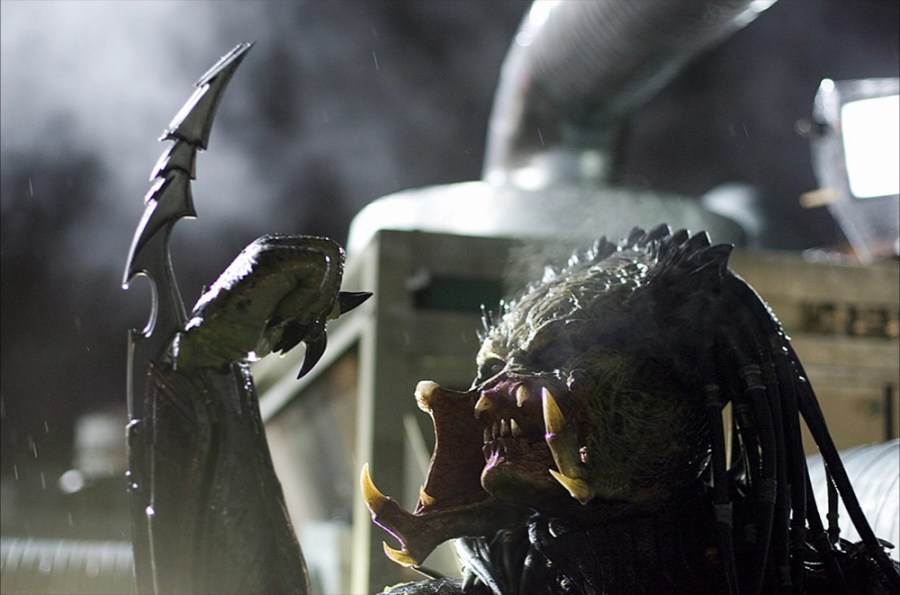
Following the emergence of a Predator-born Alien on a Predator scout ship, the tussle with it inadvertedly causes the craft to crashland on Earth, unleashing the seeds of an Alien horde. A veteran Predator receives a distress signal and gears up, departing to eradicate the infestation. Such is the premise of Aliens Vs. Predator: Requiem, with brothers Colin and Greg Strause attached as directors. To them, this scenario was “more suspenseful” than it would have been with more than one Predator, because “the Predators would kill all of the Aliens,” said Colin Strause. “The Aliens would do some damage, of course, but the Predators would kill them all because they’re such great warriors and their weapons are so good.”
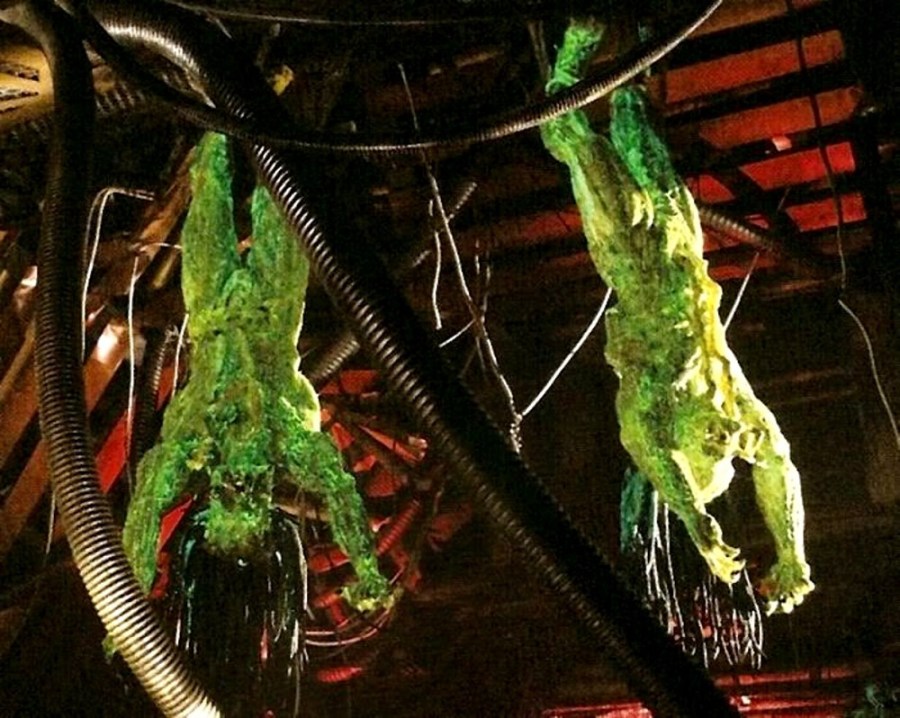
Amalgamated Dynamics returned to design and build the new Predator effects — assisted by the directors’ own visual effects company, Hydraulx, for certain stunts. The beginning sequence involves a recreation of the Predalien’s birth, which employs a refurbished dummy of the Scar Predator from the previous production. Likewise, the crew of the scout ship was also recycled material, with reassembled leftover suits, nicknamed ‘Bull’ (played by Bobby Jones) and ‘Bonegrill’ (played by Ian Feuer). Filmed but ultimately obscured in the final cuts of the film were also hanging Predator corpses — skinned by the Predalien — in the crashed ship, built as foam latex dummies.

Dealing with the Alien infestation is a ‘cleaner’ Predator, whom the filmmakers nicknamed ‘Wolf’, after the Harvey Keitel character in Pulp Fiction. “Our hero Predator is his own character — not quite exactly the type you’ve seen before,” said Alec Gillis of ADI. “This is a stealth Predator. He comes in to control the situation, he’s almost like James Bond. He’s got gadgets, he’s got an attitude and he’s a veteran Alien fighter. So, you won’t see him walking into a corridor and getting trounced by three Aliens — he’s a lot smarter than that. We refer to him as ‘the Wolf’, like Harvey Keitel in Pulp Fiction. He’s much more fluid.” Wolf would thus be an expert in dealing with Aliens, so much so that he could attempt shooting one point blank — the mark of a true tactician.

The Strause brothers were not too thrilled with the portrayal of the Predators in AvP, and pushed for a streamlined design for the Predator star of their film, one they would feel to be more in line with the original iterations. Concept art for the Wolf was spearheaded by Farzad Varahramyan, Michael Broom, and Steve Wang.
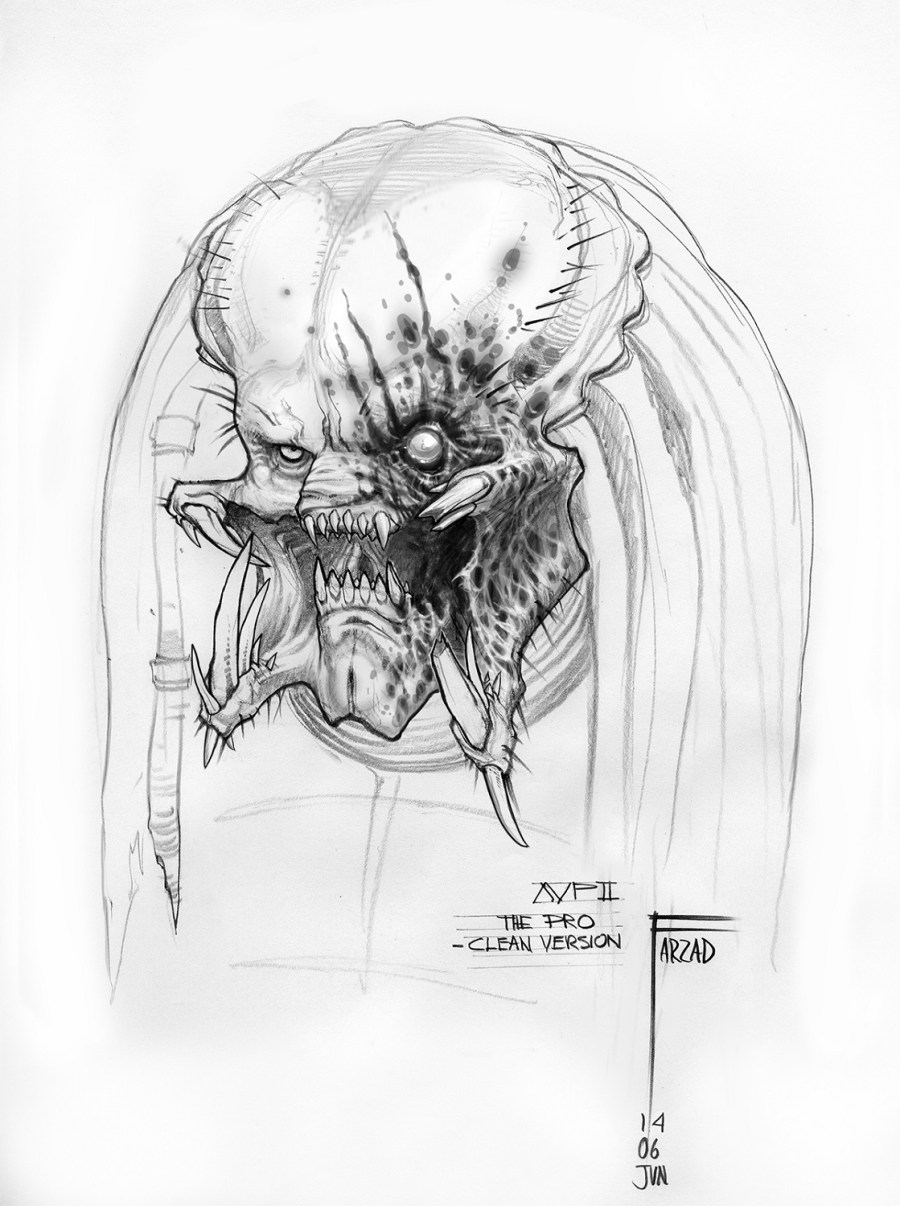
Wolf was conceived as older than previous Predators. Gillis and Woodruff said: “he’s not in the flower of his youth either. Our vision of the Wolf was that if he were human he’d be a guy in his forties, still in great physical condition, but perhaps at this point in his life he’d be relying a little more on brains than brawl.” To visually convey this Predator’s age and experience, his face was designed with a more rugged appearance, complete with scars and a burned, corroded side caused by Alien acid blood — a trait inspired by Broken Tusk from the AvP comic books. Greg Strause related: “we wanted this Predator to look like a creature who’d been through lots of wars, been through hell; and that’s what he looks like. The Predator’s face is covered with Alien acid blood scars. Some other parts have been melted off. We really studied the past designs of the Predator when designing his look. We used parts of Predator 2, in terms of the fangs, and the comic books were a great source as well.”
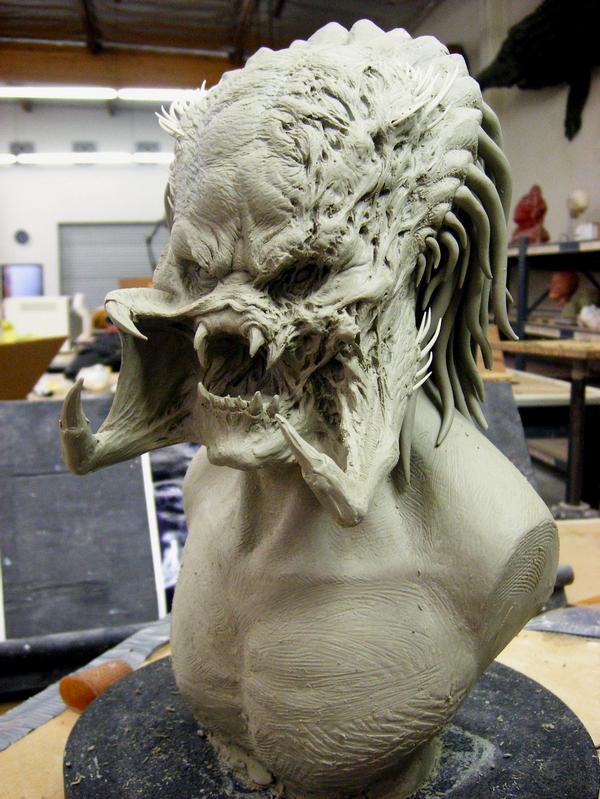
Based on concept art by Varahramyan, the rugged look — with an extensively corroded left side complete with a missing mandible — was explored further in a sculpture by Steve Wang, and then finalized in a maquette by Greg Figiel. “We wanted to re-proportion the face,” said Gillis and Woodruff, “giving the brow a more cunning, sweptback angle, like a predatory cat.”
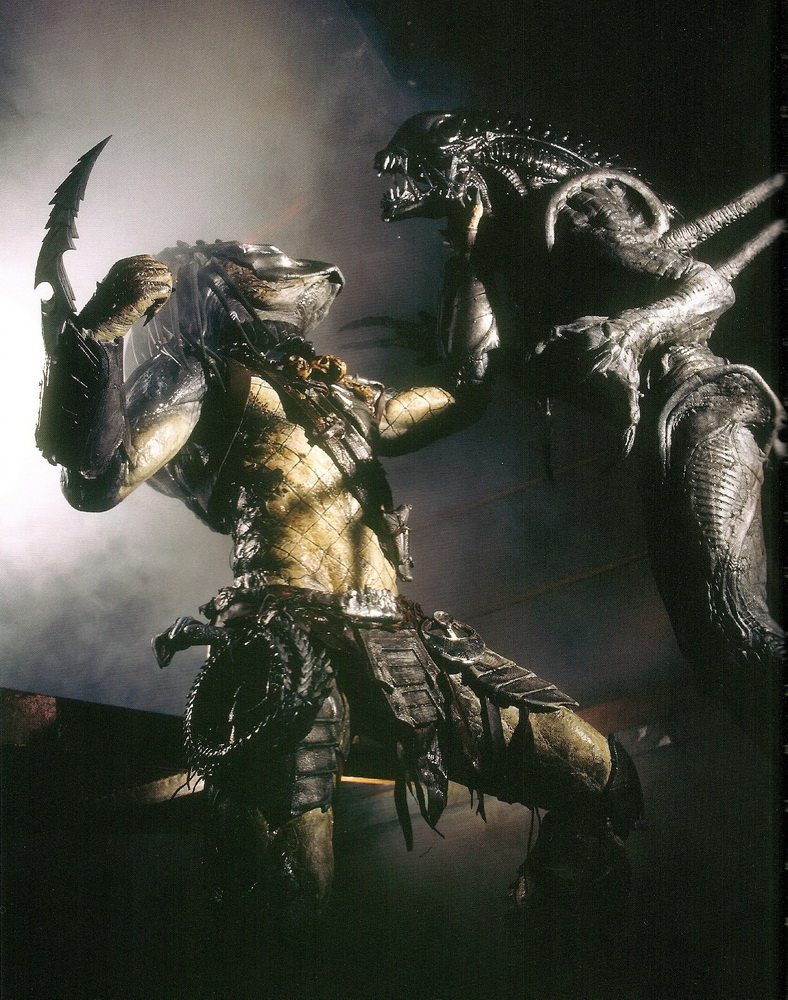
The Strause brothers also favoured a less armoured look; Colin Strause said: “we got rid of the armour from AvP because we thought, and the fans thought, it looked stupid. Why does he need armour? He didn’t need armour in Predator and if the Aliens get him, they get him. He has a real Spartan look in this film.” The brothers were also quoted as saying “another reason this guy doesn’t load up with armour is that’s not why he wins against the Aliens. It’s because he’s smarter than them. It’s because he has special gadgets that the others don’t have. So, he doesn’t need to protect his body. A sissy does that.”

Helmet designs were explored by Carlos Huante, Chris Ayers, Justin Murray, Farzad Varahramyan, Michael Broom (who suggested a mask fashioned from a prey skull) and Chris Howe in concept art, and by Steve Wang, Mark Maitre, Greg Figiel, and Cory Schubert in sculptures. The final design started from an approved maquette by Schubert, and was largely based on the City Hunter’s. To further suggest character history, it was ornated with marks, runes and other such details. “Its narrower eyes, jutting jaw, and sweptback forehead denote a character that is more cunning and ruthless than any we’ve seen before,” said Gillis and Woodruff. “Carved runes and embedded teeth of past prey show a history of previous missions accomplished by this lone hunter.”
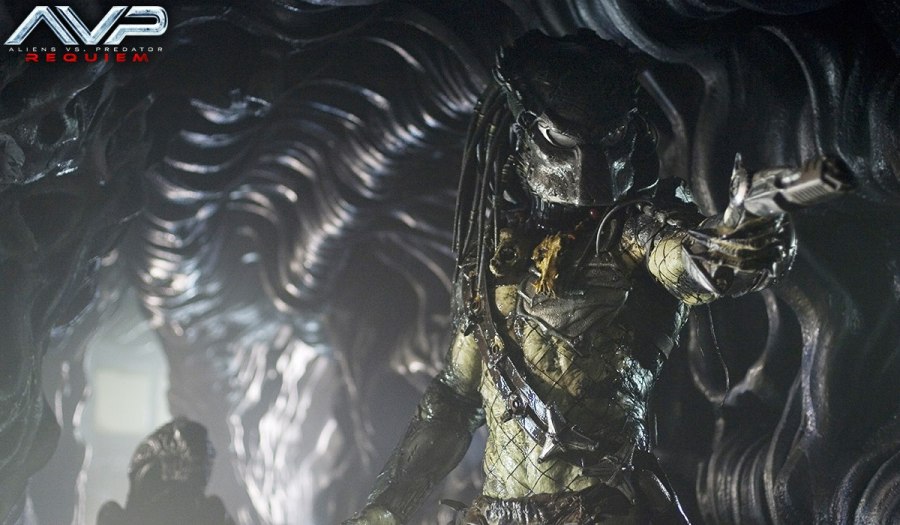
Tasked with a clean-up rather than a sports or ritual hunt, Wolf also had access to a number of new gadgets, first explored in concept art by Varahramyan and Chris Howe. Paraphernalia included the wristblades — dialled back with the same rationale as the armour — as well as aspear and collapsible throwing stars, returning from the previous film. Dual shoulder cannons could double as plasma pistols, Alien-dicing claymore mines could be set anywhere, and a power gauntlet allowed easy destruction of obstacles. A razor whip was worked into the script after the Strause brothers were impressed by a Varahramyan concept piece that showcased such option. The medikit also made a return.
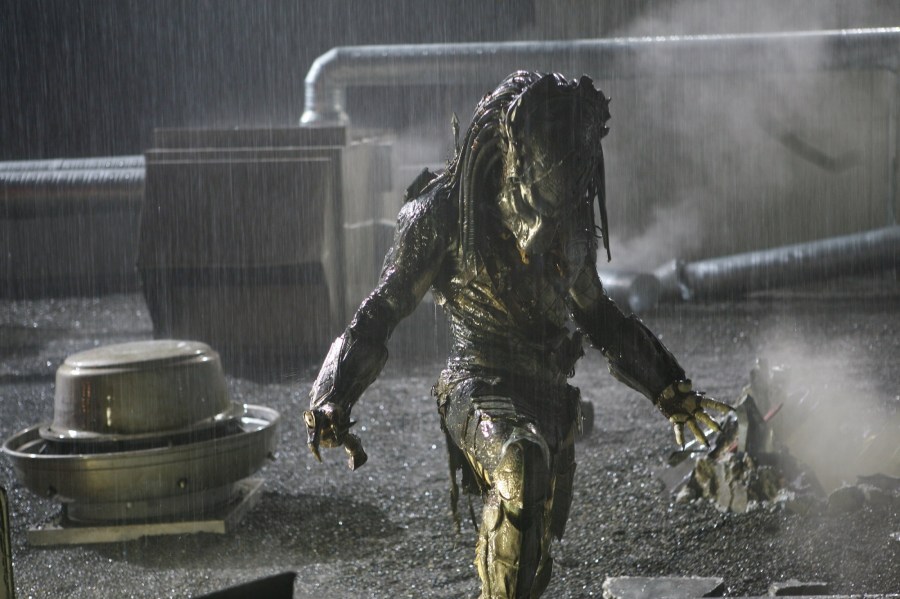
At first, the directors were unsure on recasting 7’1″ Ian Whyte as the Predator. “To our surprise, the brothers Strause were concerned that Ian wasn’t tall enough! They felt that the Predators in AvP were too short and stocky, and we had to agree. This was due to the number of Predators in the film and the number of simultaneous shooting units, which required production to use multiple Predator suit performers who were not tall enough. We actually used a stuntman who was a mere 6’5″ for a good number of shots! Once the brothers understood this, they realized that the proportion problem in the previous film would be solved by more screen time with Ian Whyte, not less. In AvP 2 there was to be virtually only one Predator. Knowing this, we were able to take full advantage of Ian’s proportions and create a much sleeker body suit.”

Based on a body cast of Whyte, the full-size sculpture of Wolf was undertaken by Joey Orosco, Davis Fandino, and Hiroshi Katagiri. To save time and money, small armour components — such as brass knuckles — were incorporated into the body sculpture. The Predator’s skin was cast in foam latex for the body and stunt head, and silicone for the hero head — a consideration ADI took to better emulate the original creature’s look, in comparison with their AvP efforts. Painting was assigned to painting supervisor Mike Larrabee and Brian Clawson. The helmet was sculpted by Katagiri, weapons and armour by Mark Maitre, Cory Schubert and a team of sculptors. Multiple copies of the various components were cast in fiberglass, semi-flexible urethane, resin (for the spears), or foam latex (for the whip), and painted by Larrabee and Koji Ohmura, among others.
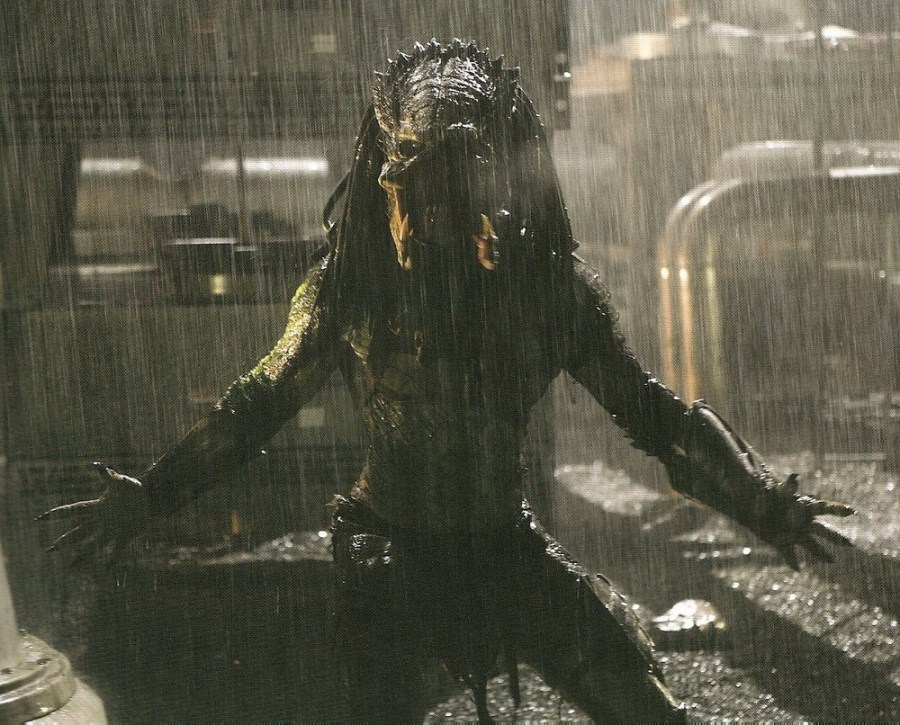
Both a hero suit (worn by Ian Whyte) and a stunt suit (worn by Ian Feuer, mostly used in reshoots) were devised, complete with corresponding heads. The radio-controlled hero head was mechanized by David Penikas, assisted by Lon Muckey and Chris Wolters. The new proportions of the face dictated a fully animatronic approach to the eyes, a first time for a Predator mask. “We knew we needed mechanical eyes instead of Ian’s eyes,” Gillis and Woodruff explained, “and that he would be performing blind during the entire end fight sequence — risky, but well worth the design improvements.” Wolf’s left eye was made blind in post-production.
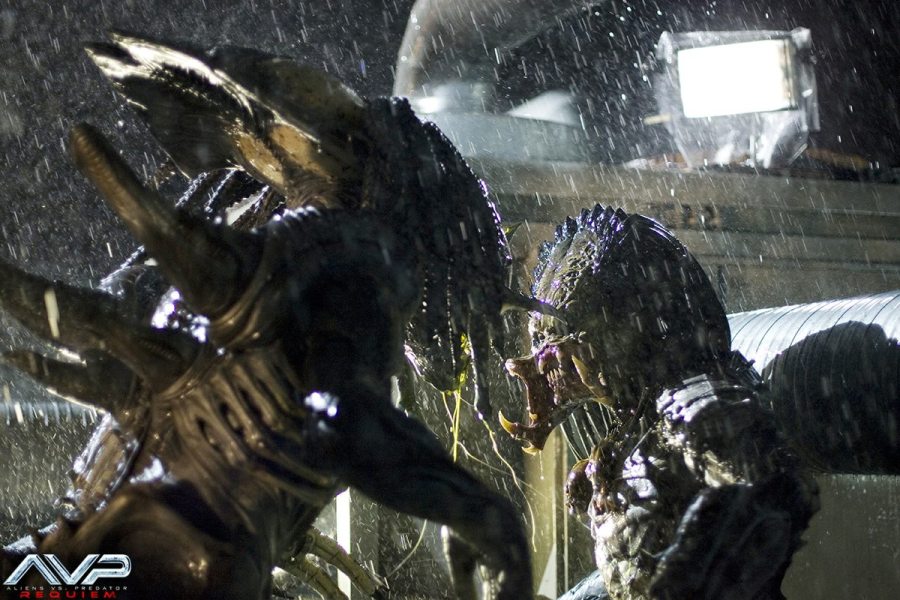
Shooting proved complicated, due to both a tight production schedule, as well as the environmental conditions: the Predator performed under heavy rain for many scenes, and was partially submerged for the sewer battle sequence. The suits needed extensive repairs between shoots, due to water absorption. More complex stunts that could not be achieved with wirework — such as long distance jumps — were achieved with a digital double by Hydraulx.
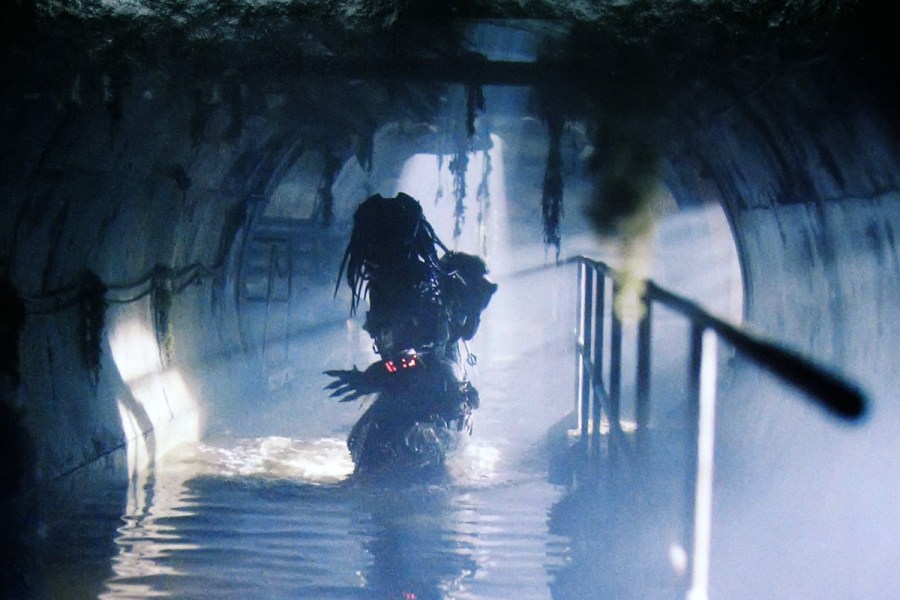
For more pictures of the Wolf Predator, visit the Monster Gallery.
Previous: Alien Vs. Predator
Next: Predators
Also see: StarBeast — Aliens Vs. Predator: Requiem | The Predalien
 Monster Legacy
I love your website. I watched all of them. Scared me half to death.
Thanks
Tammany Edwards
Thank you for the kind words!!