The popular concept of “Boogeyman” is somewhat nebulous, with different cultures and traditions attributing varied descriptions, characteristics and abilities to the character. The first challenge director Rob Savage stumbled upon, in adapting The Boogeyman by Stephen King, was not only giving something of a definition to the Monster, but also enabling the audience to project their own fears onto it. He related: “I didn’t want to invalidate anyone’s idea of what the creature is because everyone’s got their own idea. The Boogeyman is really just this name that we give to whatever we imagine in the darkness as a kid. So, I wanted people to leave and still feel like they could project their own fears onto this creature. We wanted something that was very simple and striking.”
Savage also sought to make his version the most memorable of all, what with decades of other productions with the same name attached. “The thing that I was going for is this idea of almost reclaiming the word ‘Boogeyman’, which kind of makes you roll your eyes,” he said. “There have been a lot of bad versions of this character and I wanted this to feel like the definitive version. I wanted this to feel like we were making it scary and primal again. I also wanted it to be that you saw the creature at the end, obviously because the family’s got to face down this thing, but I wanted there to be an aspect to it that you didn’t quite understand or that hinted at this deeper mythology.”

When Savage joined the project, there already was a complete script by Scott Beck and Bryan Woods. The director was determined to spin the concept in a new direction. “When I came on board, nobody had any ideas,” Savage recalled. “It was just this kind of amorphous thing; and so I kind of came up with my conception of the creature. […] Everyone was thinking more in terms of the last Boogeyman movie from 2005 where it’s a tall kind of Babadook-y looking thing. And I really wanted to make this more of a creature feature, and for this to feel like something more kind of ferocious, and feral and inhuman. And the idea was to basically take this idea of the Boogeyman and say, ‘okay, well. The Boogeyman is just the name that we give it as scared children. This thing is actually way more ancient. This is the kind of primordial beast that’s been around as long as there’s darkness, and we’ve got to kind of consider it,’ it’s like a Lovecraftian old god. This thing has just existed in the darkness, since time began.”
Mark Heyman was brought in to work on tweaks in tandem with the director. “We were kind of developing this idea of the Boogeyman as this ultimate force of darkness,” Savage detailed. “It’s this eternal demonic thing that we just call the Boogeyman, but it’s basically this force of darkness and that we should kind of counterbalance with some spiritual force of good. It’s one of the hallmarks of a lot of Stephen King, is there is always hope and humanity even in the darkness.”
The Boogeyman and its associated mythos were developed in contrast with another popular Stephen King monster. Savage said: “we took the idea of Pennywise and said, ‘we want to go in the opposite direction’. Pennywise is something that isolates what you’re afraid of and then does a garish pantomime version of it. Whereas we were thinking of the Boogeyman as something that doesn’t care what you think of it. This isn’t something that’s engaging on a human level; this is something that’s much more animalistic and is the basis for a lot of what we fear. This is the original, primordial creature.”

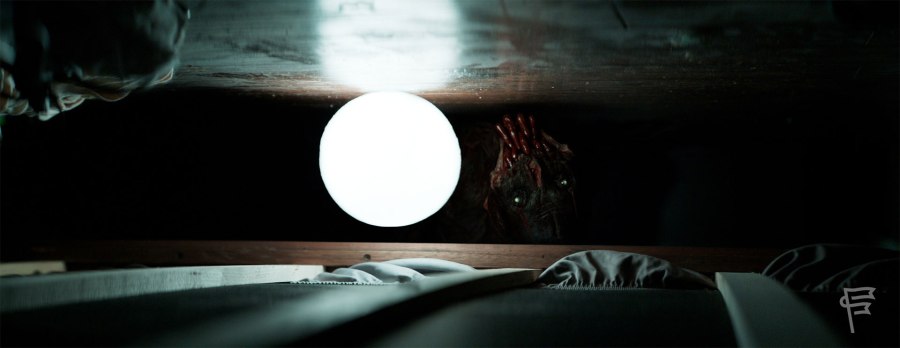
Further elaborating the pitch, Savage related: “I wanted it to feel like there was an unknowable quality to this creature. For a large part of the movie, we were just doing the fin above the water in Jaws. We weren’t really showing this creature. It needed to be kind of stark and striking, but mostly it needed to bleed off into the shadows and be something that the audience could use their imagination to fill in the rest. Then, when you finally see the creature, the idea was that you’re going to see it, so we are going to fulfill the mandate of this being a big Friday night popcorn horror movie. You want to see the monster, you want it to fight our lead character, but also it’s going to reveal some Lovecraftian depth to it that’s ultimately going to set your mind on fire and think that you’ve only seen a fraction of what this thing truly is.”

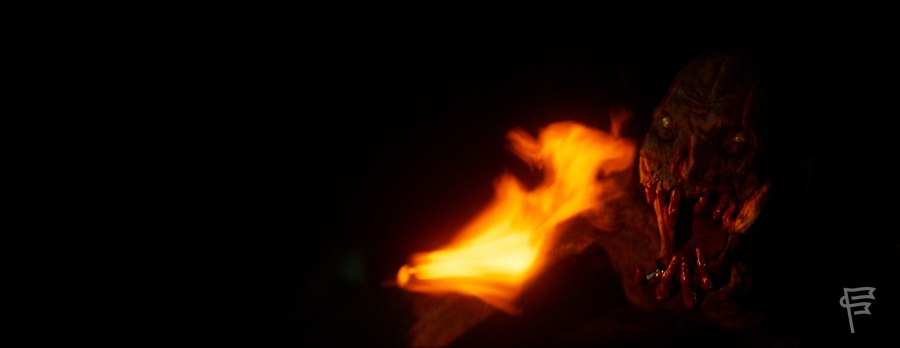
Early on, production hired a team of concept artists, including Keith Thompson, Andrew Baker, Daniel Carrasco, Ehsan Bigloo, Houston Sharp, and Rob Stanley, for a scattershot approach — the conception of multiple designs and variations to see what silhouettes and traits the director best responded to. “I gave this idea to the designs,” said Savage, “that you’ve got to imagine this creature stalking cavemen as they huddle around their fire and the flame dwindles. It’s got to be something that’s as at home there in that setting as in your childhood closet.” In another interview, the director added: “the design was about creating something that you could glimpse just in the shadows. You could just see these kinda pinprick eyes staring out from the darkness. For most of the movie, we’re just allowing it to kind of fester in the audience’s head.”
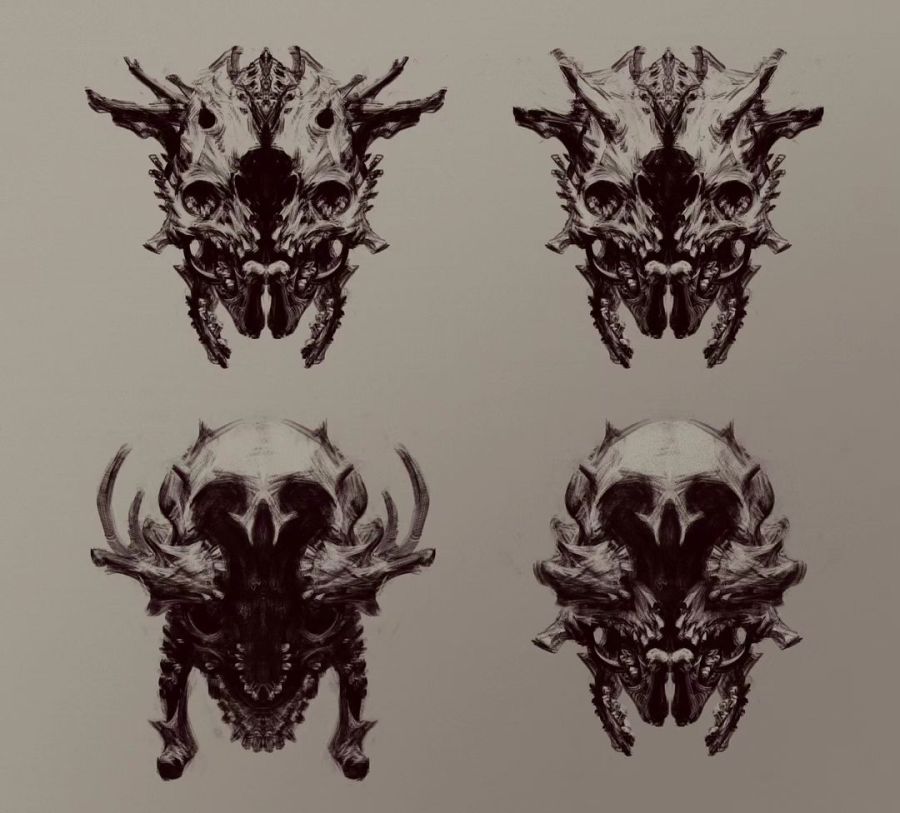
Another early — and then discarded — concept was that the Boogeyman’s head should be composed of human bones in odd arrangements. Sharp related: “the idea was that its head would be comprised of human skull fragments in unorthodox locations, which would then open up to reveal the true, dark face of the ancient creature inside.” While this baseline was abandoned in favour of more streamlined designs, concepts by Sharp still established the Boogeyman’s “spider- or dog-like body language and locomotion,” the artist said. “This was early on in the process when we were exploring a more primeval, skeletal look.”
Visual effects producers and supervisors Christina and Paul Graff approached previous collaborators Folks VFX to work on the project, with visual effects supervisor Jonathan Piche-Delorme and creature designer and CG supervisor Gabriel Tremblay-Beauvais at the helm. The Folks team reviewed the concept art produced up to that point and extrapolated from there. “We were fortunate enough to be involved in the project from an early stage, which gave us the opportunity to handle both the design and the final asset,” Piche-Delorme related. “When we joined, there were already several concepts in place, but the production team wasn’t fully satisfied with the visual direction. Initially, seeing concept art from artists we admire felt a bit stressful. However, we channeled that stress into positive energy, viewing it as a challenge to overcome.”

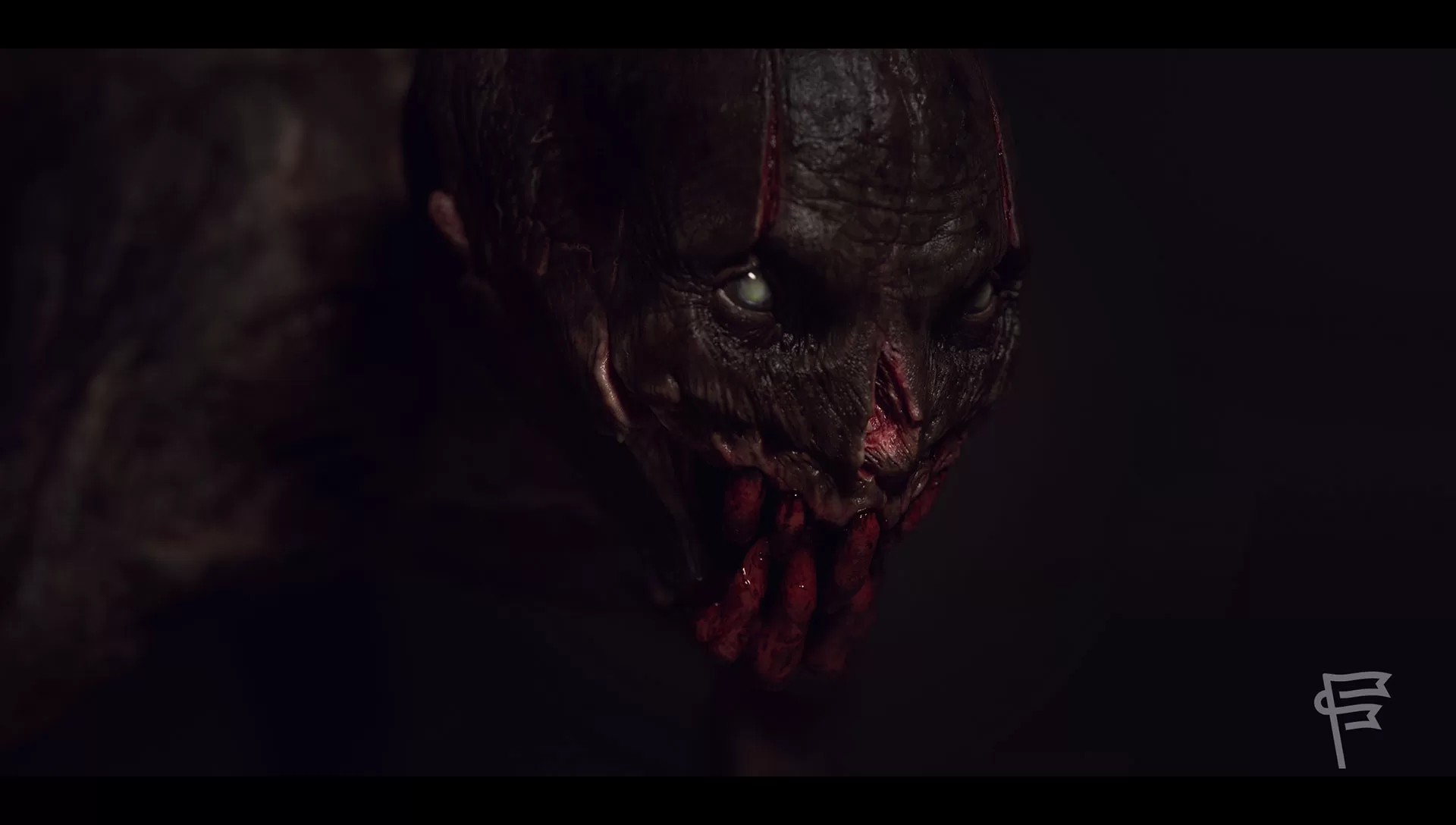
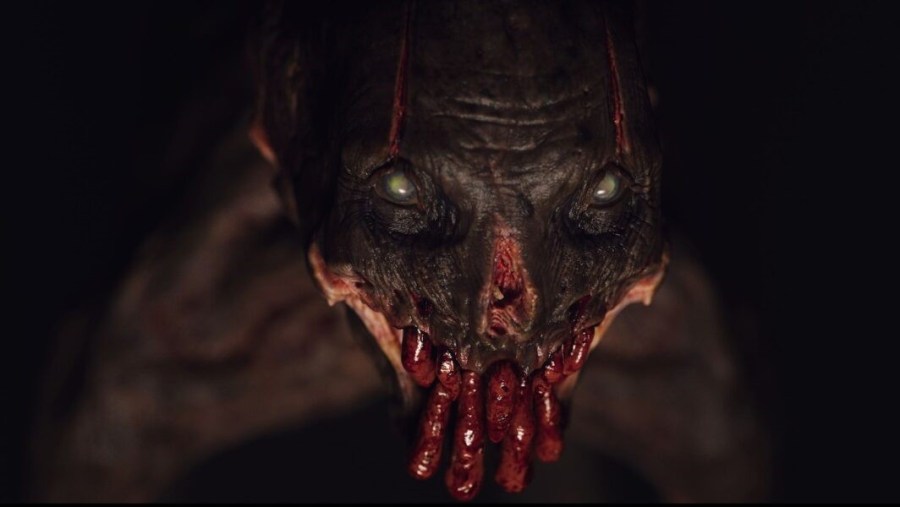
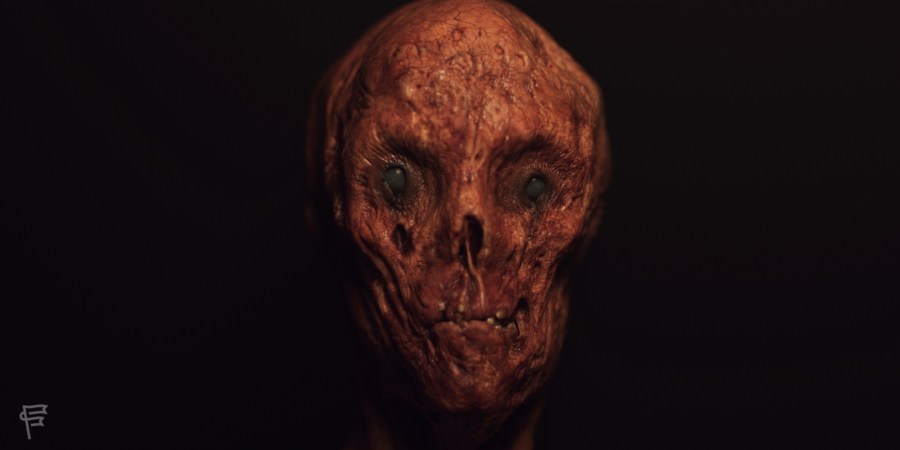
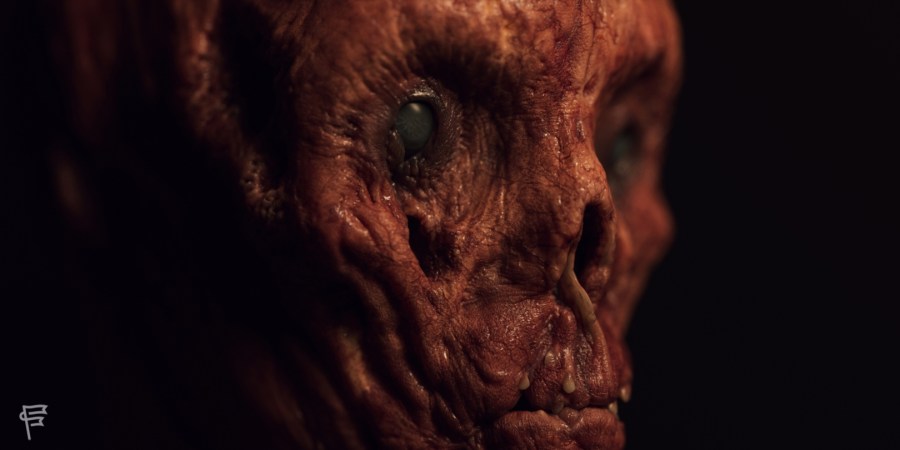
Beauvais thus began spearheading new design explorations. One idea that survived from the previous iterations was Thompson’s concept of fingers within the monster’s mouth doubling as fangs or teeth. Otherwise, the artist referenced mummified corpses, and was largely inspired by the works of Zdzisław Beksinski, “whose imaginative world deeply inspires me,” he said.
A key element the team put into consideration was that of a face with well-defined shapes that would make a categorically terrifying impression when seen among the shadows. “It was a challenge to work with a creature that is always in the dark because we wanted to show its details,” Piche-Delorme related. “In the design phase, we made sure to make the face, jaw, and eyes stand out so they are noticeable even in darkness. We focused on adding as much detail as possible to the creature’s visuals to ensure it looks good when lighting is applied. During the compositing process, we were careful to highlight the key parts of the creature to make it as visible as possible.”

Subtle references to Pennywise were added to the facial texture. “I wanted the creature to have a certain Stephen King-esque quality”, said Piche-Delorme. “Therefore, I drew inspiration from Pennywise, which is why the Boogeyman has a long, triangular-shaped scar eyebrow and a devilish smile. The reddish elements are also influenced by King’s style.”
While eyeless iterations were considered, ultimately it was decided that the Boogeyman should indeed have eyes — striking ones. The dark-piercing eyes of the Monster were based on the reflective properties of a cat’s. Piche-Delorme explained: “we took inspiration from the anatomy and shape of a cat’s eyes. We wanted to capture the essence of realism. We believe that by closely modeling elements after real-life counterparts, we can achieve a higher level of visual authenticity, especially when it comes to the reaction to lighting. During the design phase, we engaged in extensive trial and error. We experimented with numerous variations of eye colours and light reflections, meticulously refining the details. In fact, we even created eyeless models to explore. However, after careful consideration, we discovered that the most effective approach was to incorporate realistic eyes and reactions, drawing inspiration from how a cat behaves in dimly lit environments. This combination ultimately yielded the desired results.”
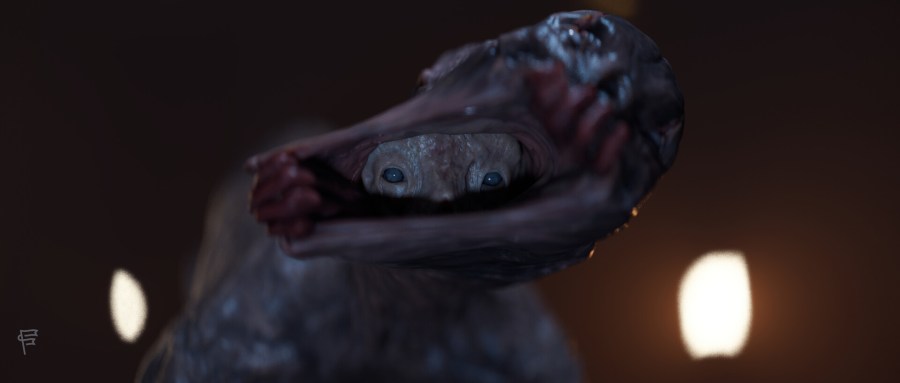
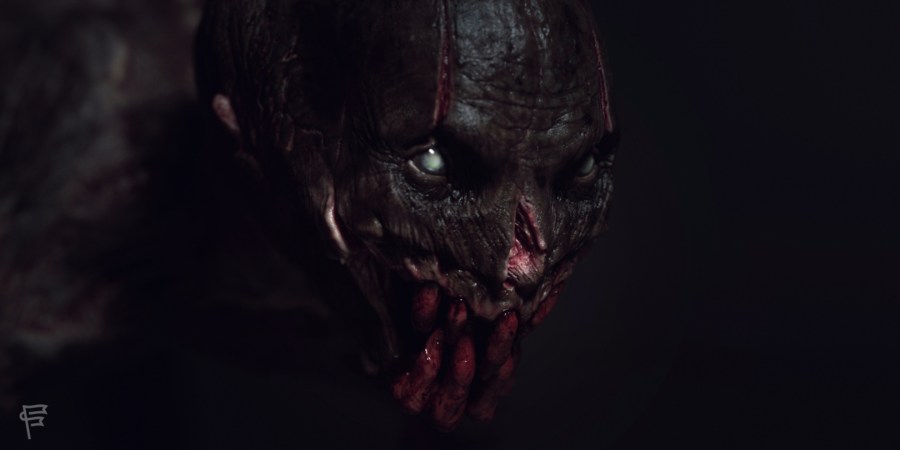
During the climactic confrontation with the Boogeyman, the creature pins Sadie to the floor and begins draining her soul, not before revealing something of a dimensionally trascendental element: its jaws unhinge and the fingers inside unravel, pushing the mouth apart and revealing an inner being. “When you finally see the creature, we came up with this weird, messed-up design whereby the creature reveals itself to have dimensions beyond what we see,” Savage said. “There’s still kind of room for people’s own nightmares projected onto our creature. And yet, we’ve got this horrific design which our team came up with which will hopefully create some new nightmares.”
Savage intended this shocking surprise as an element of “Lovecraftian body horror,” as well as “a hint at this cosmic horror beyond what we see on screen.” It was also a subtle homage to the original story: “it was really our attempt to one, kind of building in this reveal whereby this grinning toothy look that we’ve seen throughout the rest of the movie is revealed to be knuckles and fingers that then come out and reveal this inner self. Then, it was also an homage to the short story, which ends, of course, with the therapist character peeling off its skin and revealing to be the boogeyman within. It was our way of honoring that.” Beauvais added: “we can see the Boogeyman in-between our dimension and another supernatural dimension, being himself a portal to another creature. We used the idea of the hands acting as both the teeth of the creature on the outside and the hands of the true face on the inside, opening its jaws to get out.”

Allegedly, Savage originally intended to employ practical effects to bring the Boogeyman to life; a distended and time-consuming design process, however, forced the team to switch to a completely digital approach. “I was pushing for practical for a lot of the movie,” the director explained. “The thing that made me relent in the end is that we just couldn’t lock into our design for the creature until very late in the day. We went ‘round the houses on what this creature should look like and how best to represent the Boogeyman and even what his form looks like when you finally see him at the end. It kind of immediately became apparent that one, we wouldn’t have enough time to build a suit; and two, [for] the things that we had to have this creature doing, practical would be very cumbersome. It would add onto our days. We shot 34 days, so we didn’t have a huge amount of time to be messing around with a practical suit.”
Nonetheless, on-set interaction with the actors was provided by a stand-in performer — sometimes Savage himself — as well as a 3D-printed Boogeyman head mounted on a rod. “We believe that this step was critical for obtaining great performance from the actors,” said Piche-Delorme. “By having someone play the head of the creature on set, the actors would be able to feel its presence and even experience a surprise effect.” Savage added: “we had a Boogeyman head that we had 3D printed and slathered in KY jelly and lit by Eli Born, our incredible cinematographer. And we had that in every single scene, we had a shot like that that we could show the VFX people and say, ‘that’s what a real Boogeyman head looks like.’ It’s gotta look like that.”
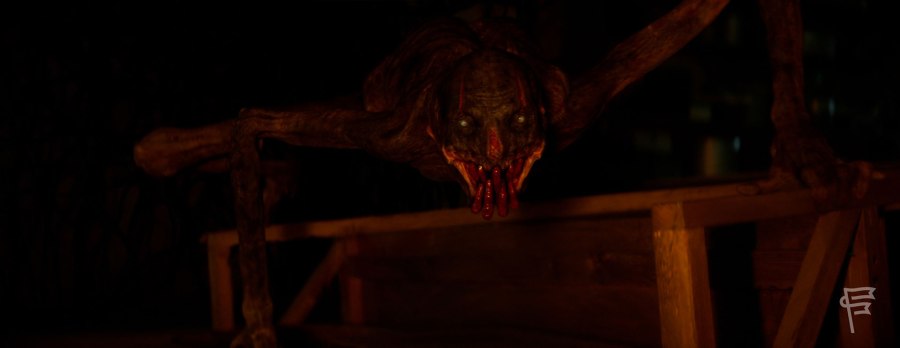
Folks VFX delivered a total of 120 creature effects shots for the film. Animation of the Boogeyman was based on an ample archive of reference, which included footage of primates, big carnivores, and arthropods. “Some scenes had an orangutan-like quality, others had an arachnid feel, and there were even elements of a predatory wolf or human characteristics,” said Piche-Delorme. “During the development phase, we tried various walk cycles mimicking the different types of animals mentioned. However, the movements of spiders and felines ended up being the primary sources of inspiration for our animators.”
The shots of the inner being were indeed the most complex to achieve due to the inherently fantastic nature of the concept. Beauvais explained: “this CFX shot spanned approximately 1000 frames and involved intricate animation work as two characters interacted within two adjacent worlds. Throughout the shot’s creation process, various aspects posed challenges, including animation, composition, and lighting. The main difficulty stemmed from aligning the double reality seamlessly, as the two worlds did not naturally converge. Overcoming these obstacles required meticulous attention to detail and collaboration across multiple stages of production.”
As the Boogeyman attempts to drain Sadie’s soul, so-called soul strings begin dripping upwards towards the Monster’s maw. After a long development phase, which took various factors into consideration, the team settled on the final strand-like look. Piche-Delorme explained: “our initial concept was based on the idea of the Boogeyman feeding on the fear and essence of its victims. […] We worked with R&D, a DG double, and the FX department to strike the right balance between the strings’ attraction to the human body and the Boogeyman’s attraction to them. In the end, we came up with the idea of twisted black spaghetti-like strands, which became the embodiment of the soul strings in our project. It was an interesting and enjoyable process to merge the visual and conceptual elements.”
As the creature’s influence grows stronger, black mold spreads all over the house; dubbed “black roth” by the visual effects artists, this element was devised by Folks VFX’s environment team, which developed a procedural system in Houdini that generated rotten vines.
For more pictures of the Boogeyman, visit the Monster Gallery.
 Monster Legacy