
Content Warning: the article includes discussion and explicit pictures of alien hybrid anatomy, as well as nudity, which may be problematic for readers of a certain sensibility.
The original idea for Species came to writer Dennis Feldman while he was working on Real Men. During that time, he read a scientific essay by Arthur C. Clarke; it was suggested therein that, since the distances between stars are overwhelmingly large, and faster-than-light travel is likely a physical impossibility, interstellar travel could not be achieved by conventional means. Feldman concluded that contact with extraterrestrial entities would more likely occur via information. “What they would do is send a message travelling at the speed of light, communicate with us through information,” explained Feldman. “Dots and dashes, ones and zeros. I quickly realized that, given the distances, response would be impossible. This would be a one-way communication. What made more sense would be for them to send us plans to build a machine that we could talk back and forth with. And why not a biological machine? A wet machine. Have us build something that was alive, maybe even one of themselves. Programmed with information, memories, things to tell us. This was the germ of the idea that was to become Species.”
There was also a remark made by a scientist that Feldman took note of: “given what we see of the way biology works, we’re fools to be broadcasting where we are”. The writer agreed that there is a degree of naivety in transmitting signals to contact otherwordly entities: “in nature, one species would not want a predator to know where it hides. We’ve become so dominant on this planet that we’ve lost sight of the fact that we’re a species, like any other. Maybe we shouldn’t be so freely broadcasting where we live to lifeforms that might prey upon us.”
Feldman expanded on the premise and reasoned that, whatever the being resulting from this hypothetical concoction, it would be driven by the primal, biological impulse to reproduce. He related: “I realized that the engine of biology is reproduction. I started to examine what we’re all doing here. Certainly, as a species, what we’re doing is reproducing, thriving and battling with other species — and ourselves. We’re in a constant invasion here, in reality. Animals seem to move from one continent to another, from one niche to another. This entire story is a way to look at what humans are as animals, and what human animals do.” A pivotal theme of the story would thus be interspecific competition.
The pitch would eventually revolve around a hybrid being, a woman with throat-slashing nails whose purpose becomes progressively clearer: reproduction — “the female biological imperative,” as Feldman put it. This was inspired by mayflies and certain species of butterflies and moths, whose only drive upon emergence as adults is to mate, as they lack mouthparts altogether. Praying mantises and their occasional habit to devour the male head-first during mating were also referenced in early drafts of the story. Feldman added: “I did a lot of biological and psychological research for this, and there are certain things females do that males don’t. It’s the male’s function to be more aggressive, and it’s the female’s function to be more enticing. These are biologically based, and we can’t deny these. They’re built in.”
In the resulting first story treatment, then titled The Message, “the thing would have been ‘us-plus’, human with additional attributes.” The hybrid’s biological drive to mate would result in a child with apocalyptic potential. As the treatment reads, “if she can give birth to a male child, he can impregnate hundreds of women. The growth would be exponential, starting a biological chain reaction that would eventually push us off the Earth.”
The hybrid was endowed with certain shapeshifting and adaptational abilities granted by the terrestrial part of her DNA. Feldman explained: “the theory was that she was born from a unique DNA sequence that took control of ours. Since our DNA has a lot of garbage in it, like the gene that makes a mouse brown, white or black, she could access all the defenses of the entire animal kingdom that we evolved through — including ones that had never developed, plus ones we don’t know about that have become extinct. So, she was a composite, a constantly transforming being.”
Following this concept, the climax of the treatment mentions “some abilities and transformations that catch us completely off guard.” For instance, the woman’s body parts, such as a hand, can move independently when severed. In the end, it is the human side of her that ends up being her downfall: “in the mixing of human genes, the predators from the other side of the Milky Way ran into something they didn’t expect. Human emotions. Their surrogate fell in love with a man from the species she was supposed to destroy.”
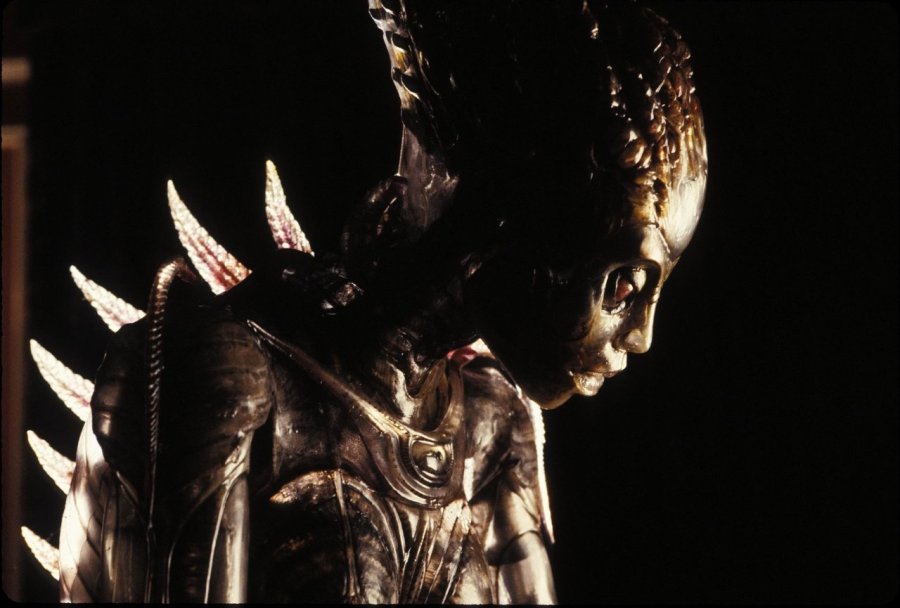
After many unsuccessful pitches, Feldman expanded The Message into a full-length spec script — now retitled Species — with several elements changed. The hybrid woman, unnamed in the treatment, was baptized as Sil. “I was looking a long time for her name, and I landed on Sil,” he said. “I wanted to get an acronym, but couldn’t for the life of me figure out what ‘Sil’ could be an acronym for. I learned from geneticist friends that when they grow DNA material in human cells, most of them die or peter out, and only a few of those prosper enough to become individuals. And of the 100 human cells that they put the DNA into, they were coded with three letters. SIL is just the three-letter code for ours. It was really just a name I liked. It’s short, it’s three letters, and seems like a name, but also like it could be a creature.”
Even the full script had difficulties piquing interest from studios. Eventually, Species was proposed — more than once — to Metro-Goldwyn-Mayer. With the help of producer Frank Mancuso, Jr., the studio responded positively, but the greenlight was still uncertain. Roger Donaldson became attached early on as director, intent on exploring new ground with a genre he previously had no expertise in. In addition, he was interested in the then rising field of digital effects. “I indicated to my agents that I was interested in doing something that involved special effects, because I felt it was a very important part of filmmaking that I was still very ignorant about. I wanted to get into it and find out what was going on. The bottom line was that I wanted to throw myself in the deep and educate myself at a fast and furious rate.”
Following Donaldson’s attachment, the director felt the need to revise the script, which would eventually go through at least eight different drafts. An important addition was the development in the first act of a sense of sympathy for Sil — in contrast with the first draft where she makes her first gratuitious kill in the opening pages — before she matures into a being with no compunctions about killing. A degree of sympathy is maintained throughout, with Sil being tormented by biological urges and nightmares, and falling into brief despair when she realizes her chosen mate is with another woman. Some sequences that would have required complicated set-ups were also abolished, such a third act sequence where Sil splits apart into three separate creatures made out of her body parts.
Creature design was a primary concern. By chance, Donaldson stumbled upon Hans Ruedi Giger’s Necronomicon in a comic book shop and proposed that the artist ought to be involved with Species. Initially, the director was apprehensive about the inevitable comparisons to Alien: “he [Giger] did the creature in Alien and I was concerned whether we should go that route, because he was so identified with that creature that I was afraid it would look like we were ripping that film off; but, ultimately, it just seemed like he was the guy we should go to.”
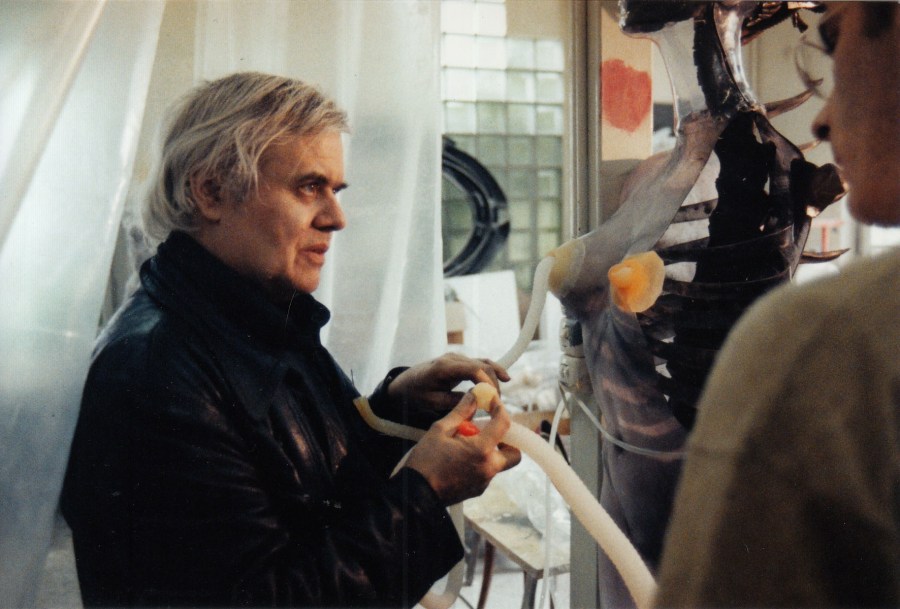
Mancuso became convinced that attaching Giger’s name to the project could ensure its ultimate approval — and he was proved right. Regarding creature design, the producer said: “we wanted her [Sil] to be scary, but at the same time have a sensuality that isn’t lost when she appears as the creature. There needed to be a constant level of elegance and grace to her character, and H.R. Giger was the only person we could think of who could accomplish this.” Giger was first contacted through his publisher James Cowan, who thought the project would be ideal for the artist, who could perhaps be able to give life to “perhaps the most elegant design since the Maria robot in Fritz Lang’s Metropolis.” Mancuso added: “we talked to him [Giger] on the telephone, and found that he was intrigued by the idea of creating a being that was aesthetically pleasing and still had a tendency toward horrific actions. That got him going.”
Indeed, Giger himself was captivated by the proposal: “usually, they ask me to design monsters with bad-looking, ugly faces and horrible teeth,” he said. “I wanted Sil to turn into the monster and still look beautiful.” The artist was indeed attracted to what he called “the beauty in the beast,” commenting: “it was an opportunity for me to create a creature that was not only disturbing and frightening, but at the same time beautiful in a powerfully feminine and elegant way — much like I had conceived the exotic biomechanical women in my paintings. I liked the subtleness of the design possibility as the creature was not to be a strict extraterrestrial, but was also based on the human physique. It was this potential ‘beauty in the beast’ that completely enticed me to participate. Additionally, and very importantly, there seemed to be sufficient capital behind the film to enable my designs to be appropriately realized without having to be done on the cheap.” Indeed, Mancuso’s initial reassuring claim to Giger and his representatives was that the project’s budget would be in excess of $30 million, purportedly allowing the artist’s designs to be fully conveyed.

Richard Edlund and Boss Film Studios were approached for the visual effects front of the production. Edlund was captivated by the premise, saying that “I like the way the story’s set up, because you have a creature that you can achieve a strange kind of dramatic forgiveness for.” More importantly, he found Species to be the perfect challenge for his company’s growing digital skills at the time. He recalled: “we had been working for more than a year on developing and testing a new motion capture system and we were looking for an opportunity to take it to a higher level.” Donaldson had no previous experience with digital effects; Edlund and Jim Rygiel, both visual effects supervisors on the project, convinced him that motion capture would be ideal for Sil.
Boss Film head of production Ellen Somers recalled: “we had begun our own R&D process in response to the huge number of scripts coming to us that involved nonhuman-type characters. We knew we had to get to the forefront of computer animation. Recognizing that the interface is always a problem for the director — because there is no physical puppet to watch — we wanted to move computer animation in the direction of interactive real time, with the ultimate goal of creating a virtual studio where a director can literally walk in, direct a computer character with full body and facial motion in a temporary composite, and leave the same day with a videotape to take back to his editing room.”
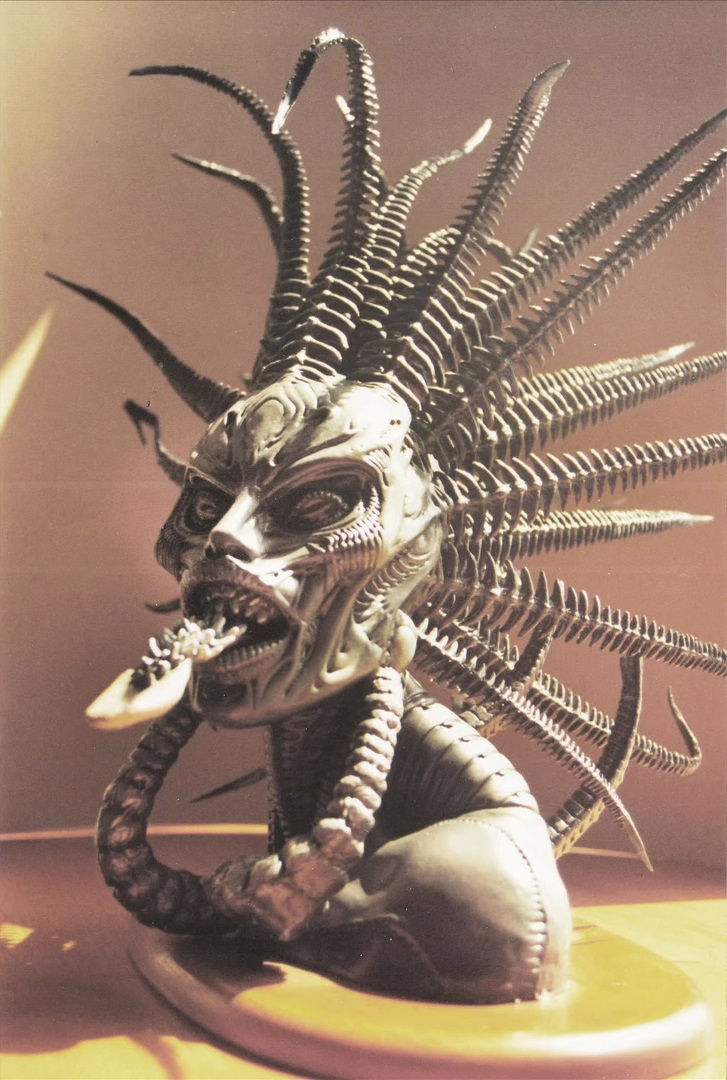
Concept and comic artist Ricardo Delgado was hired to storyboard the script and provide elaborations upon Giger’s initial concepts. In the meantime, Mancuso and Donaldson approached many special effects artists for the physical creation of Sil. Reportedly, among those contacted figured Rick Baker, Rob Bottin, and Stan Winston — all unavailable due to scheduling conflicts and other factors. Eventually, Burman Studios was preliminarily contracted. “Before the project went to XFX, my dad [Tom Burman] was doing a lot of work on it,” said Rob Burman. “Quite a bit of the design’s vagueness was worked out at that stage. A number of life-size sketches were done, and a miniature sculpture. Apparently, there were some production issues and my dad left the project… from there it went to Steve [Johnson], who did it brilliantly.”
After some pre-production delays — which would eventually impact the practical effects build time — it was Edlund who pushed for the inclusion of Steve Johnson and his company, in light of Johnson having been one of the Boss Film creature effects chiefs on Ghostbusters, Fright Night, Big Trouble in Little China, and most importantly Poltergeist II: The Other Side, where Giger designs had also been involved. “It was great to work with Richard Edlund again,” said Johnson. “He was the real reason I got this job. They had written off so much of the beginning of this as a digitally created character, and I’m not sure they had really done this for a feature before. I think the reason Richard wanted me to do the job so badly was because we had a good working relationship together when I was head of the creature shop at Boss.” Pictorial documentation of the work from Burman Studios was still provided to the XFX crew.

A long time enthusiast of Giger’s art, Johnson was ecstatic to collaborate with the Swiss surrealist again, and this time made it a mission not to disappoint him. He related: “the thing about working with Giger on this project for me was, he had some bad experiences in the past, working with people that brought his visions to the screen, and I’ve always been such a fan of Giger’s work that I really wanted to go out of my way and do whatever it took to make him happy and please him on this, so we really did maintain a close working relationship.”
Natasha Henstridge was cast as the human Sil. At the time, the young actress was emerging from the modelling world and was new to film productions. Out of dozens of candidates, she was Donaldson’s favoured choice — based on her successful screen tests. “He was the one pushing for me the whole time,” the actress said. “The producers and the studio were sort of leery to use me. I had worked with him so I knew what he was looking for from me and the character.”
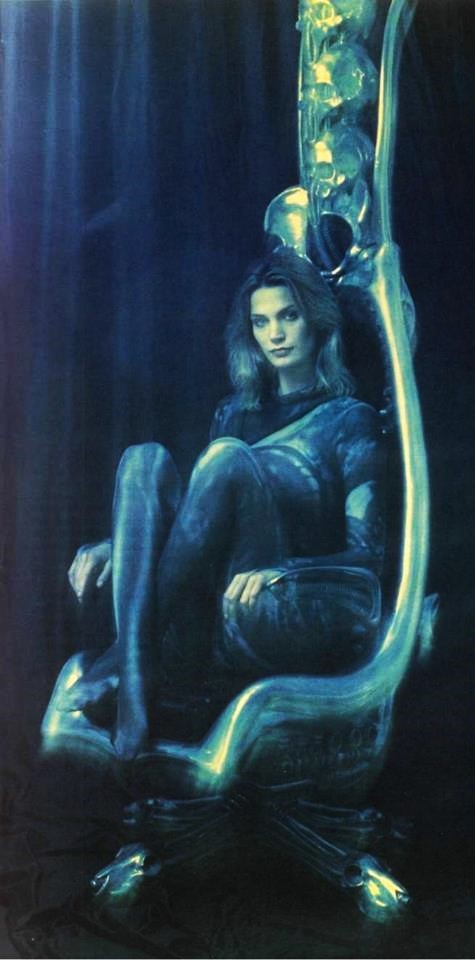
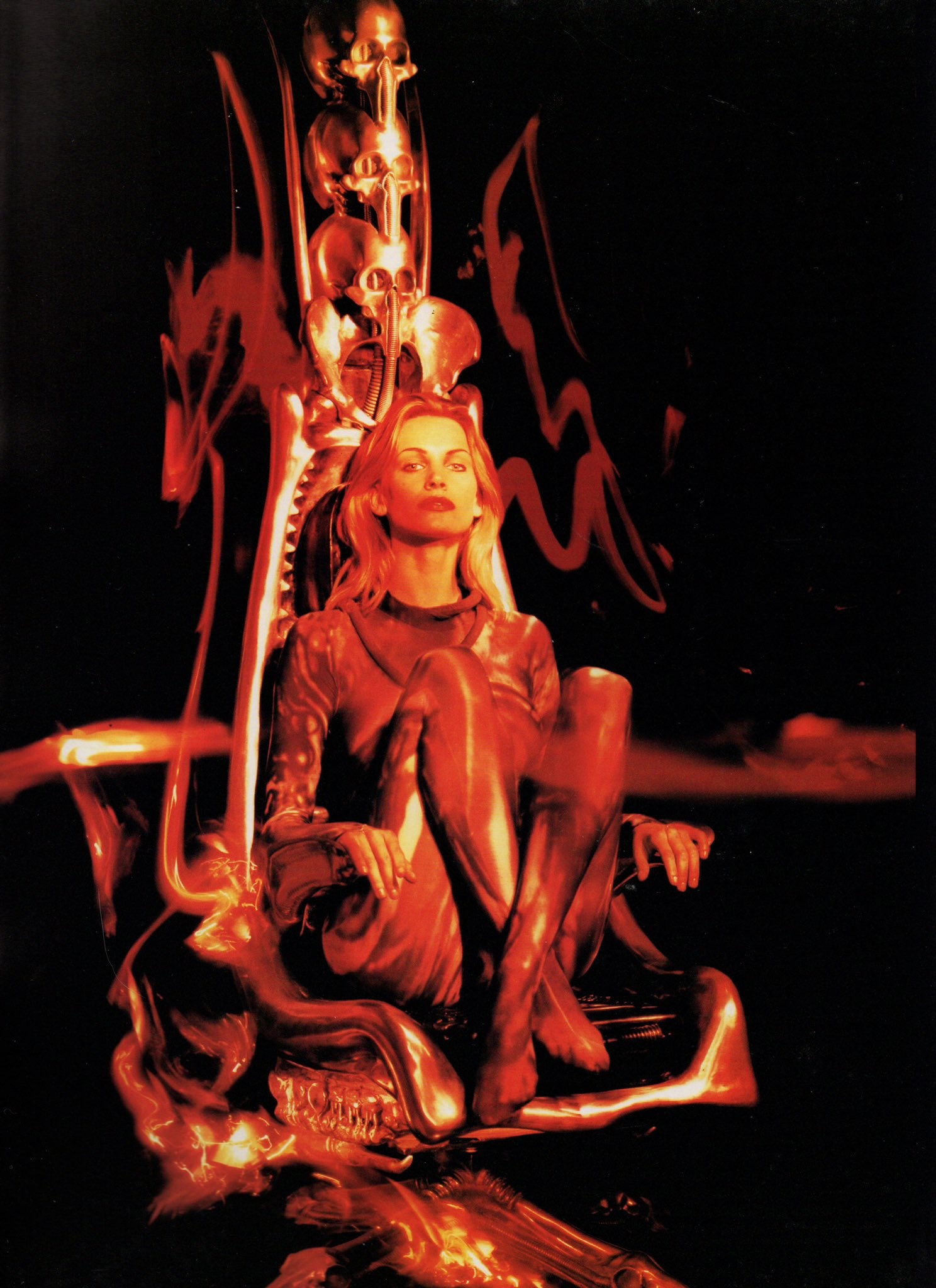
Sil is seen in the briefing scene as a growing embryo and then as a fetus, all portrayed by inflatable silicone puppets. Child actress Chauntal Lewis plays a toddler stage, and Michelle Williams plays young Sil — the phase the character is first introduced at. For the shot of the hybrid girl quivering during a nightmare, Williams was fitted with a prosthetic back that could extrude a back spike — the very first effect shot during production.
Earlier in the film, young Sil pupates in a train cabin. Giger’s storyboards depicted his idea of how the scene should articulate, including a moment where the young Sil tries to pop the growing pimples on her face. The sketches served as a point of reference, but the sequence ultimately played out somewhat differently. The transformation starts with make-up appliances sculpted by XFX art director Bill Corso and applied by Corso himself and department head of make-up Kenny Myers. According to Corso, the make-up was a “full-wrap, cheeks and neck foam latex prosthetic to make her appear like she’d gained weight quickly while gorging on food”. This provided a foundation for the following stages.
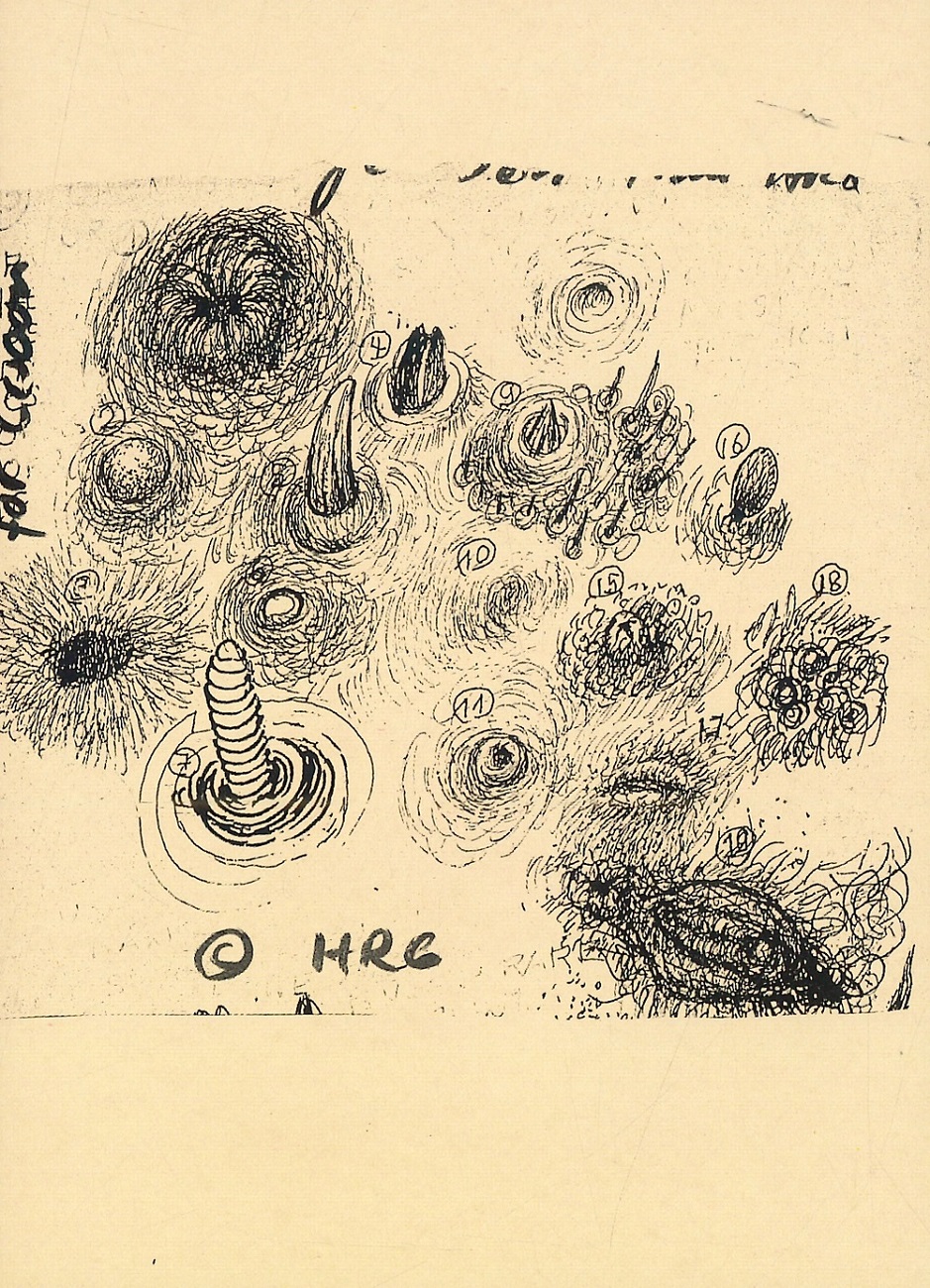
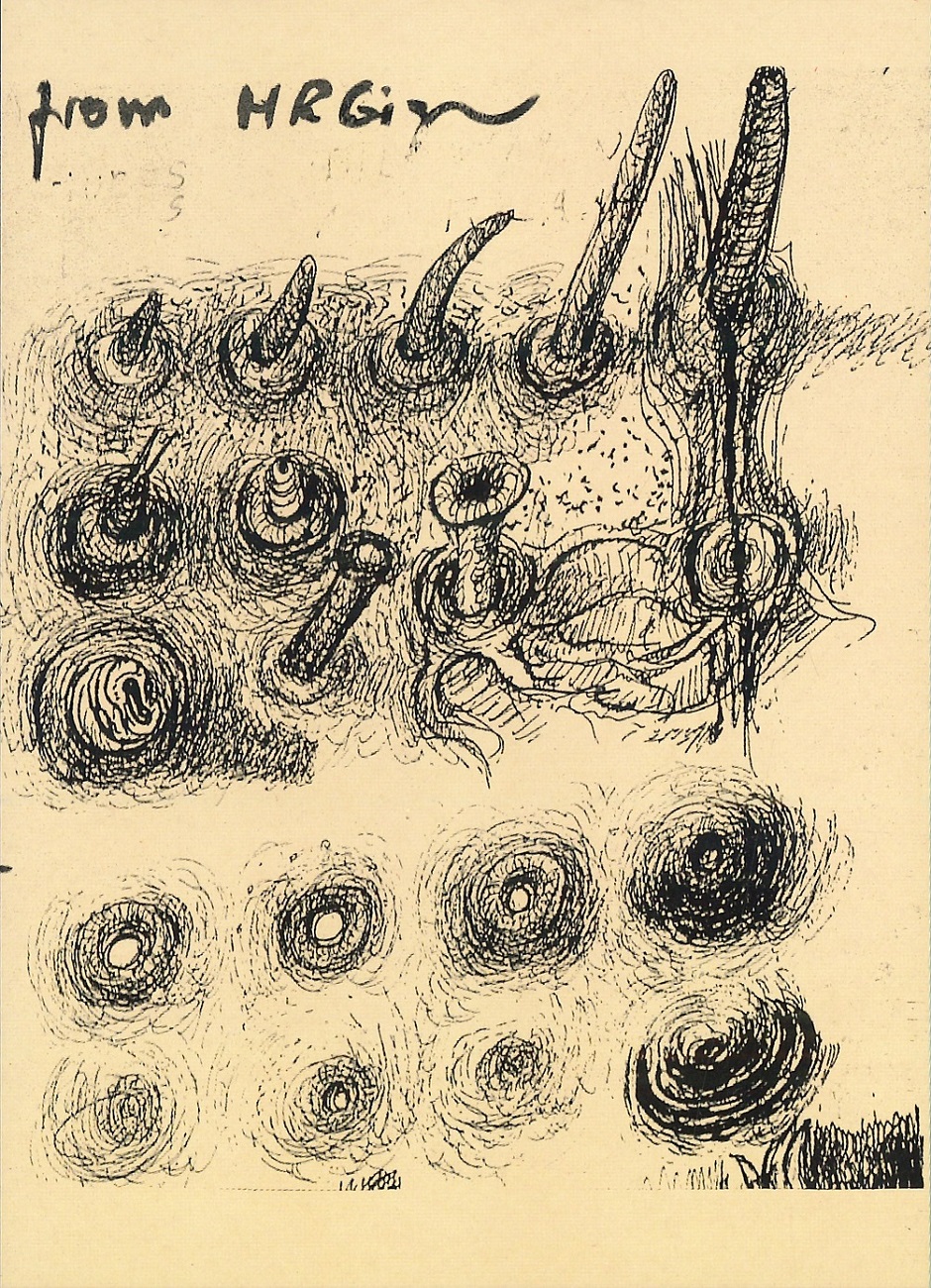
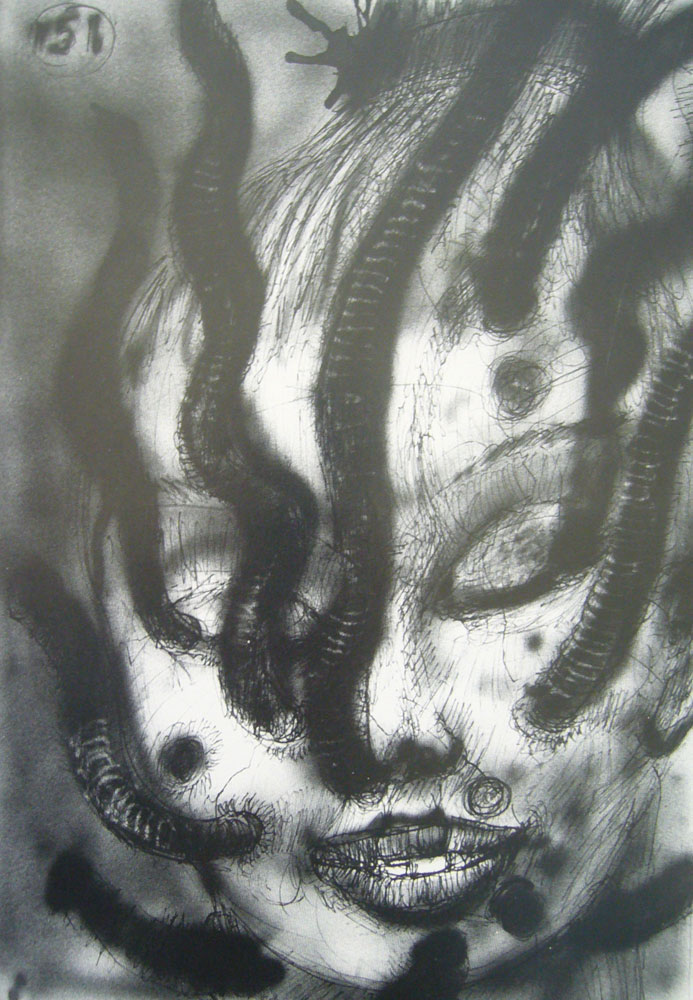
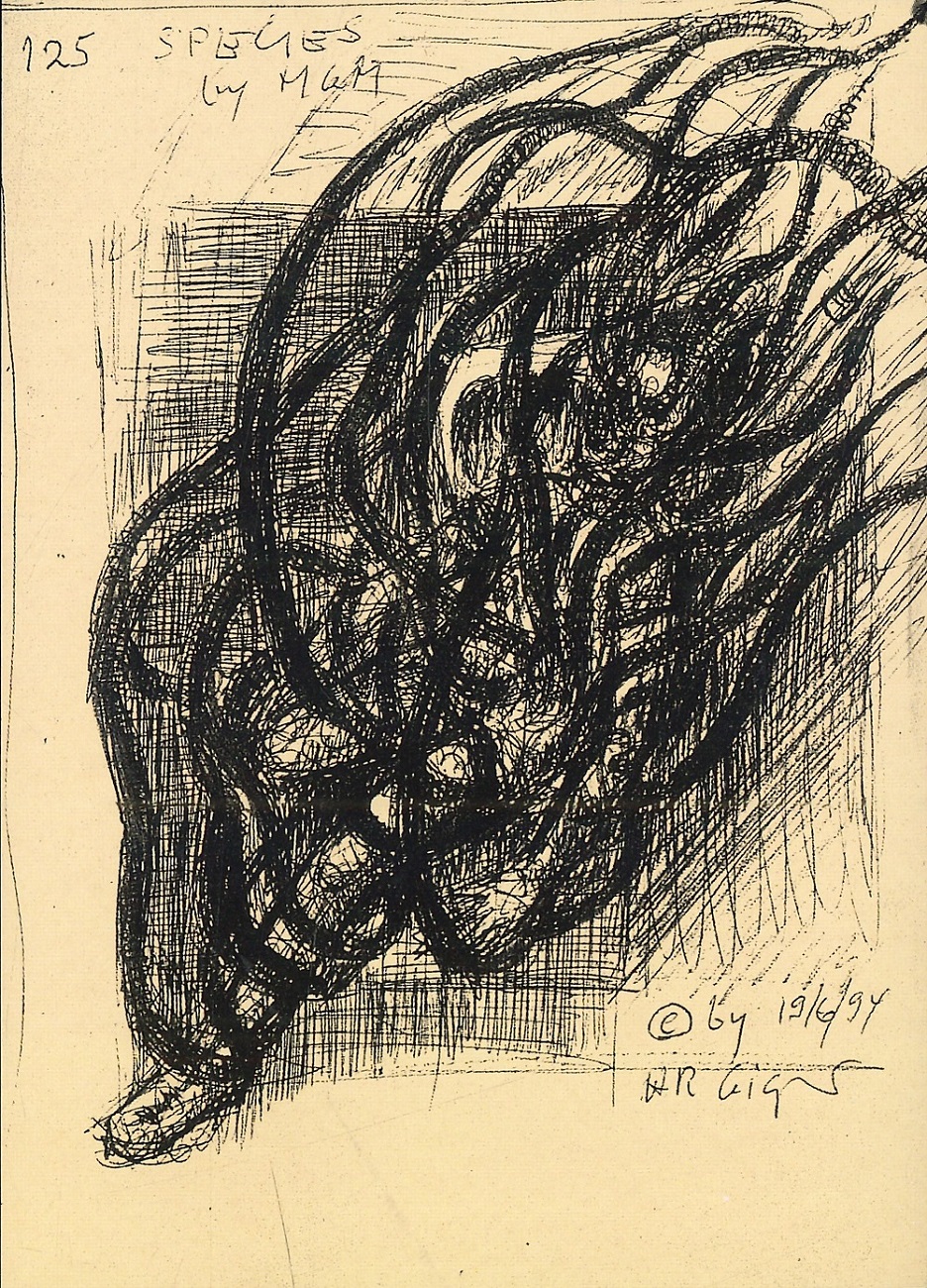
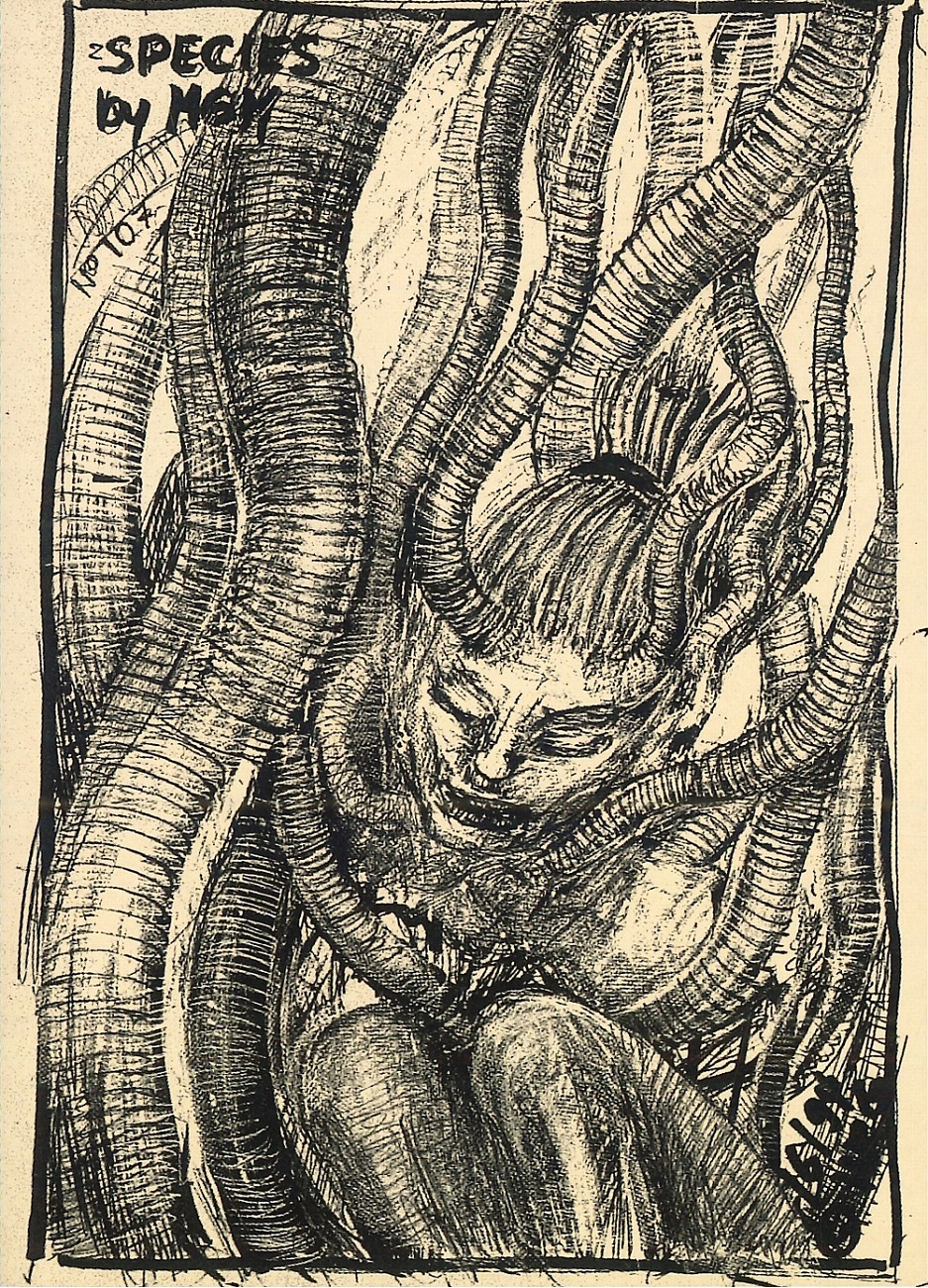
A close-up of a hand’s flesh bubbling below the skin was achieved through small wire-pulled shapes beneath a foam latex skin layer, with the wires removed in post-production. The effervescing skin on Sil’s face and neck in the following shots was operated by the same principle, although on a larger scale. The skin on the face, neck and hands bursts, revealing growths pushing from beneath. The appearance of this effect was based on Giger’s designs and notes, elaborated upon in concept art by Corso. Giger’s initial idea was of tentacles — dubbed “worms” by the artist — resembling flexible, elongated bolts — aptly — screwing their way forward. “I had intended for the worms to slowly screw out from the exploding pimples in Sil’s skin,” Giger said. He sculpted his design for the tentacles and sent XFX silicon casts of them, but the concept was eventually taken into another direction by the production team.
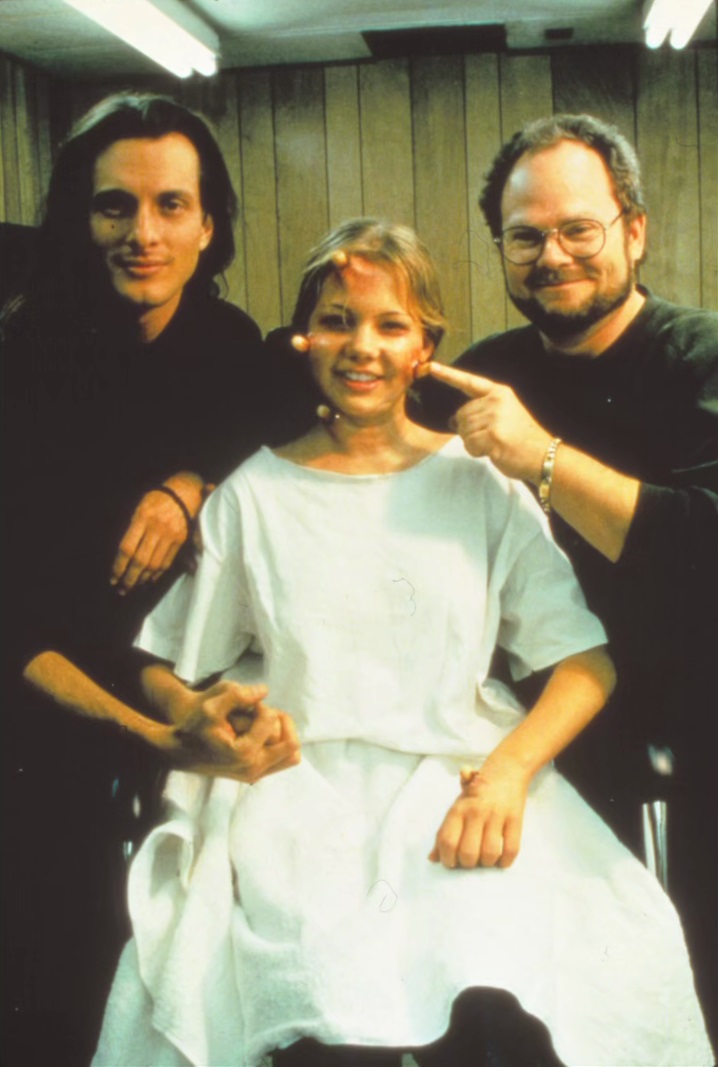
A delay was also caused by language barrier, according to Johnson: “in trying to translate what Giger was saying, it was one of those things where the language barrier definitely got in the way; he kept telling me ‘[the growths] must look like pickles coming out of her face’, so I’m over at my studio making pickle-like protuberances, and finally I sent him photographs, and he became infuriated. I realized [then] he was talking about pimples. He wanted them to look like pimples.”
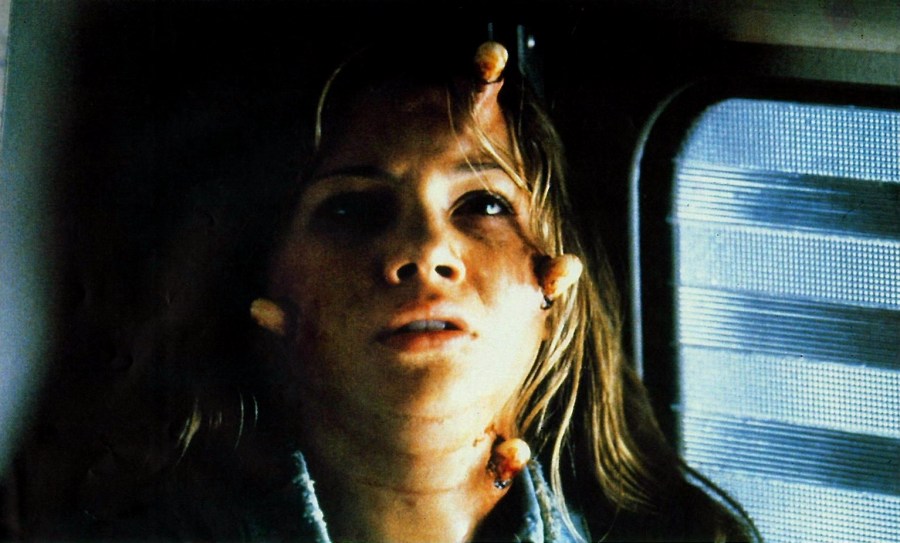
The bursting protuberances emerged from ten breakaway points in the make-up applications. They involved a large number of semi-flexible buttons cast in flexacril, pulled by wires that would then be erased in post-production. “We covered them with a section of painted condom,” explained Johnson, “followed by a section of slimed-up nylon hose, and attached a monofilament to each device; then we replaced the appliances, scored them and glued them back together with the monofilaments protruding. By pulling on the monofilaments we could manipulate the devices so they squirmed and stretched and, after a point, popped through the skin as slimy-looking worms.”
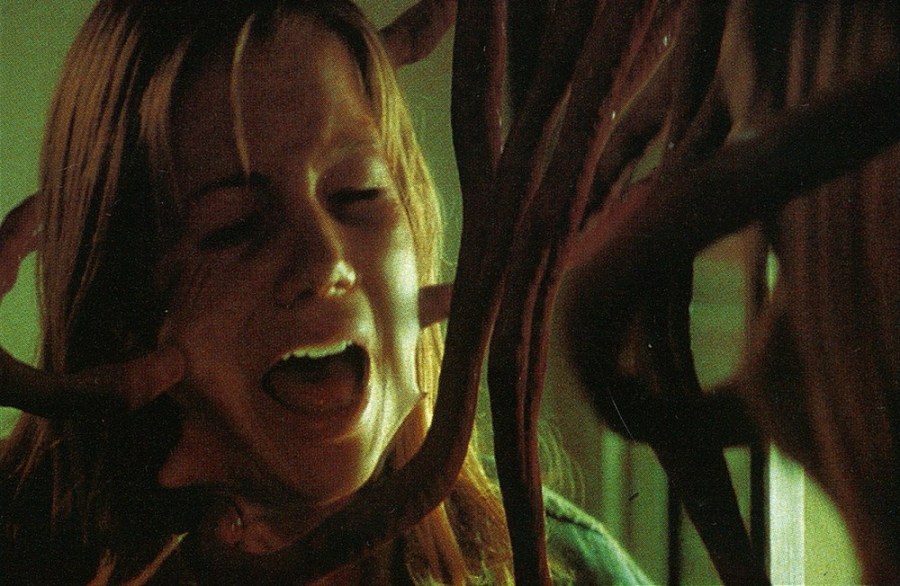
Digital tendrils — “brown sausages”, according to Giger — were animated and then composited by Boss Film onto the breaking make-up skin, shooting out of Sil’s face and onto the surrounding walls and ceiling, eventually enveloping her. When the ticket collector inspects Sil’s cabin she finds a large, pulsating cocoon. The special effects crew called it a chrysalis — with crewmembers Bill Bryan and Leonard MacDonald officially credited as chrysalis supervisors. The original description for the cocoon, as faxed to Giger, is as follows:
This is where Sil transforms from a young child of ten years old to the grown-up woman. This cocoon is a living thing that allows Sil to change. In the script the ten year old Sil eats a lot then vomits up a dough-like substance that moulds around herself into a cocoon.
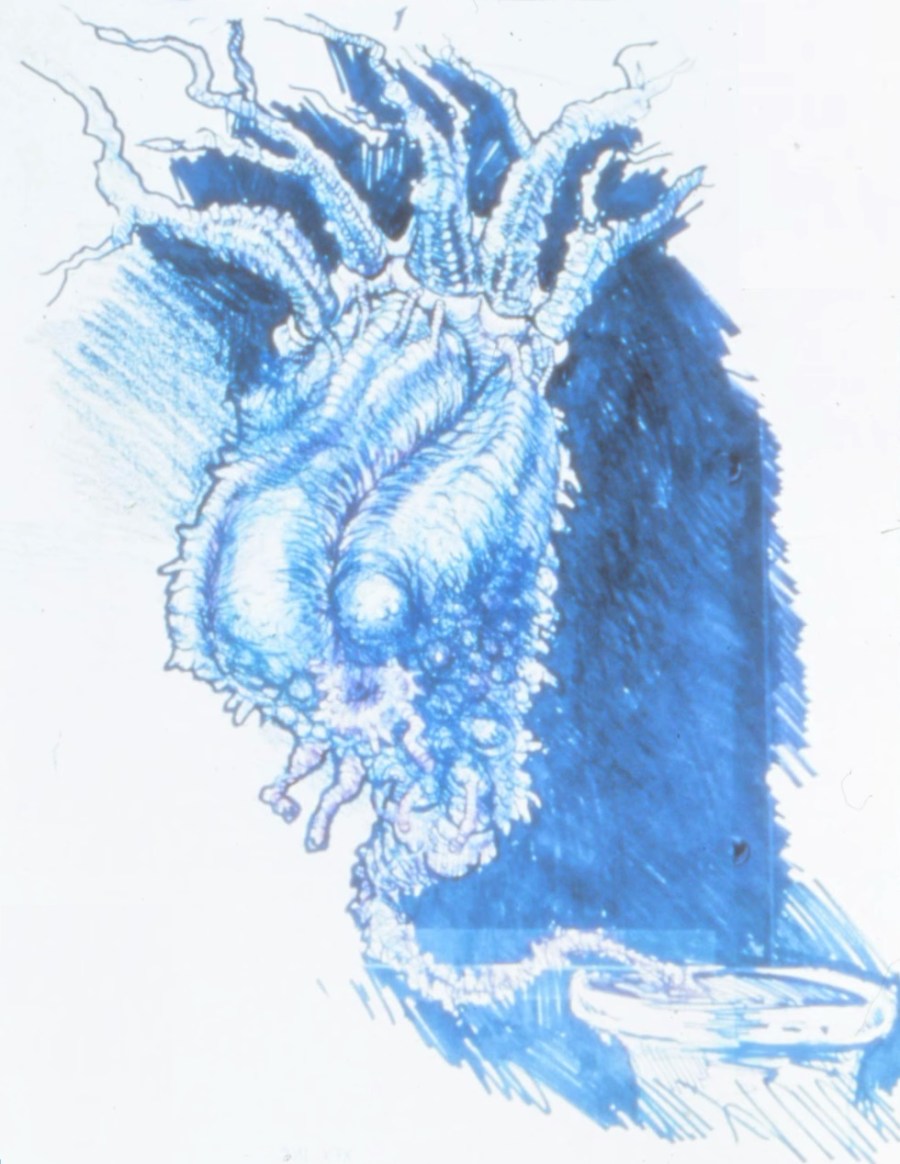
Giger produced initial sketches and Corso further developed the design, which ultimately sported the shapes of female genitalia and tendrils anchoring it to the walls. Instead of being traditionally sculpted, the chrysalis effects employed what Johnson eventually liked to refer to as the “garbage bags” approach — a fabrication technique employing multiple layers of clear polypropylene, conceived by Johnson and chrysalis supervisor Bill Bryan. “We found that we could hand-manipulate the plastic,” said Johnson, “which is as malleable as clay, by cross-pulling it to create shapes and textures with layers of puckers and protrusions that looked very Gigeresque.”
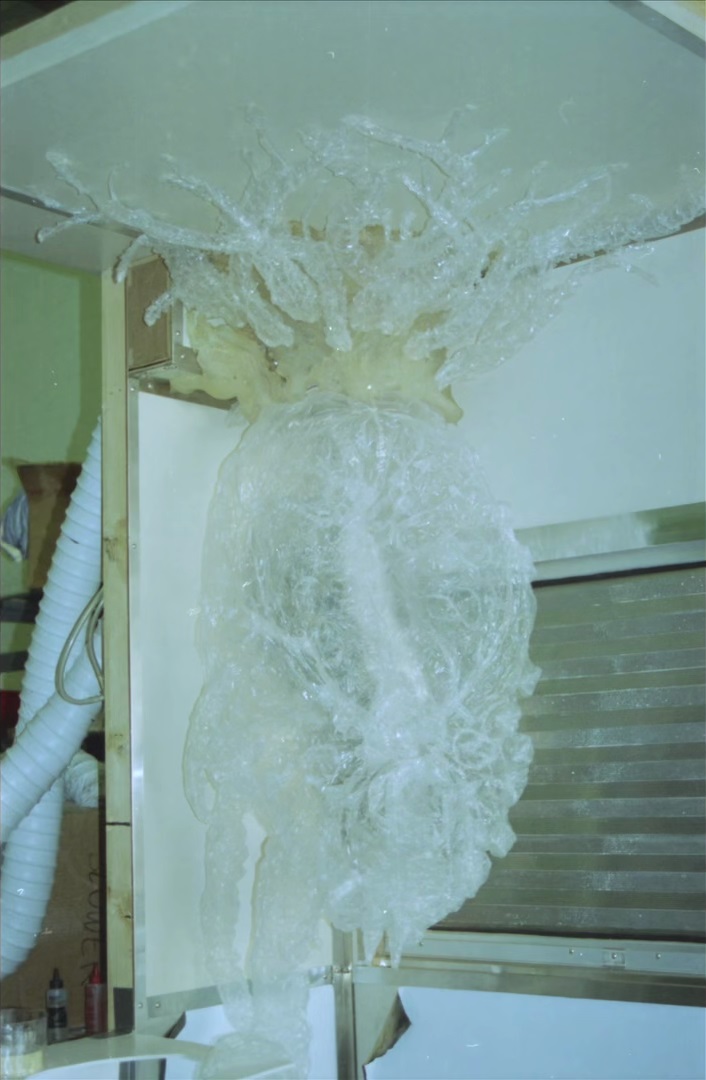
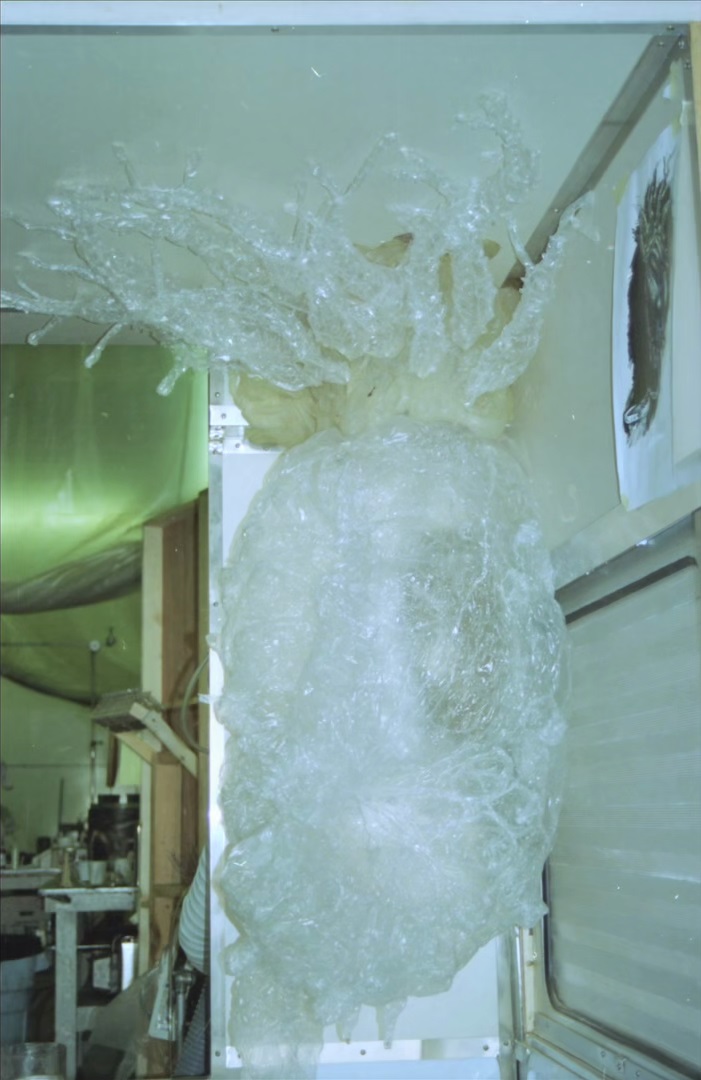
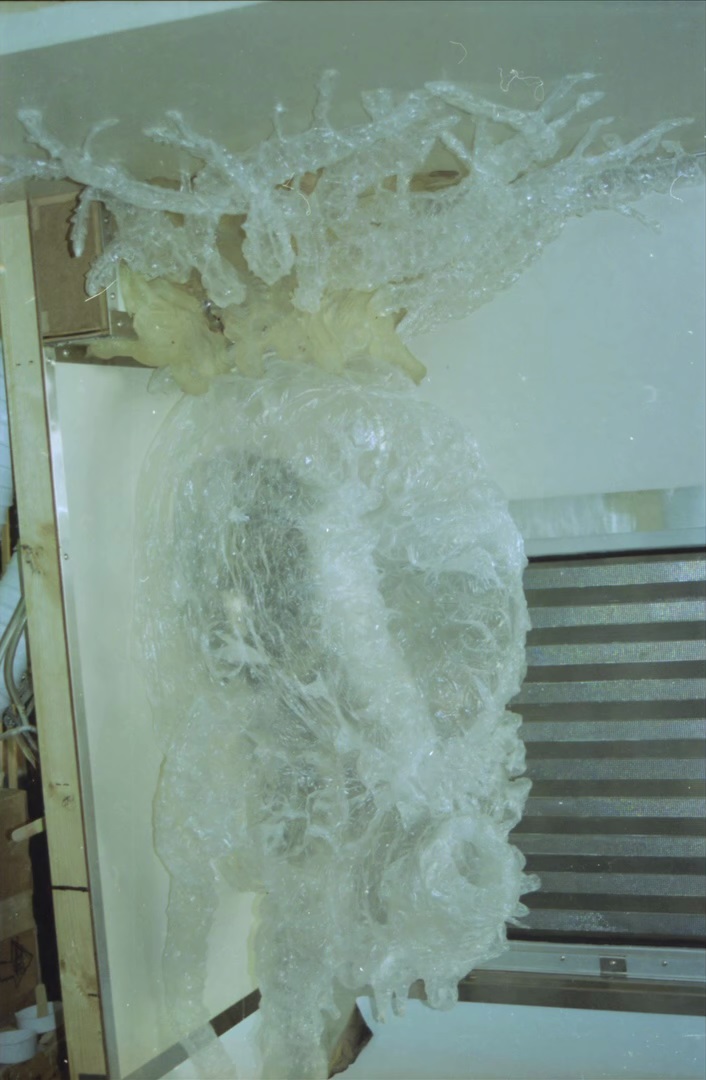
The cocoon was painted with coloured gels that formed highlights and shadows. The paints employed therein were so toxic that, according to painter Doug Stewart, the chrysalis was “painted with poison.” Installed on a wall, the creation was puppeteered by manipulating positive and negative air flows within its cavities. Gross motion was also provided by pulling internal and external strings, with a resulting wide range of overall motion.
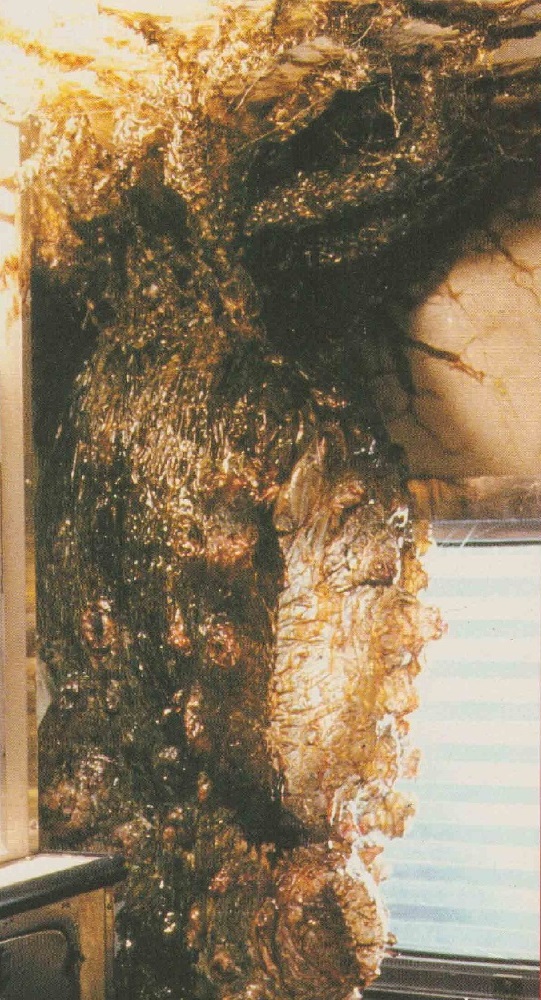
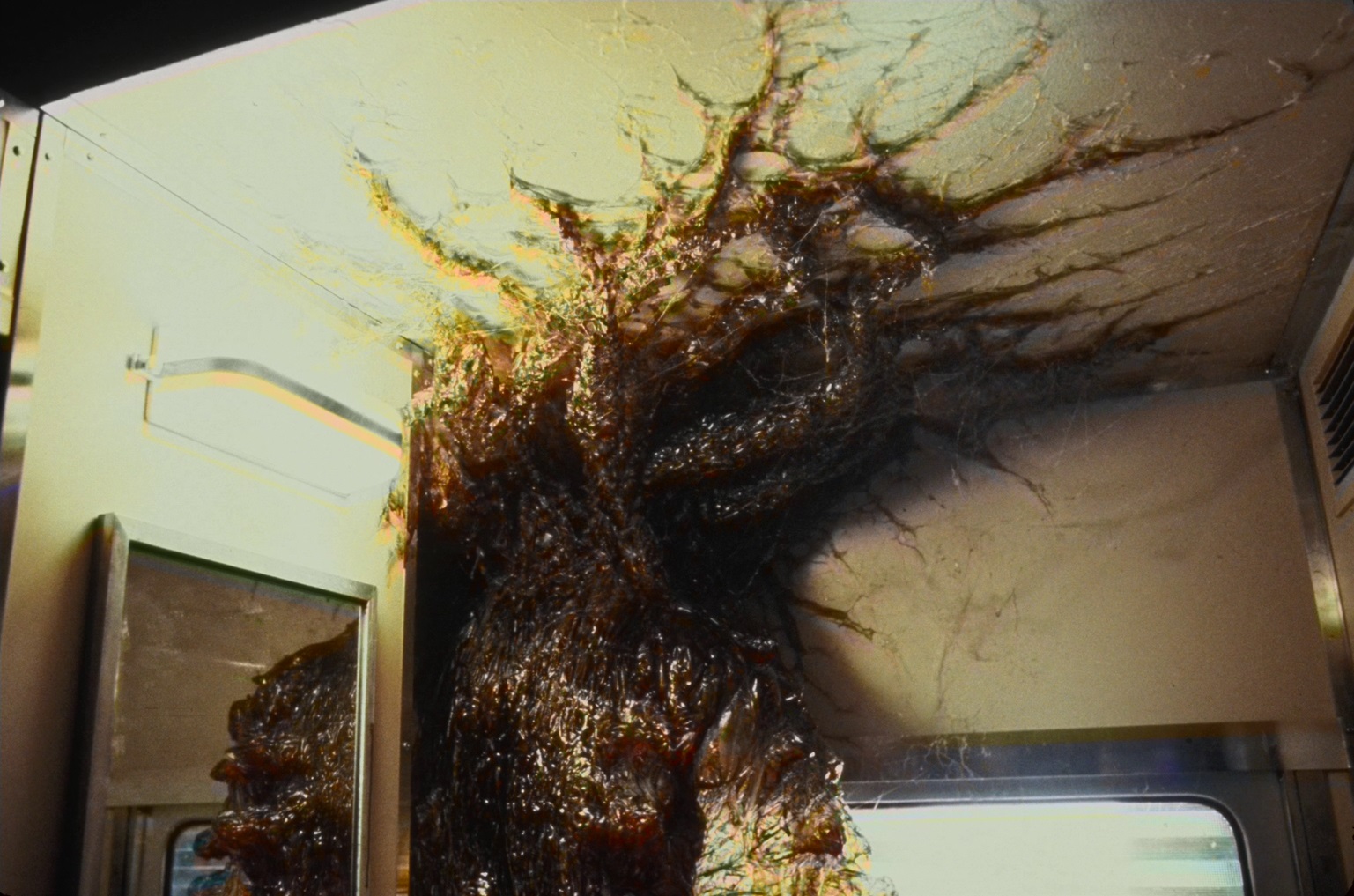
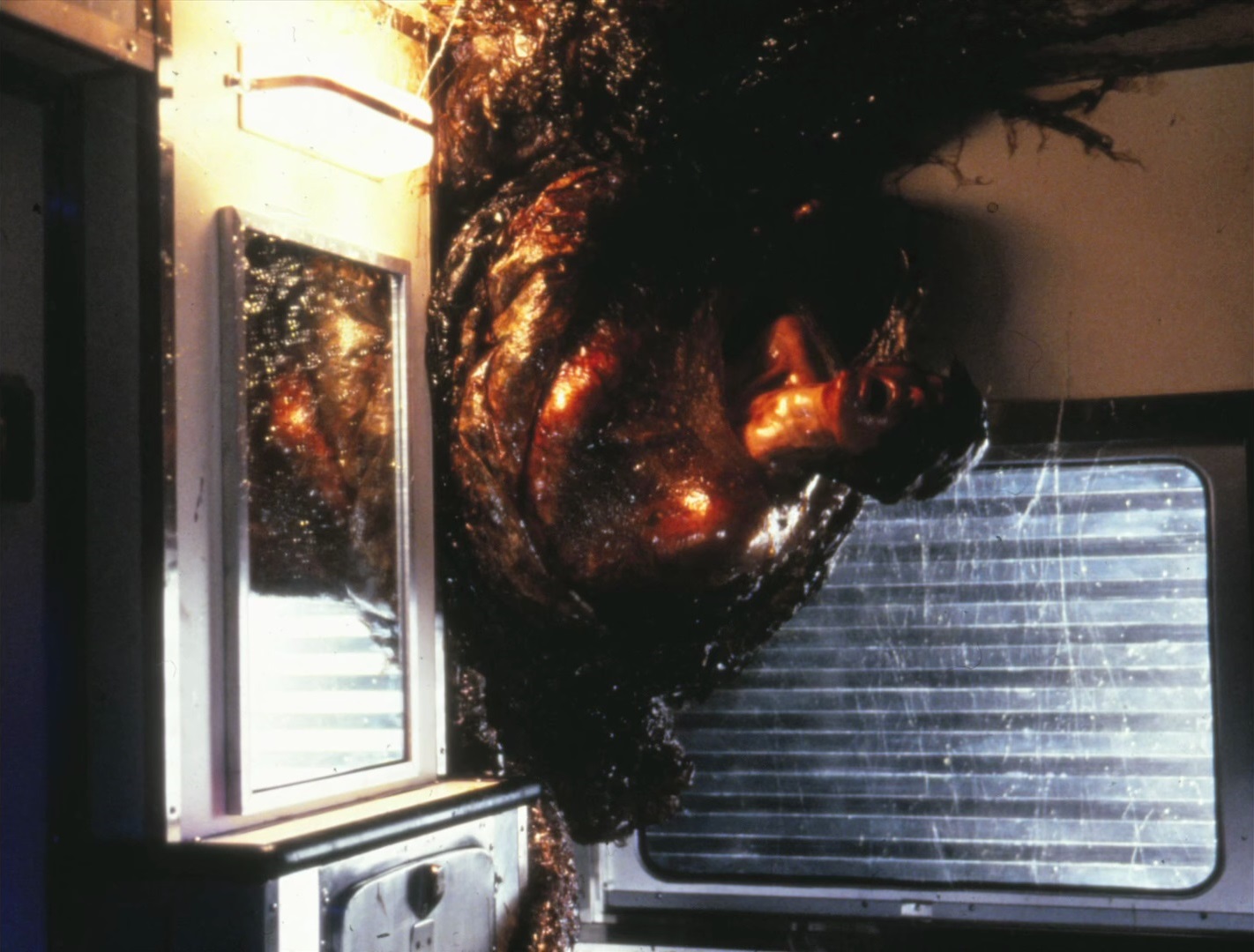
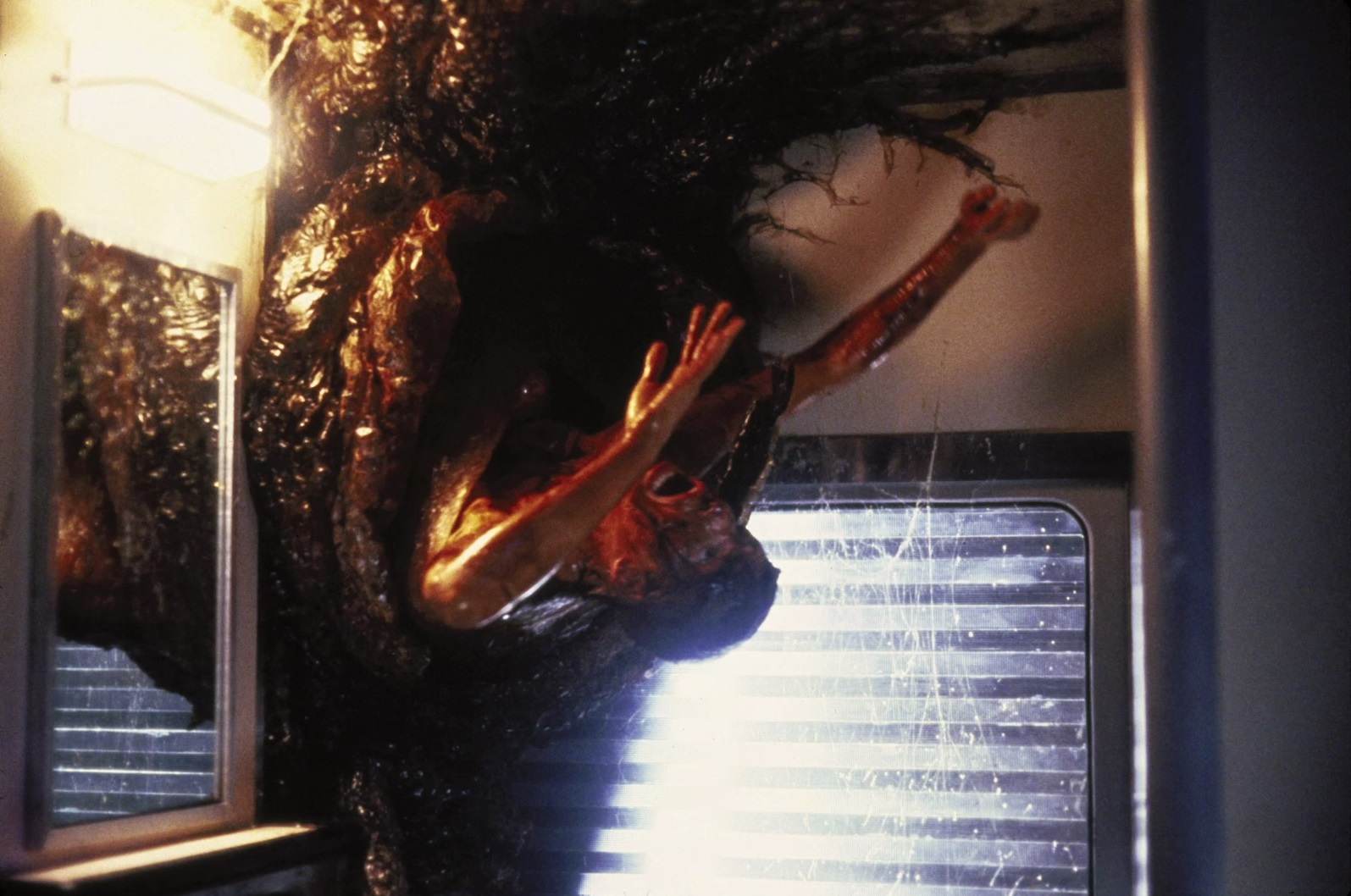
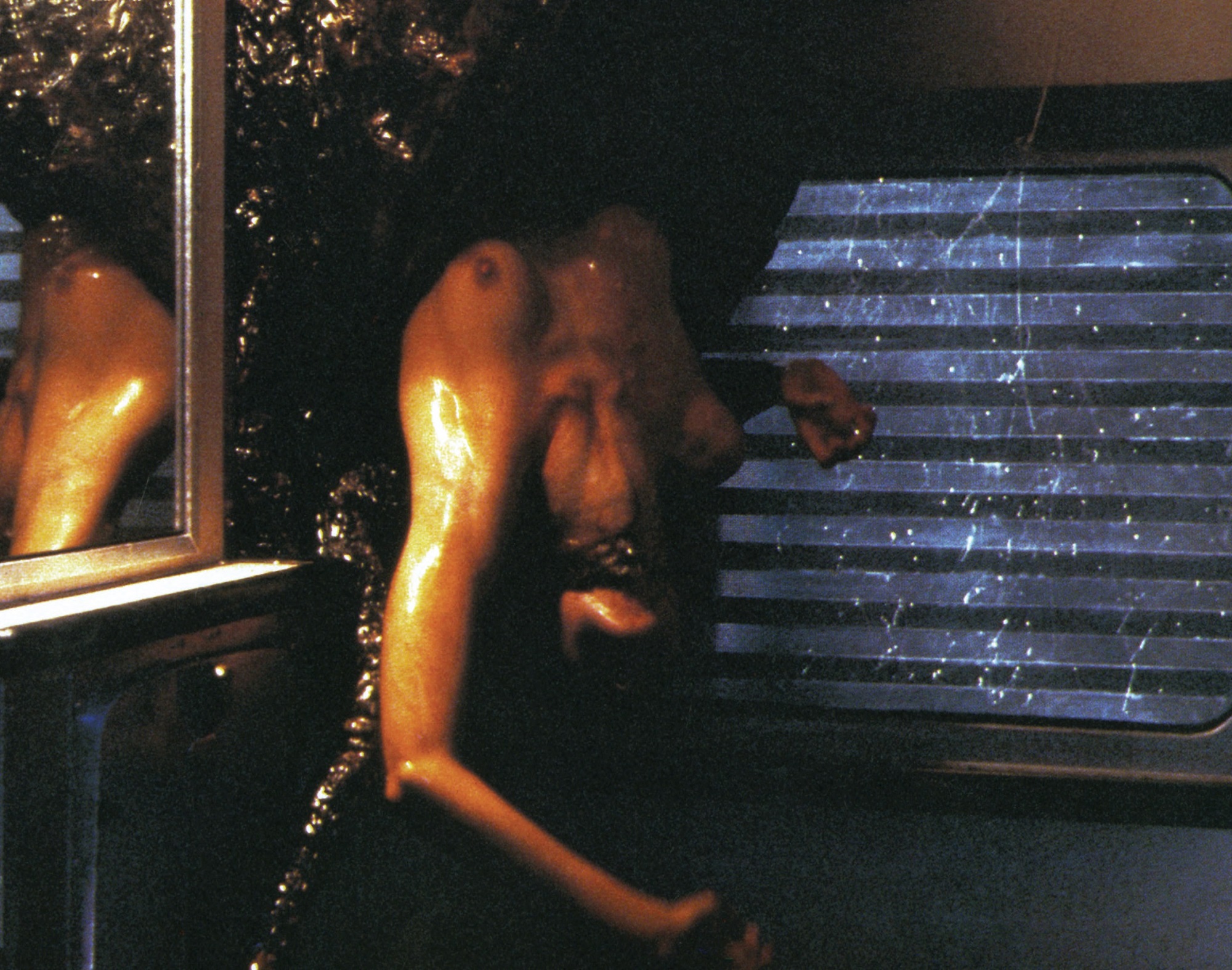
A stunt creature hand shoots out of the cocoon, killing the ticket collector. Next, another aptly-devised cocoon enveloped Natasha Henstridge herself for her first appearance in the film. Giger’s sketches of Sil’s emergence were based on theatre shows by the Spanish theater group La Fura dels Baus. In one of their performance pieces, as recalled by Giger, there was “a scene where naked women tumbled head over heels out of hanging, translucent rubber tubes.”
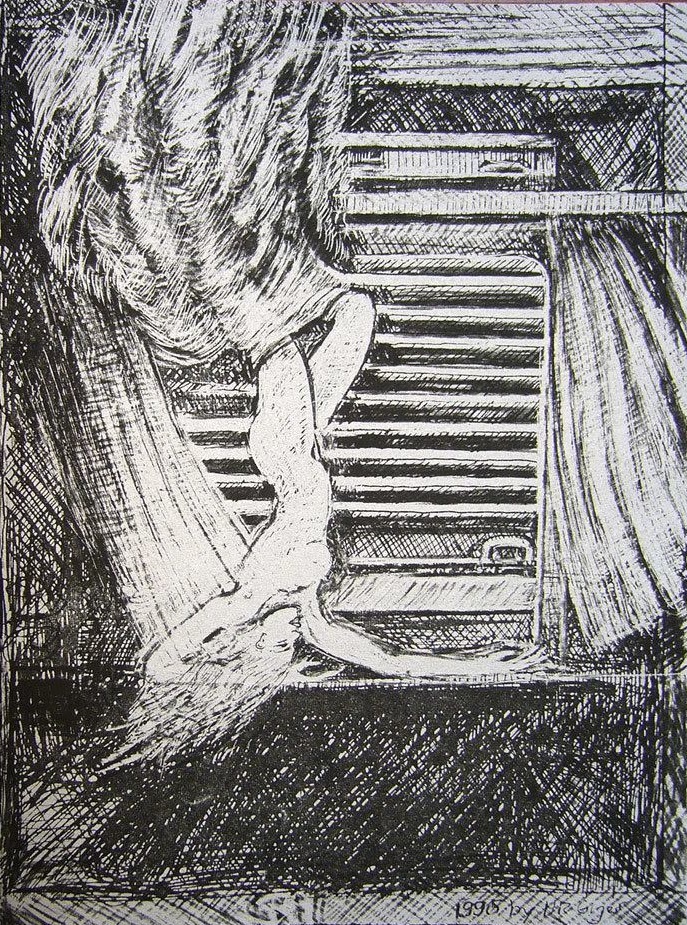
The special effects crew was initially stumped by the logistics of the shot, trying to figure out how the actress could be pulled out of the cocoon. Eventually, it was MacDonald who suggested that gravity could aid the action: the set-up was thus built upside-down. Henstridge unfurled from a hole cut into the cabin wall, tore through an effects membrane and emerged from the chrysalis with smeared effects blood and methocel of varied viscosity. “My whole body wouldn’t fit in there so I had to go in one leg at a time, sort of doing a split,” Henstridge said. As she reached out with her arms out of frame, she grabbed a trapeze bar which then hauled her up, making it appear as if she was falling down. “It was very cold,” the actress recalled. “They were heating up this jelly and stuff that they put on me for the slime. They were heating it up in crock pots, but it was still very cold.”

Henstridge could somehow identify with Sil, a stranger in a strange land. “For a long time I was thinking she’s really naive and lost in this world,” she said. “Anybody can understand what that’s like. Her feeling of having no parents, no family, that sort of thing. She’s naive, and out there in the world just running on instinct because she’s this half-alien character.” As Henstridge shot her scenes in sequence, the darker side of Sil only became apparent to her later during production. She continues: “I started to realize that she’s not that good. After a while, she begins to feel human behaviour in a way. Like the scene where the woman walks into the bathroom, and she gets pissed off about it. Starting to feel these human emotions, she sees this woman as someone stepping into her territory. She’s very instinctual, which I thought was kind of interesting about the character, and was the most fun part to play. But it changes every time I see it in a way.”
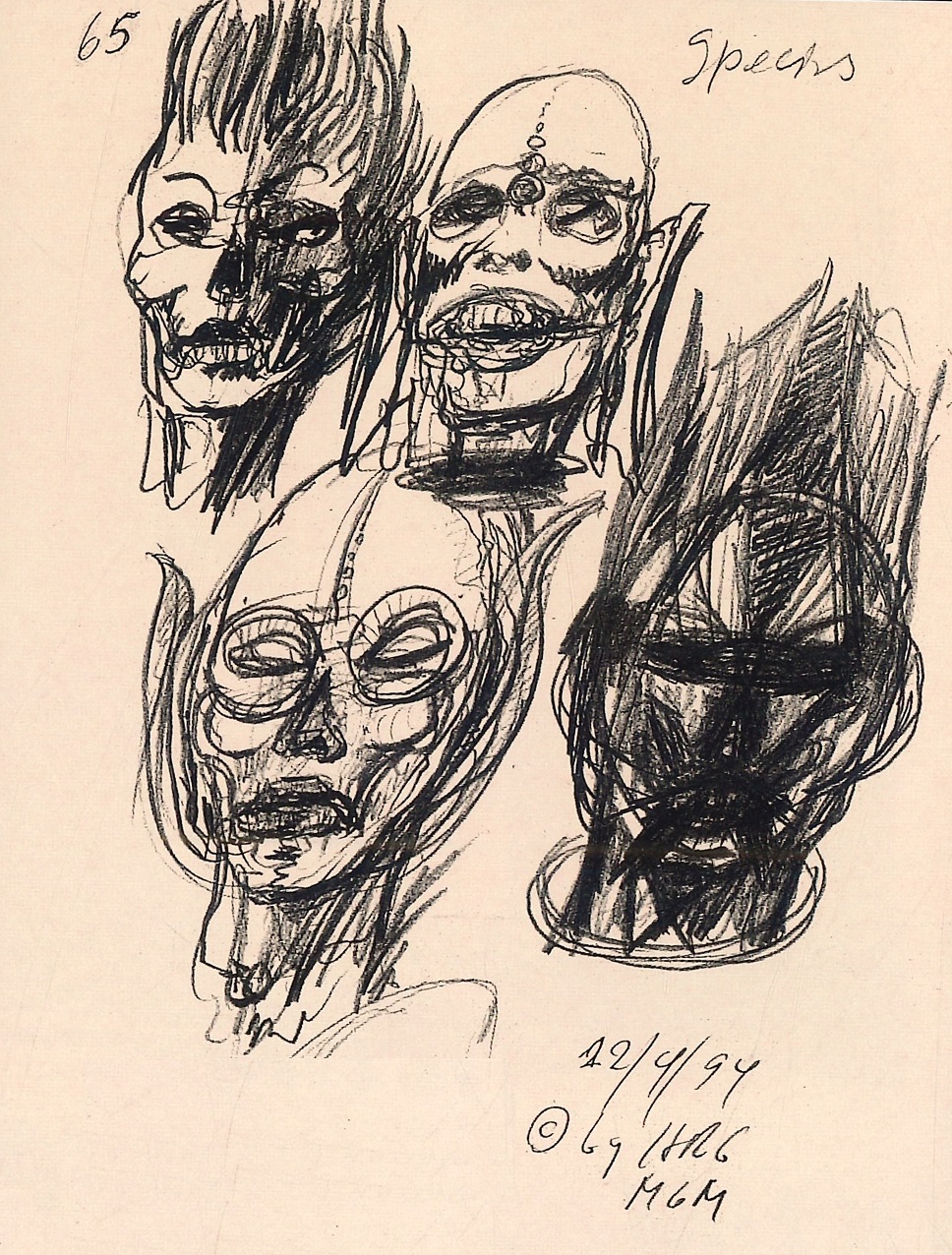
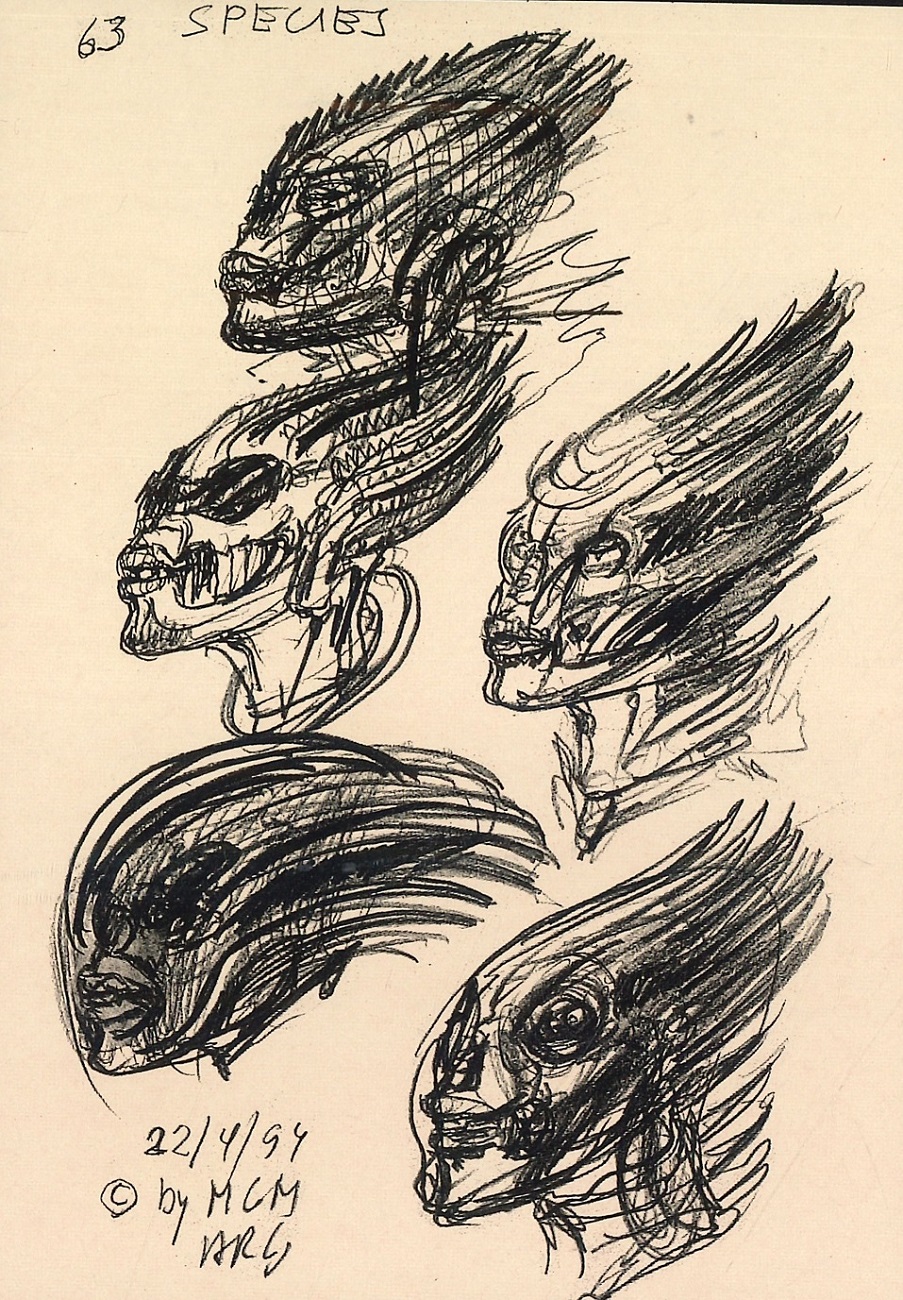
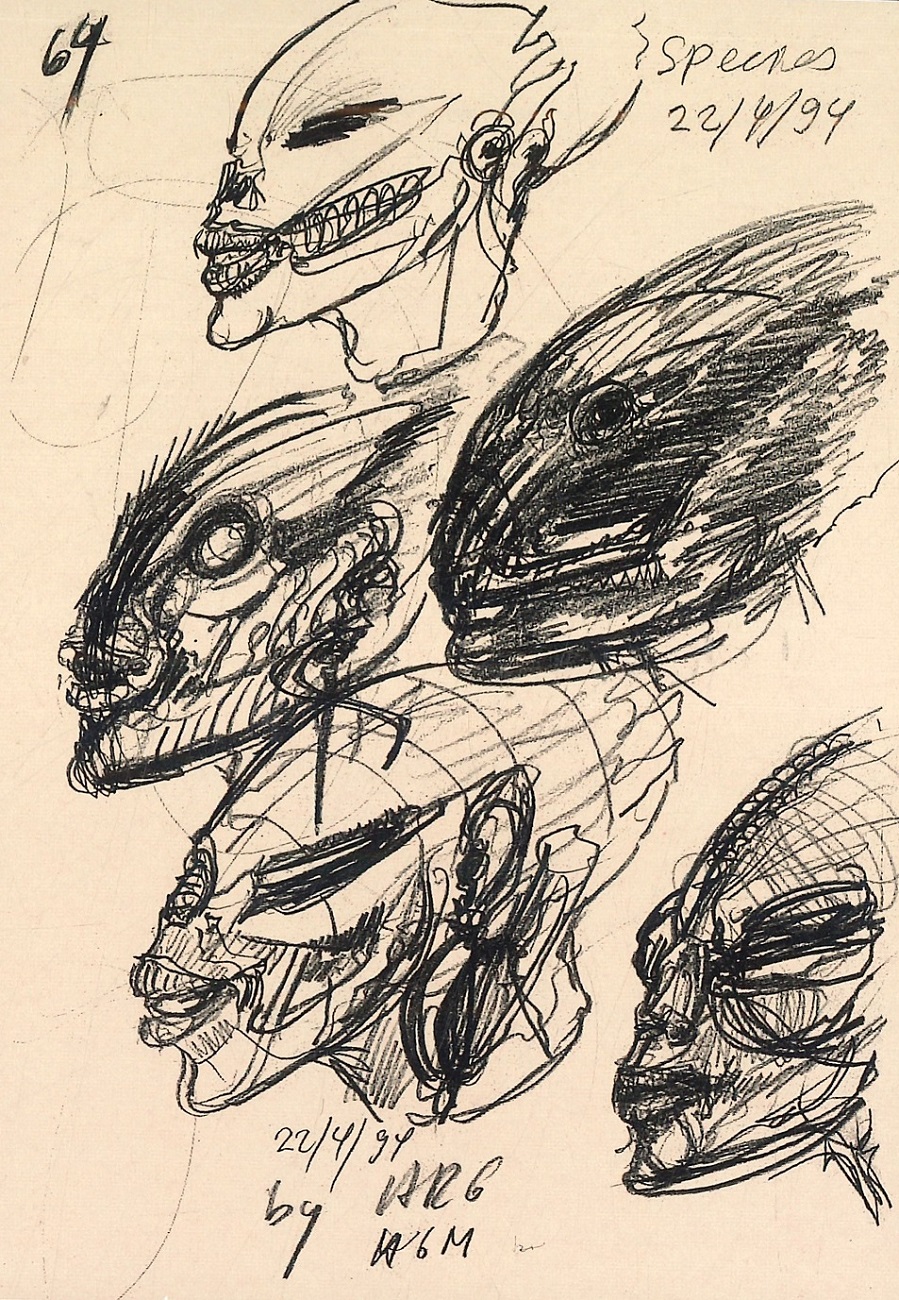
Design work on Sil’s innermost form began as soon as Giger became attached to the project, even before contract negotiations were finalized. After the initial phone calls, Donaldson and Mancuso came to Zurich to discuss the details of what they wanted Giger to do. Language barrier was a concern, with the filmmakers trying to outline Sil’s characteristics and functions as clearly as possible. Mancuso said: “we felt that for Giger to be successful, we had to give him a series of functions for the creatures to do. […] The fact that he is an artist and used to creating still pictures was a concern. We had to convince him that this creature had to move with an energy that still pictures don’t have, and possess a distinct personality. It took a lot of patience to work with Giger; not because he was difficult to work with — it was more of a language thing and the fact that he was such a long distance away.”
Following the preliminary meetings, Donaldson and Mancuso agreed to constant communication by phone regarding production developments and script revisions. To start, they sent Giger a list of requirements that had been discussed for the creatures as additional reference. The fax read:
SIL — THE MONSTER
In her human form, she will be a beautiful young woman between 20-25 years old. The actress to play Sil will hopefully be about 175-185 cm in height. We hope that the monster you create will have a visual connection to the actress who plays Sil in her human form. In other words, the monster may have eyes or a face or something that makes realize the monster is the alien form of Sil.In the monster form, Sil must be:
- Between 225-240 cm in height;
- She must be able to move easily and fast;
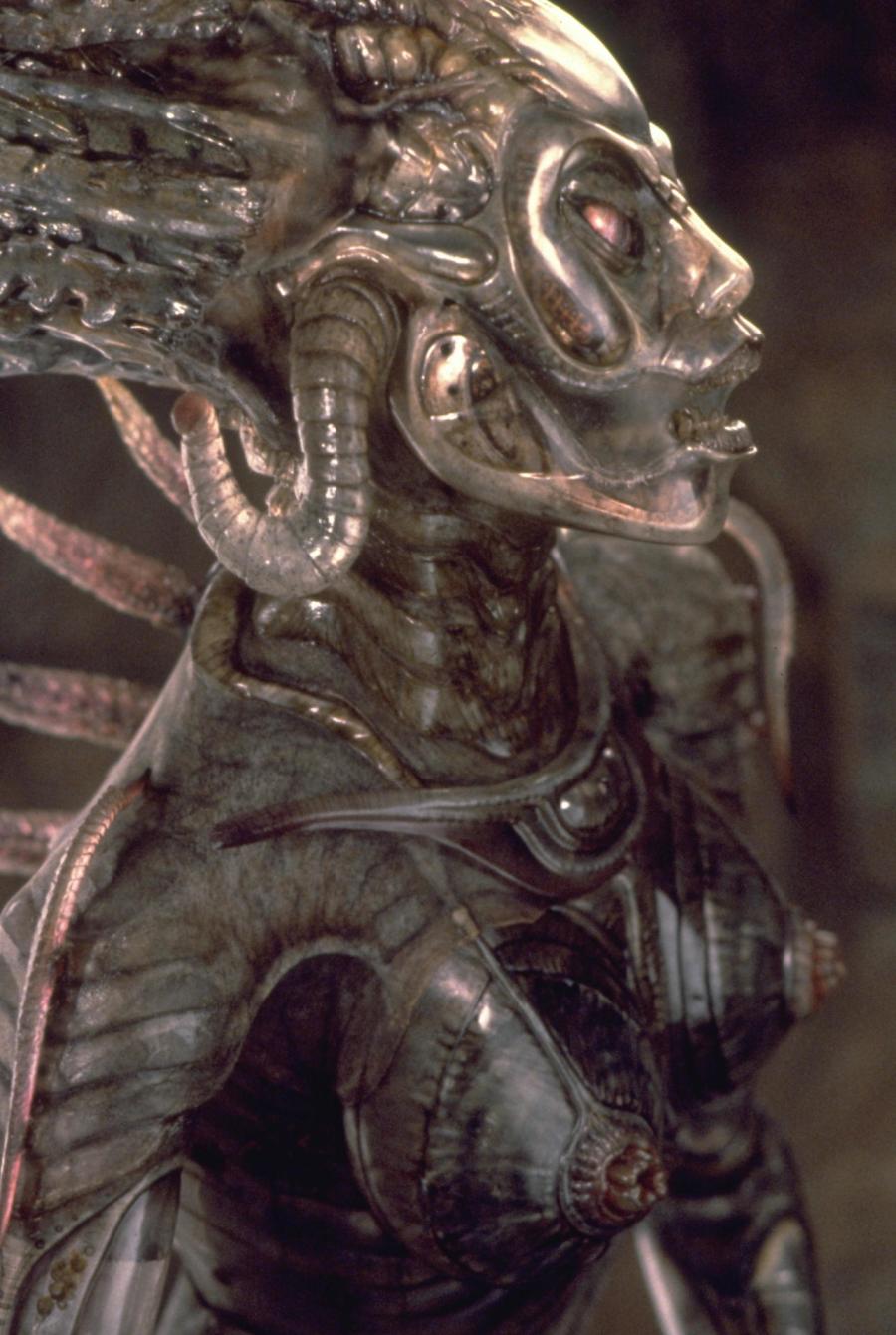
- She must have in her biology the means by which to kill a man without effort (we want to avoid anything metallic, i.e. blades, guns, etc.). We discussed the possibilities of things like bone spurs, tentacles, and/or a barbed, sharp tongue. She should look very organic.
- We spoke of some parts of her body being translucent so that we can see the monster’s inner workings.
- She should be a mixture of very beautiful and very horrific.
- She should be able to burrow in the ground (she escapes this way in one of the scenes of the movie).
- Sil has an extra-sensory ability. She is able to create an obscure image of what exists through a wall rather like a cat-scan, ultra-sound or MRI (magnetic-resonance imaging). We should have some visual thing occur to her eyes when this process is taking place.
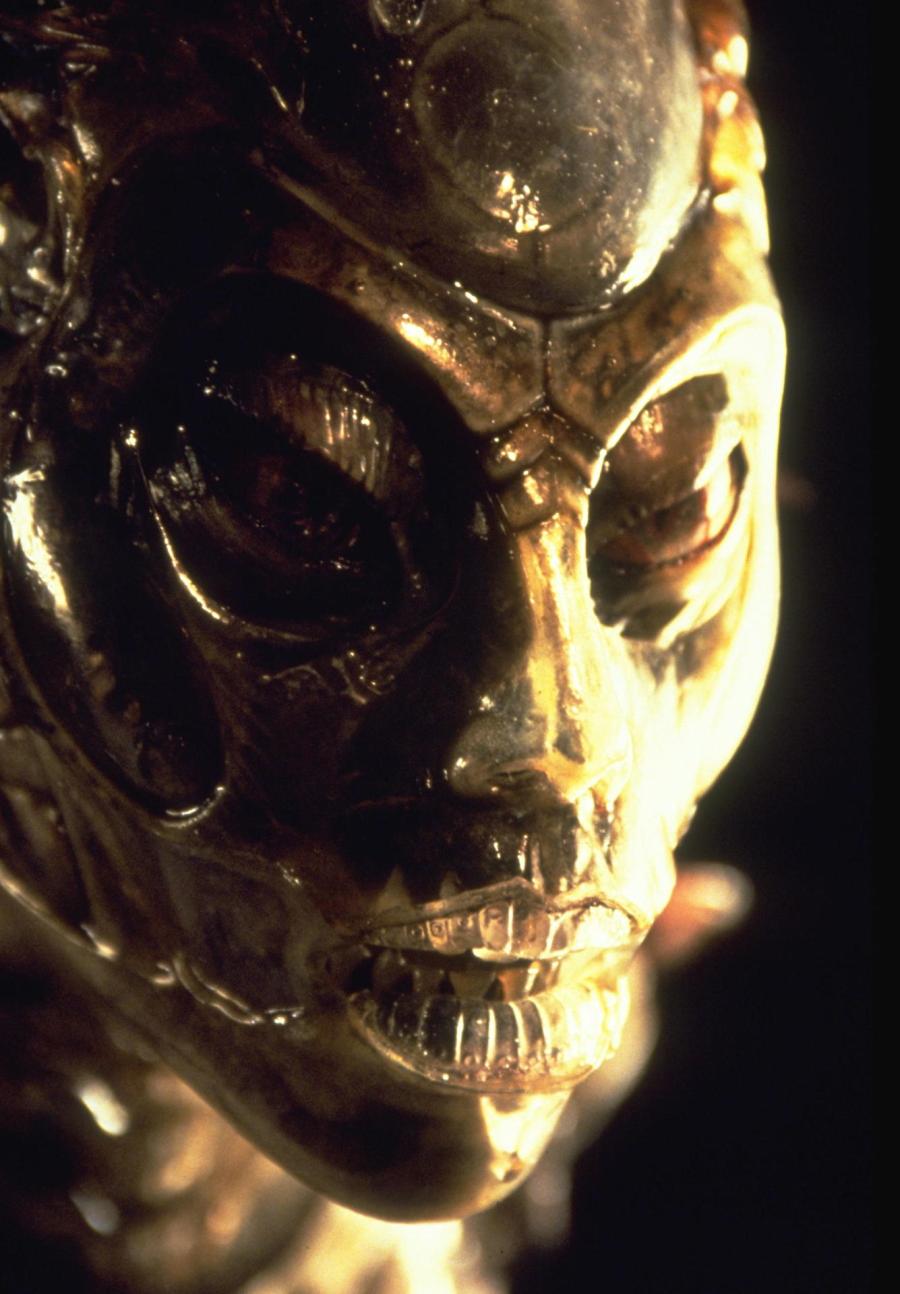
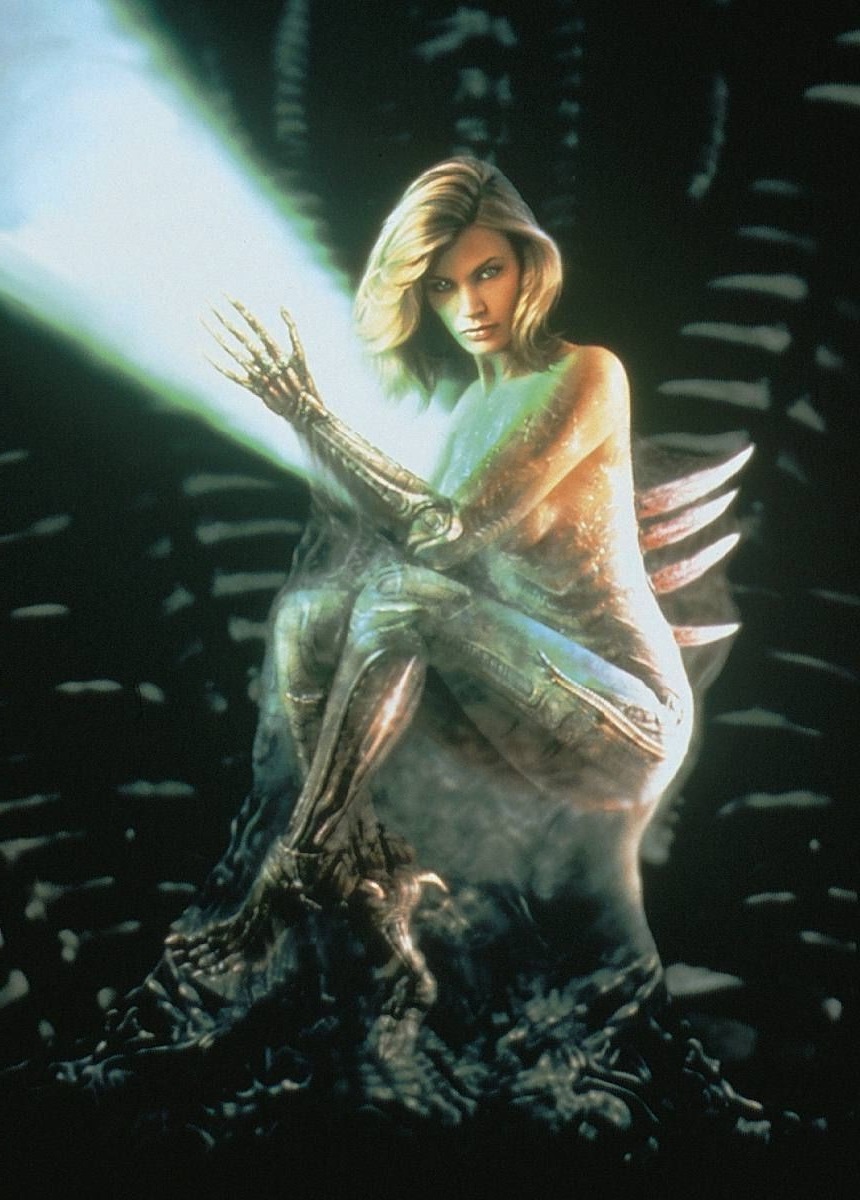
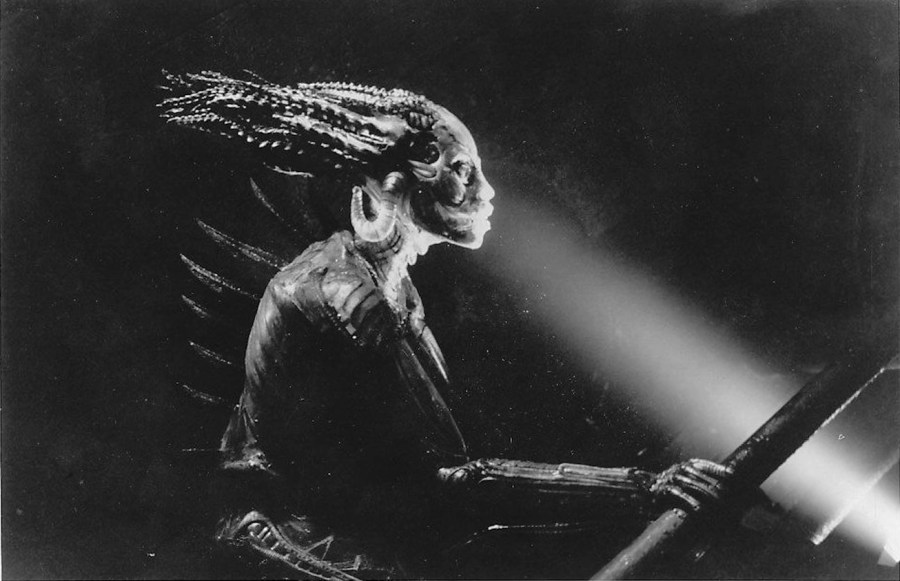
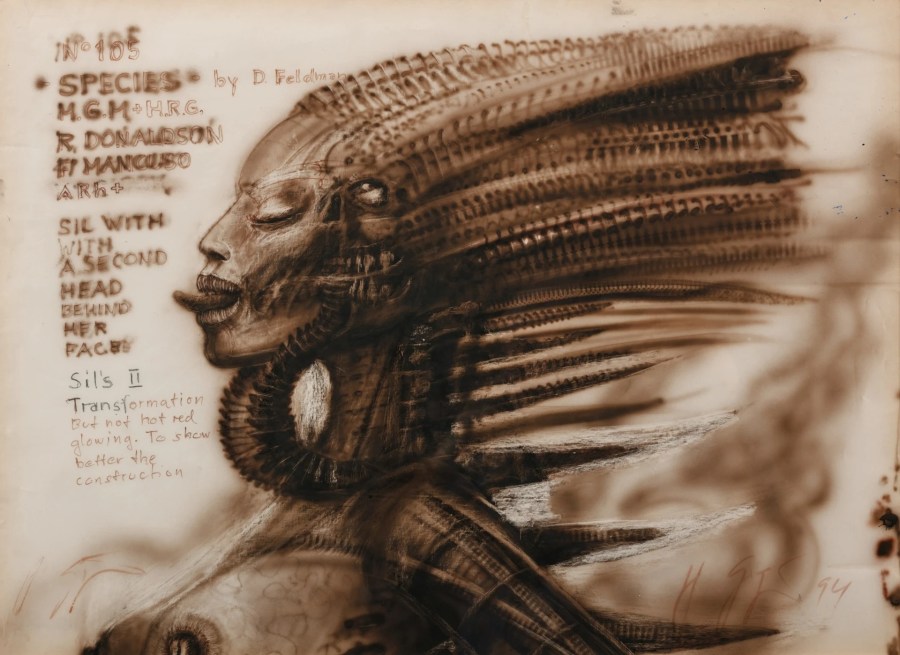
Well before Species, Giger had attempted to create a translucent full body creature suit for Alien, with unfeasible results due to technological and material restraints of the time. Almost two decades had transpired since then, and the artist thus took the chance to propose the idea of a translucent creature with visible layers underneath its skin. His designs portrayed an elegant, statuesque womanly figure, with hair-tentacles collected in the shape of an Egyptian headdress. Her back was lined by dagger-like vertebral protrusions, which Giger described as “serrated daggers protruding from her elongated vertebrae, which shoot outward when she makes her transformation.” Serpentine tentacles springing from Sil’s nipples — initially visualized with curled tongues as tips — were also meant to coil around a victim to bring it closer for the kill.
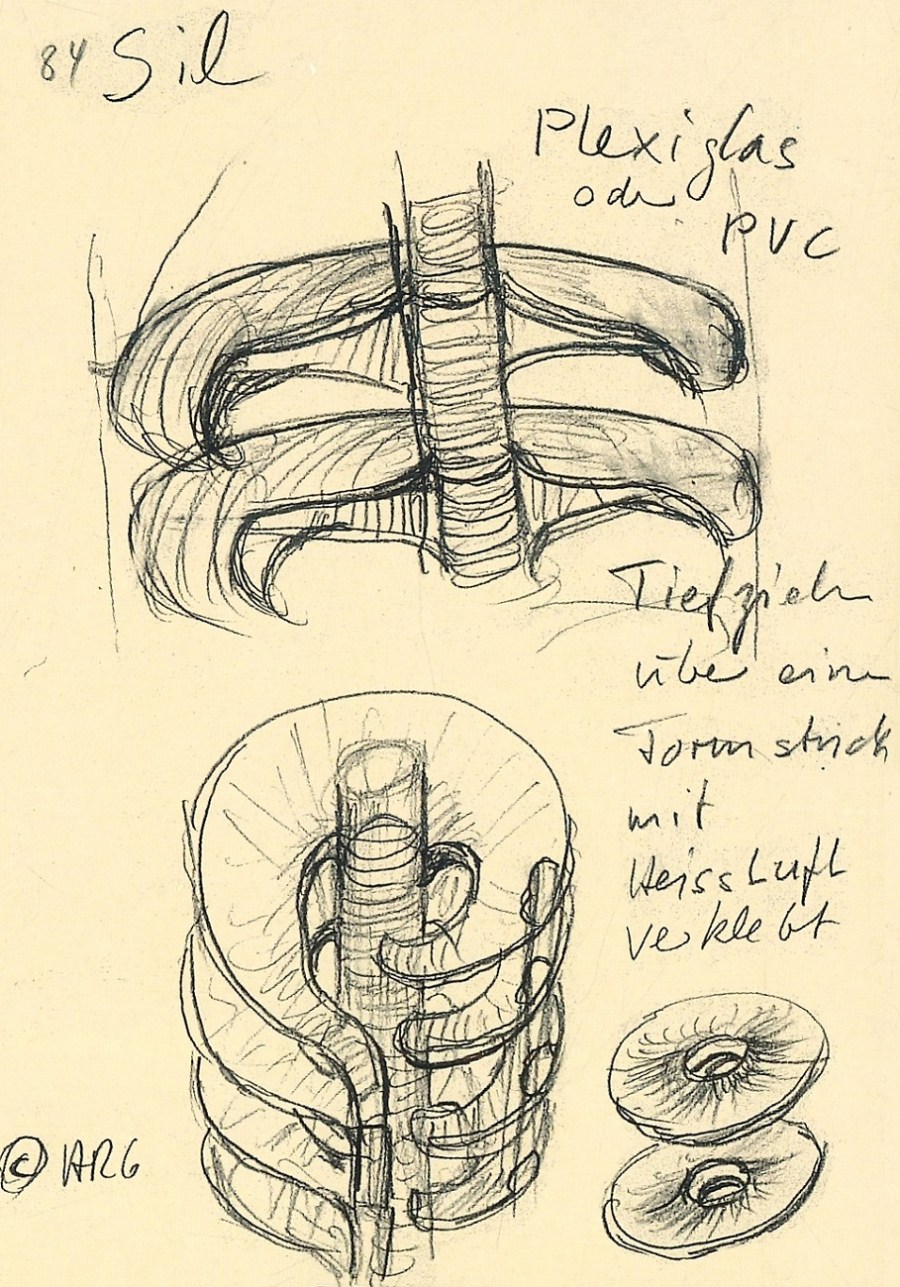
“She was to remain aesthetically beautiful and elegant,” Giger commented, “even after her transformation into a lethal creature. [She is] transparent, with a rather massive skeleton, the shape of her body accentuated by saucer-shaped plates around the joints. Filmed suspensefully, she would produce a sense of horror.” As an initial failsafe, Giger’s preliminary sketches — prior to XFX’s involvement — were deliberately difficult to interpret, rather than being workable blueprints. He said: “Since I couldn’t travel to the States, I didn’t want to leave Sil to just anybody, so I produced my sketches in such a way that they conveyed an impression of Sil, but would never have enough detail to construct her from.”
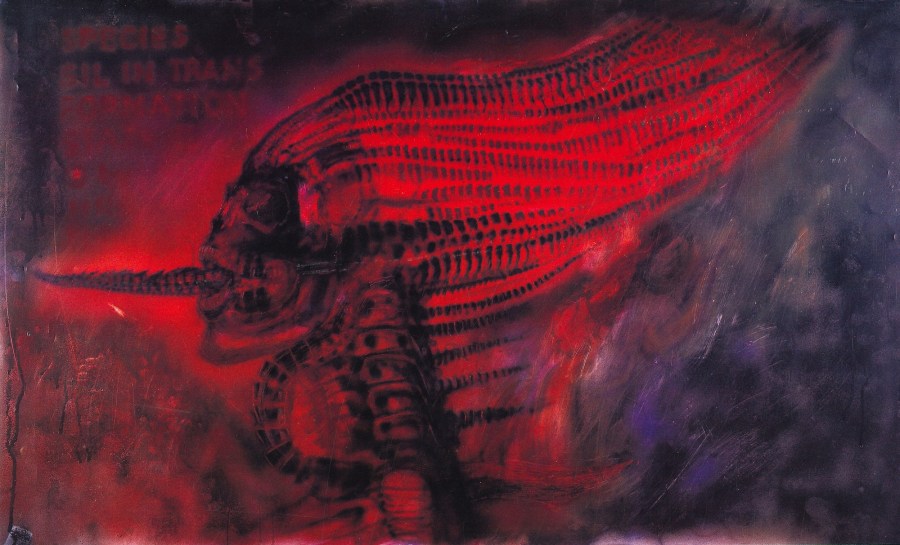
Giger wanted Sil to go through a flamboyant multi-phase transformation associated to shifts in her mood. Her colours would shift following a rise in body temperature. “My original idea was that Sil’s transformation from a tall, beautiful young woman into a deadly but still beautiful monster would develop in four distinct phases,” the artist explained. “First, she transforms and begins to glow red hot and quickly increases her temperature to an orange glow, whereupon all of her clothing and hair burn off.” At this point, “her body weapons are like red glowing steel.”
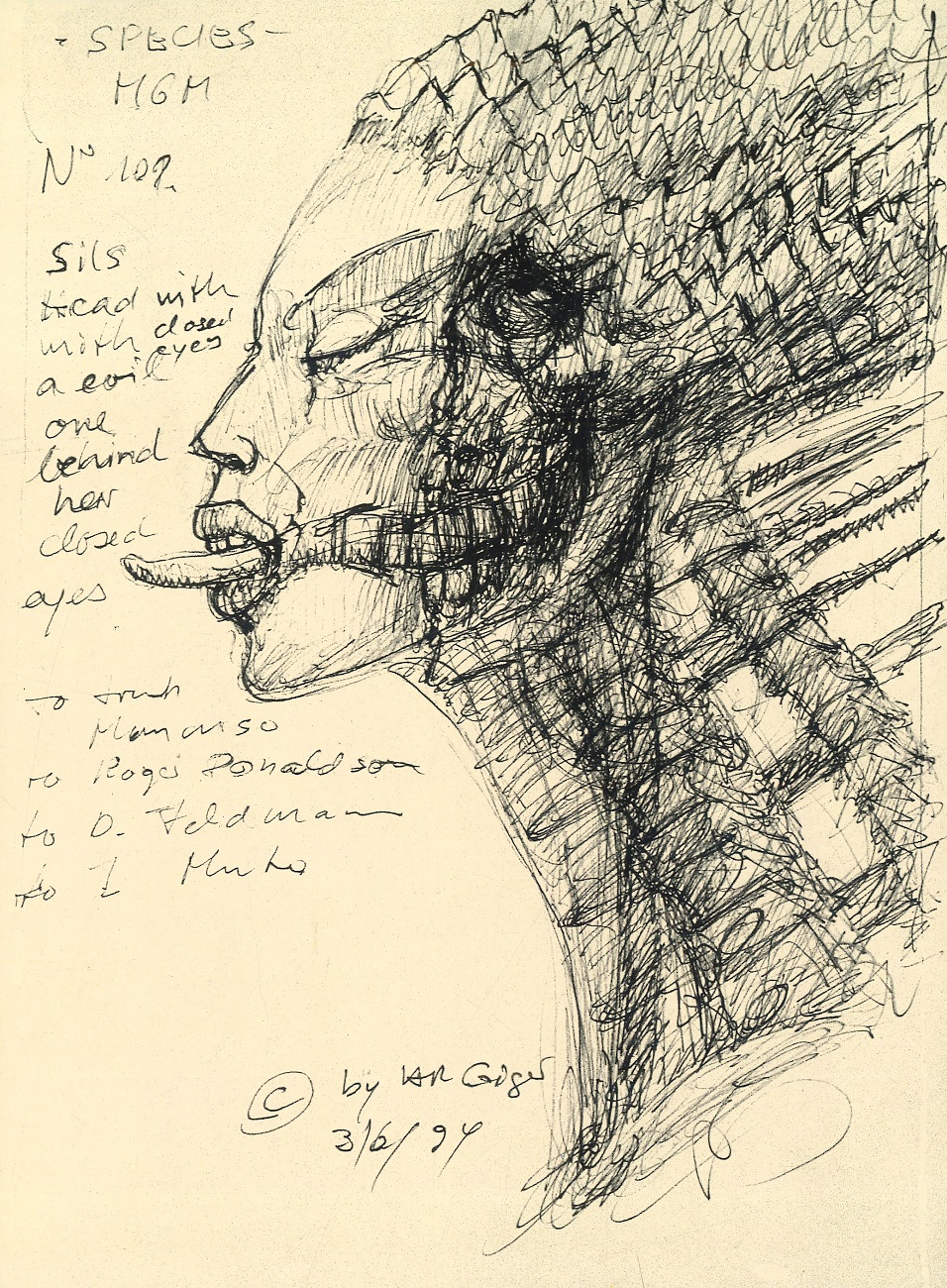
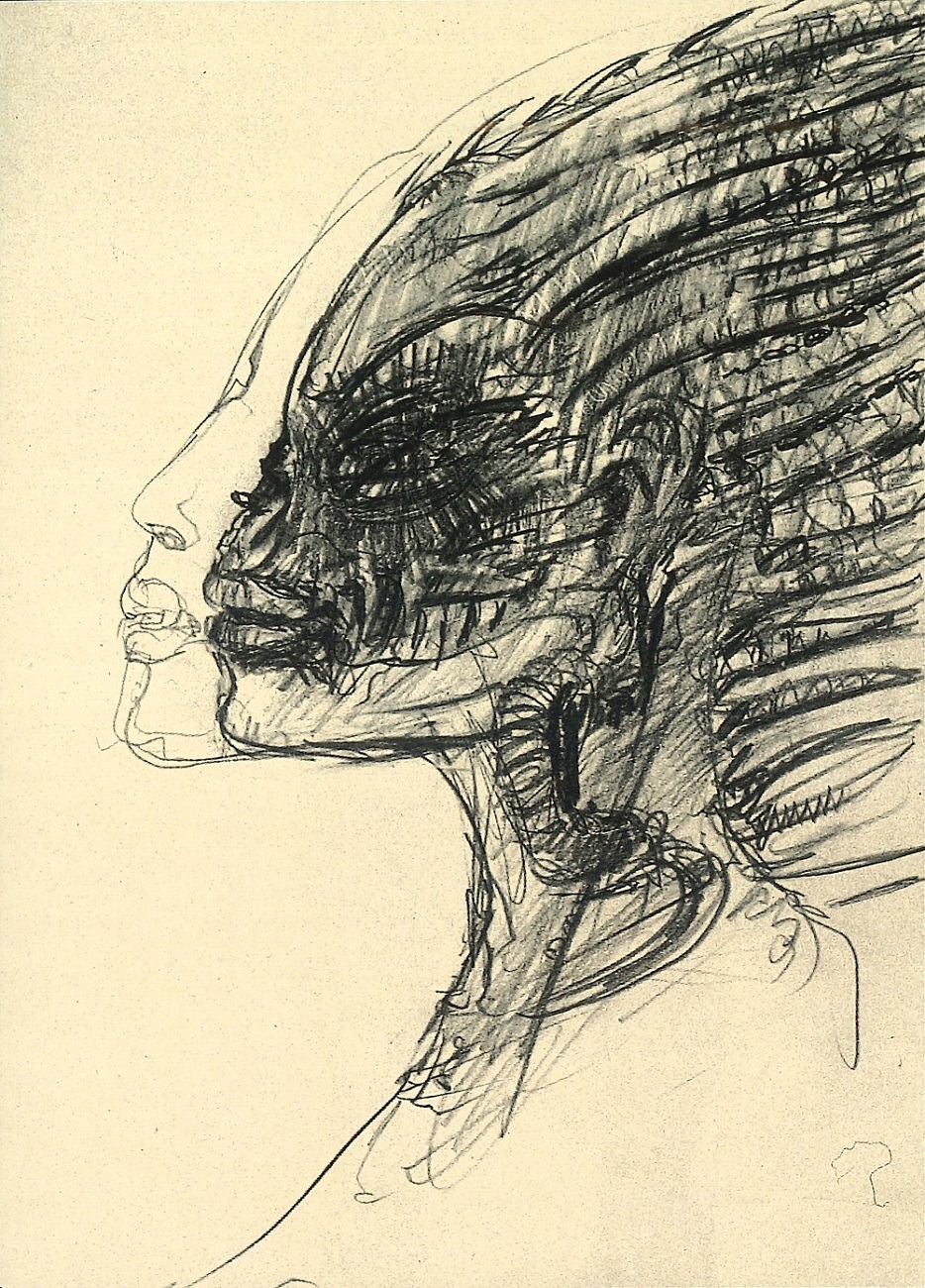
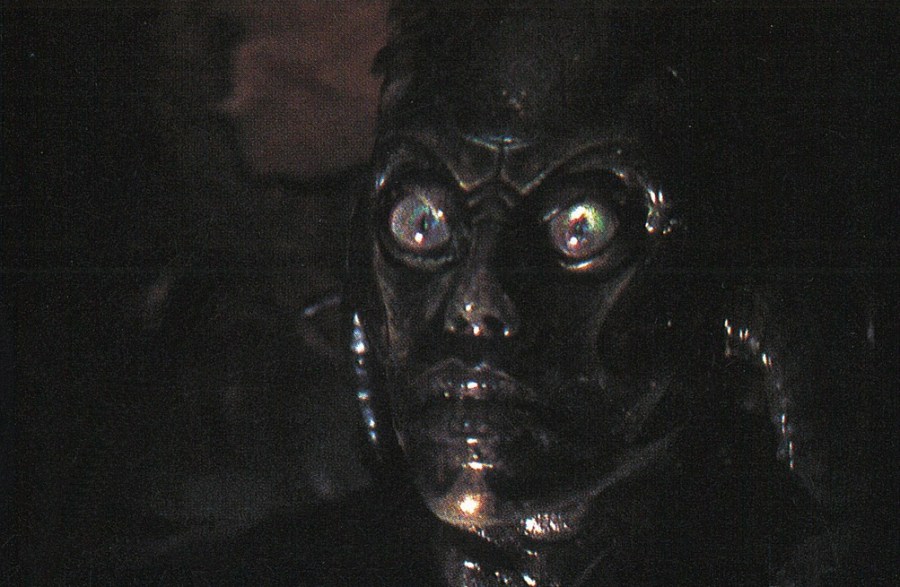
The heating is followed by a cooling, towards an appearance reminiscent of carbonized glass, with “an evil face beneath” Sil’s human visage. Giger continues: “simultaneously, spine daggers shoot out of her back and we see that she is transparent. [Then] we see her interior organs and even her baby, when she has become pregnant, resting in its womb between her breasts, with her carbon-like bones encased in her glass-like structure. [Then] the black bones revert to their human form and her skin becomes opaque.”
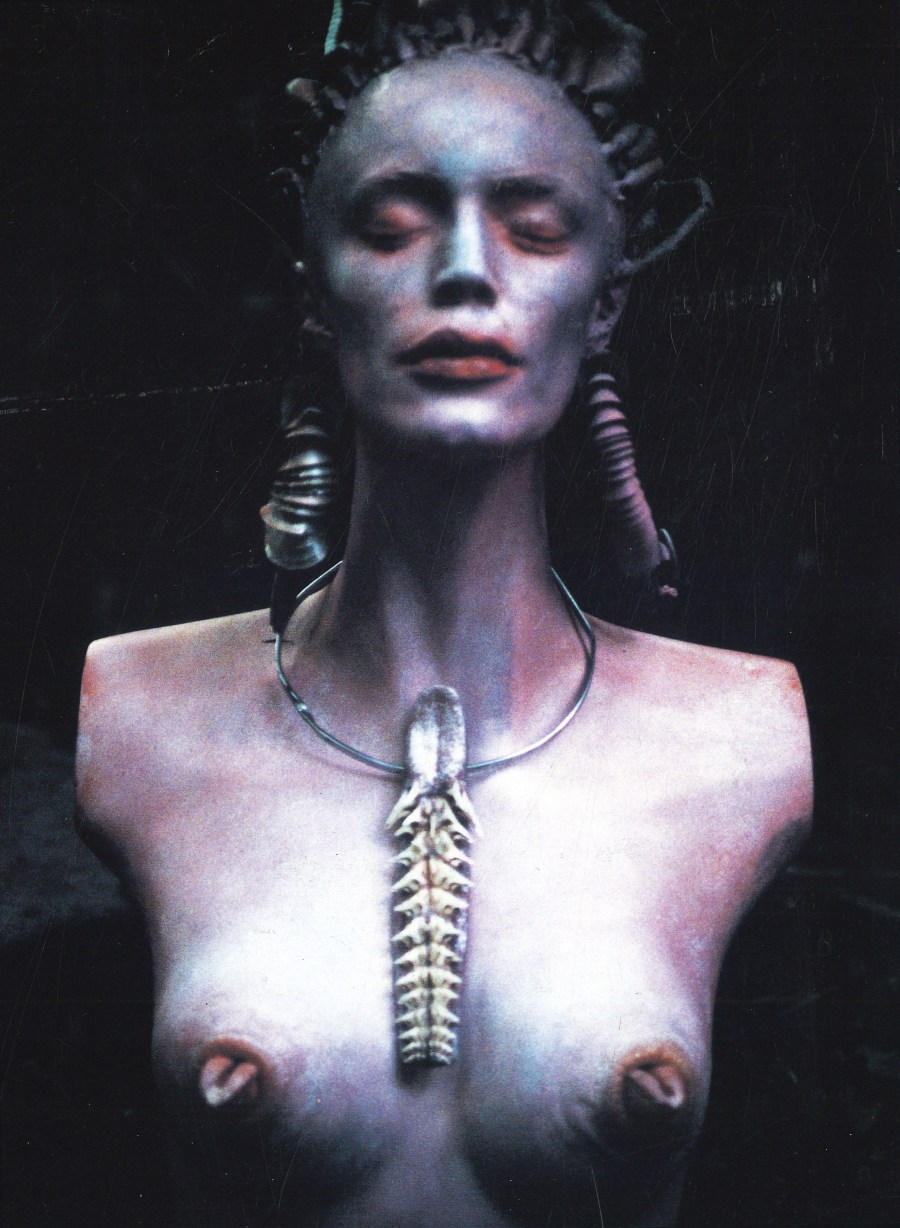
Initial response from the filmmakers about the translucency idea was not welcoming, with the claim that such effect would be too expensive to achieve, forcing the use of extensive computer graphics. Determined to prove the idea was not only possible but also cost effective, Giger recruited friends Conny De Fries and Andy Schedler — previous collaborators on the Giger Bar in Chur — to build a proof-of-concept, full-size model of Sil in Zurich, paying himself for the effort and materials. Sculptor Daniel Rieser was also involved.
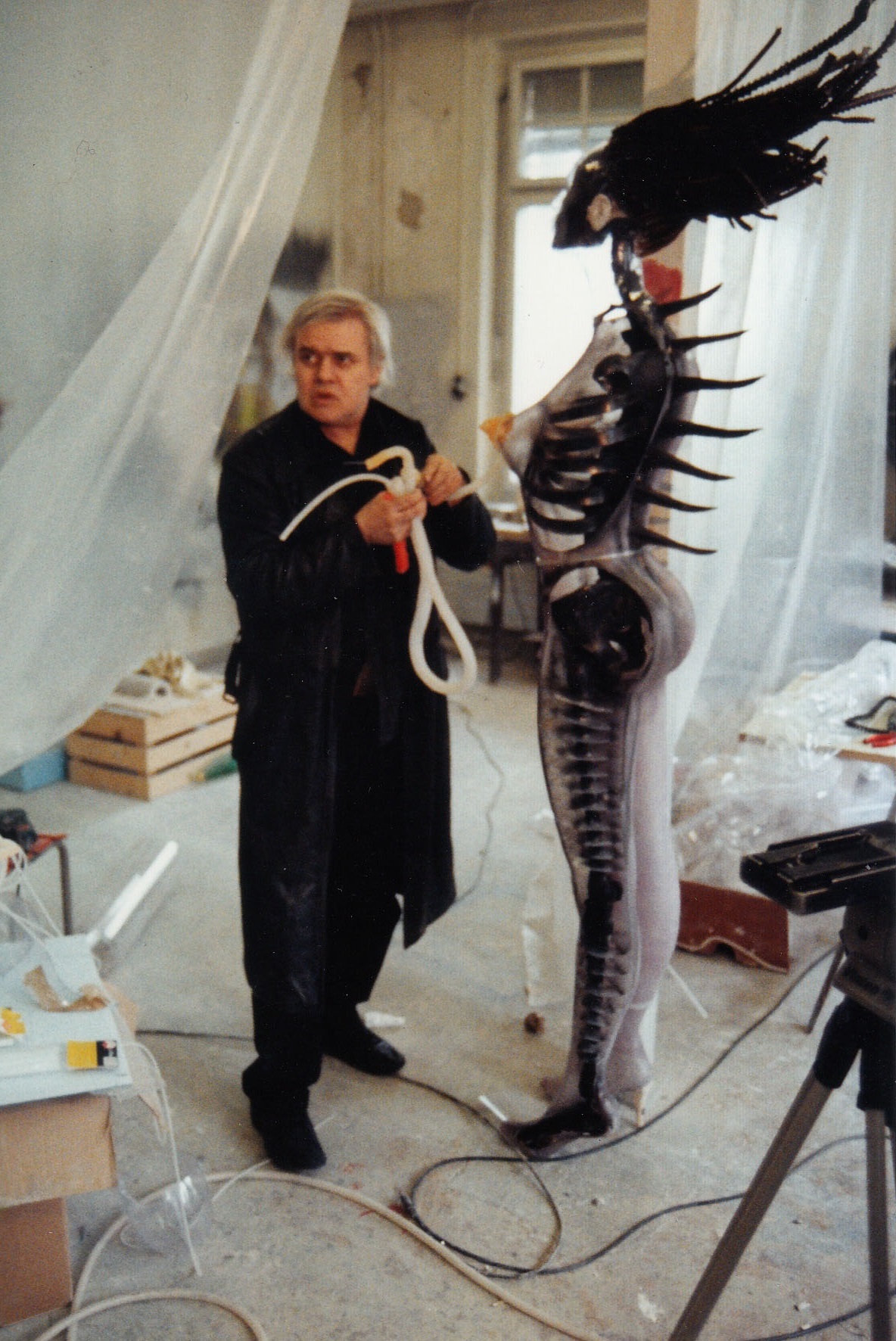

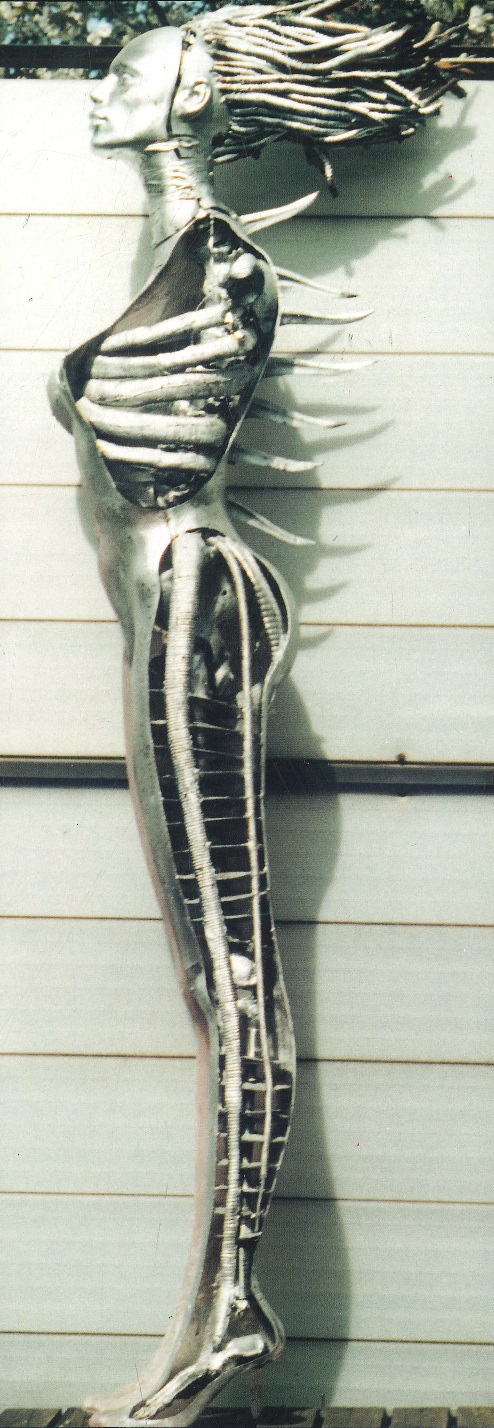
As a starting point, Giger and the Swiss crew did body casts of a tall woman named Nadia and the head from Swiss model Nadine. Two other unnamed women were also cast. “Several reasons made it necessary that the woman be ‘stitched together’ like Frankenstein’s Monster,” Giger related, “or more specifically, his bride. [The prototype Sil] was built from moulds taken from four different women.” The prototype Sil statues were cast in polyester and plaster as main materials, with other structures employing real animal bones and zinc wire. About four different versions were assembled, with holograms inserted into their cut-away limbs to show how the translucency would be incorporated.
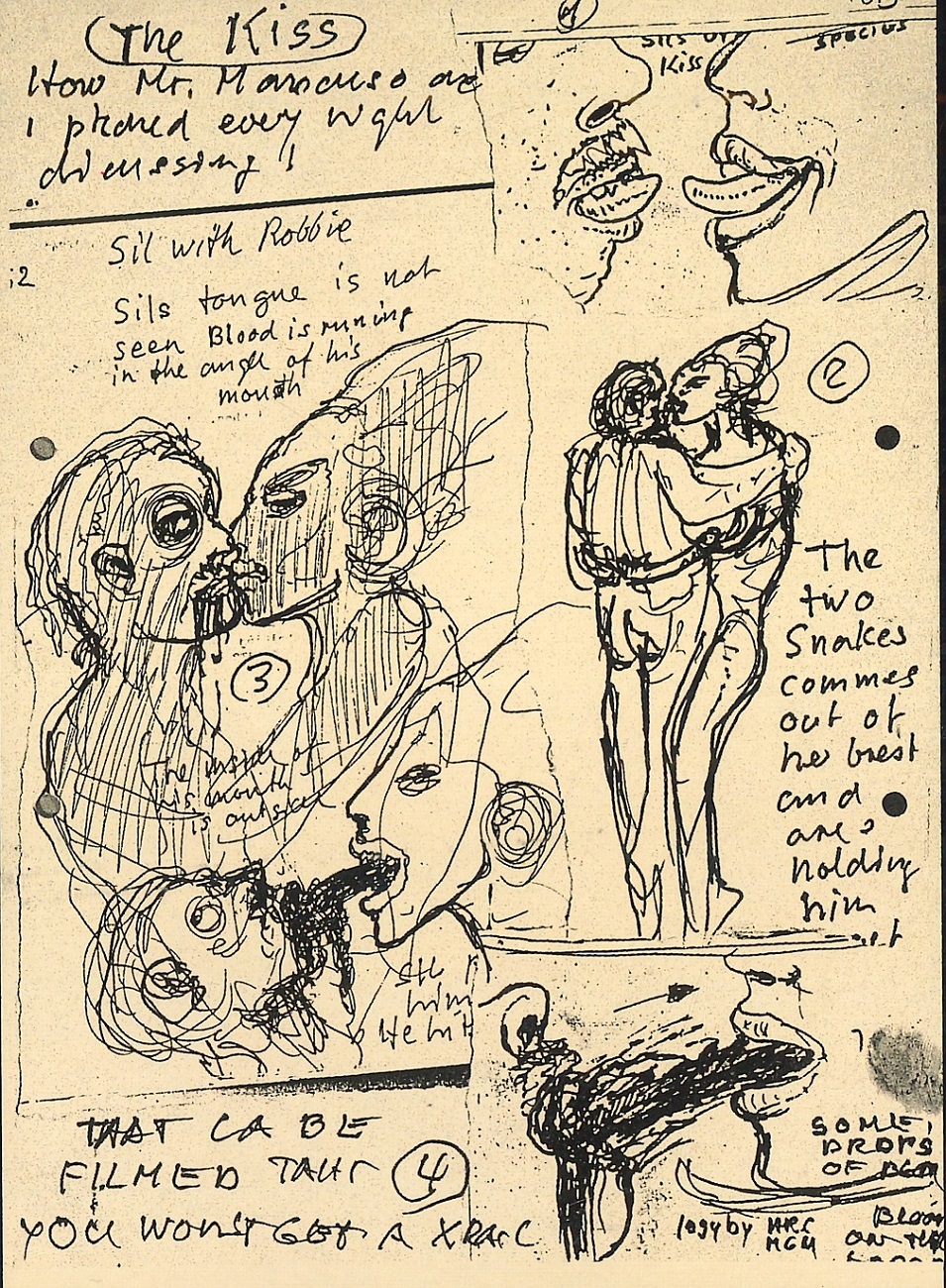
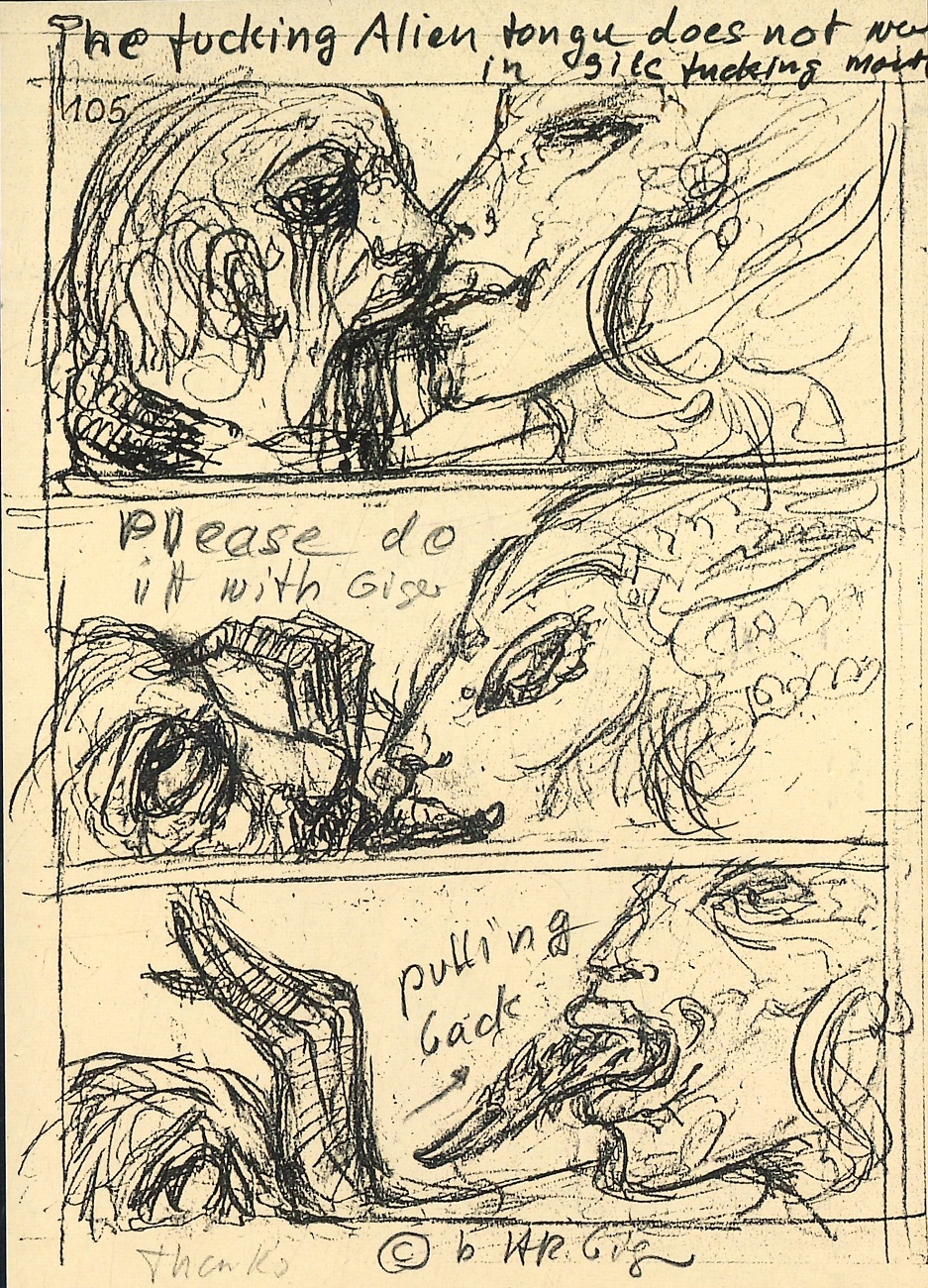
Giger also wanted to incorporate an idea he had previously proposed for Alien3 — that of the “kiss of death”: a barbed tongue that could violate a victim by mouth, pushing into their insides and then scooping and pulling entrails out as it retracted. Giger’s agent, Leslie Barany, sent him “a set of shark jaws full of sharp serrated teeth,” the artist recalled. “I carefully inserted them into a tongue I fabricated, creating a unique and frightening weapon, the most powerful aspect of Sil’s face.”
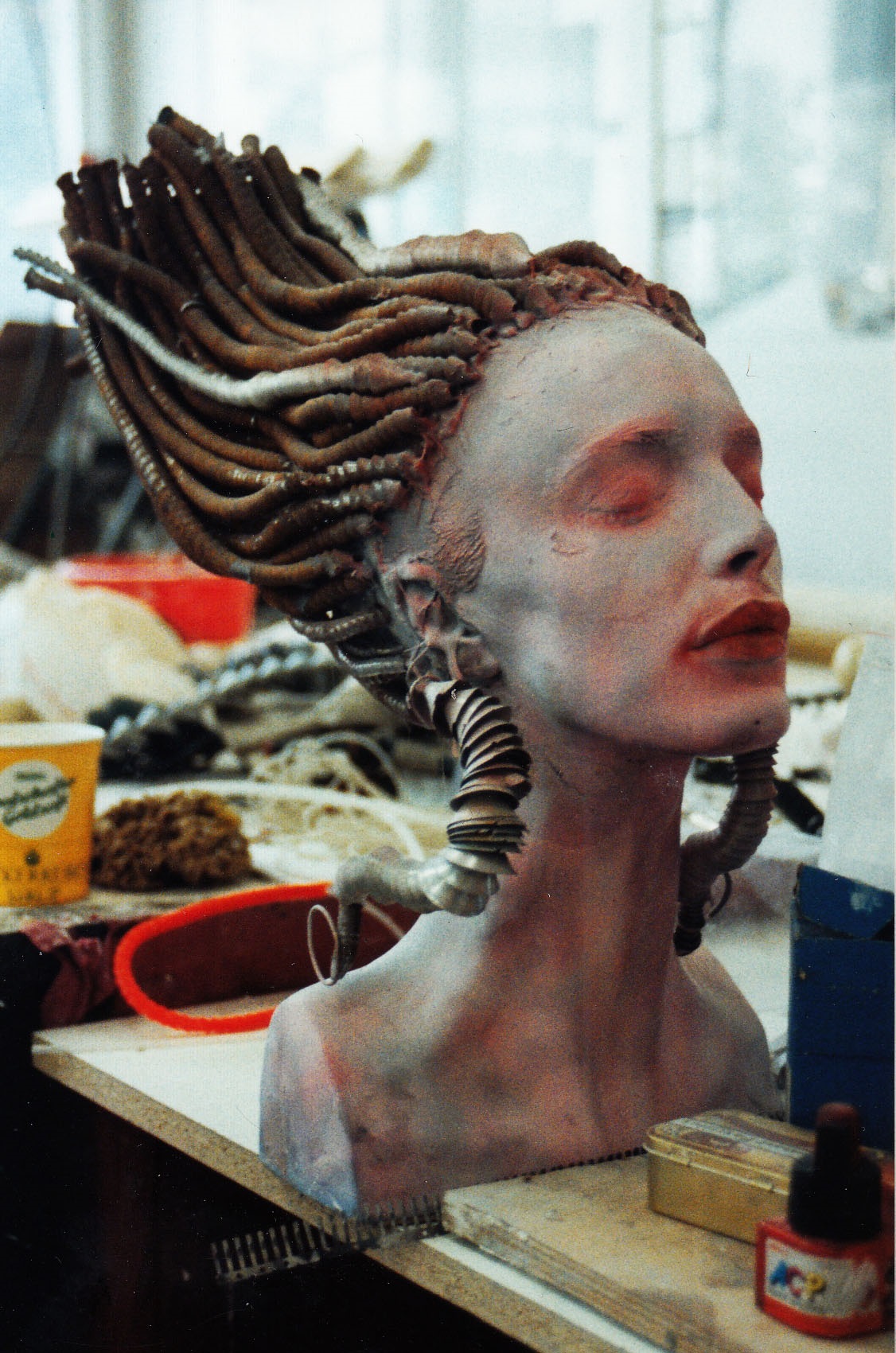
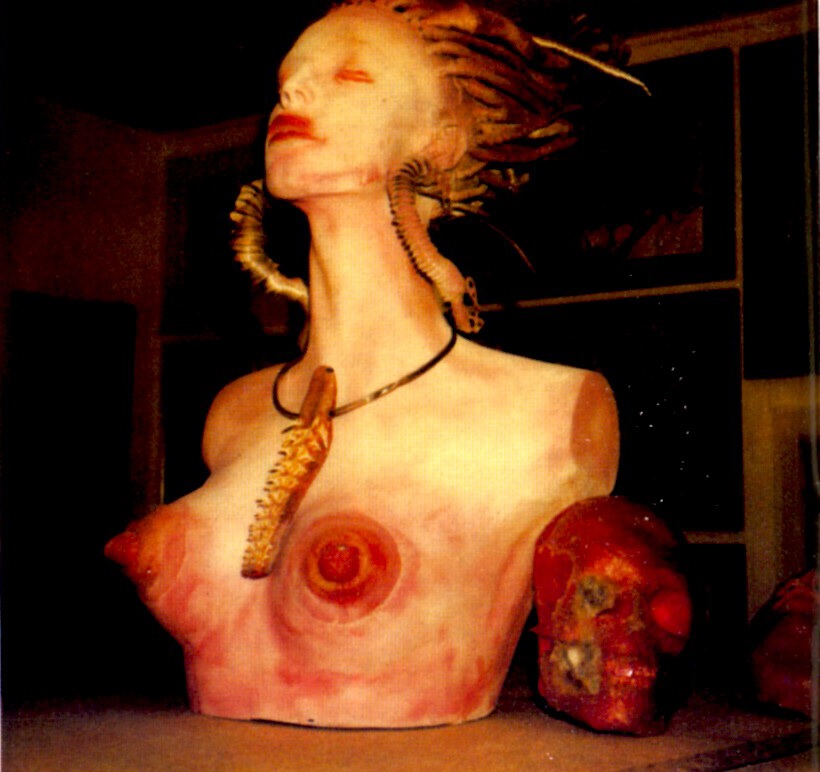
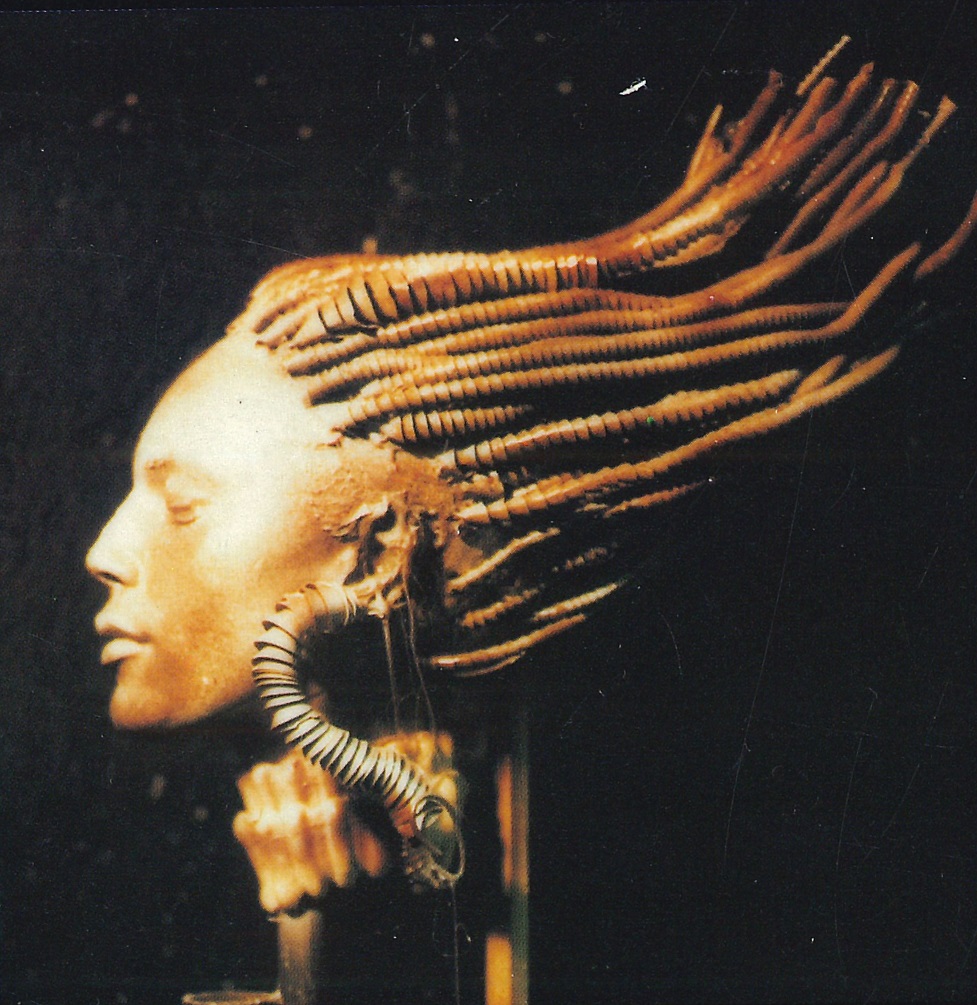
There were other prototypes made. Based on a modified cast of the prototype Sil, Giger and Schedler fashioned two busts in polyester, silicon and metal: an opaque bust that defined the forms of the design as established up to that point, and a translucent bust portraying the red glow idea. It was cast in translucent silicon, with elements in polyvinyl, polyester and metal. Extrapolating from the early notion that Sil would kill her victims with razor-sharp nails, Giger also built a detailed long-clawed hand out of polyvinyl, bones and zinc wire.
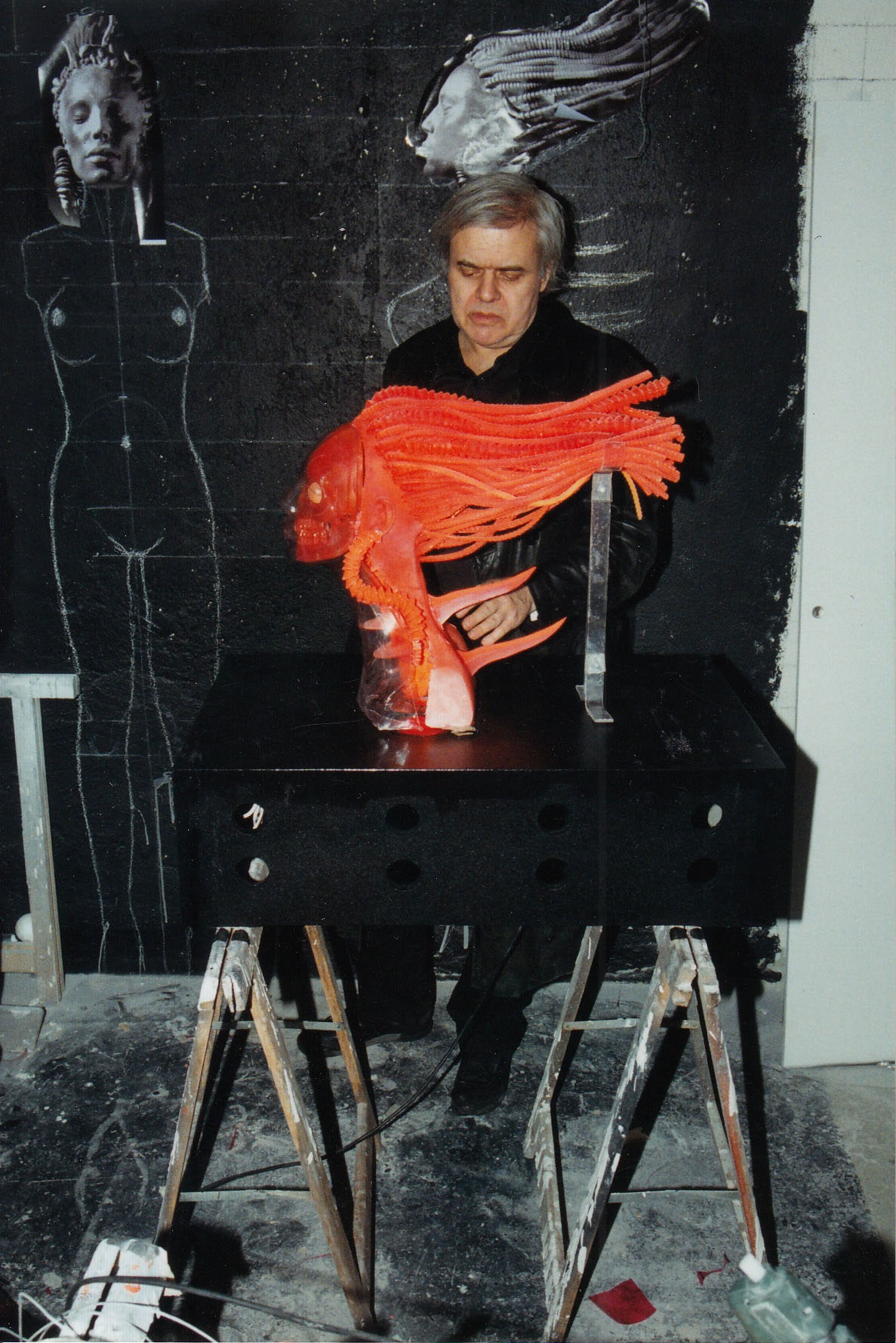
Production schedule was tight, and Giger ran into several hindrances and delays. Between the search for the right women to cast parts from, the time consumed by construction, his mother’s health conditions and even an unexpected car crash, he ended up only showing the filmmakers only the polyester body and vacuformed head. The lack of practical expertise among his crew was also a factor. “The work morale was counterproductive from the beginning,” recalled the artist. “We had no specialist and too little know-how. There is no film industry in Switzerland.” The artist’s requests to be assisted in loco by American special effects experts were rejected, something that he lamented: “I always thought Mancuso would send us somebody with experience to help us and teach us state-of-the-art Hollywood techniques. I felt the help would give us a chance to accelerate the fabrication and allow us to build the filming version of Sil here. In the end, I spent the majority of the money brought in by the film on my own experiments in fabrication.”
Another visit came from Mancuso, Feldman, Donaldson and production designer John Muto. While Giger could show them the prototypes and the busts — including a demonstration of Sil’s red glow with a LED light — he realized he could not finalize Sil in Chadler’s shop with respect to the production schedule. “I was just not going to be able to complete a transparent version of Sil within the required time frame,” he related. “Back at the film atelier after the visit of the Hollywood film giants, we all felt quite insignificant.”
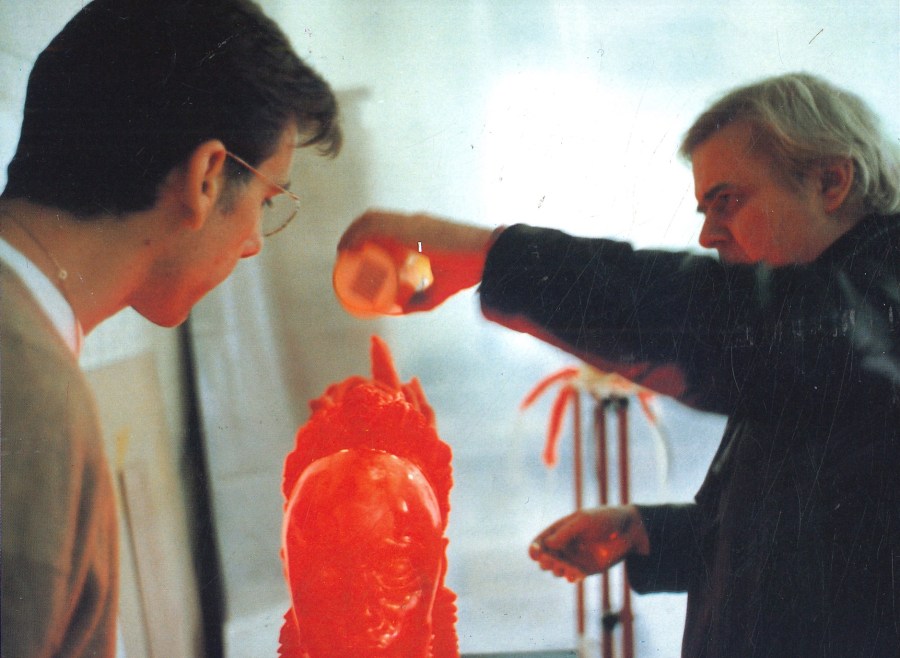
At this point, Mancuso was still convinced that Sil’s translucency would dictate a mostly digital approach to the creature effects, as he believed that a puppet would end up too stiff. While the translucency would eventually be approved, this was not the case for the elaborate transformation with the livery shifts. “They cut out the colour changes and the glowing aspects,” Giger continues. “They didn’t like someone else making suggestions, saying how the script should go. I gave many ideas… in the beginning, I was not happy because I saw my suggestions were not welcome. I think the director always wanted to make her ugly and I wanted to keep her beautiful. I think he’s a great action director, but for the horror scenes, he and I did not share the same vision.” He also added: “they said, ‘we can’t make her glowing’, but they never did tell me why.”
As he had done with the Big Chap for Alien, Giger had retained that he could and should be thoroughly involved in the building of Sil and the other creatures, with the belief they could be developed and executed in Switzerland and then sent to the film crew. This was primarily so that Giger could stay beside his mother Melly, whose health at the time was rapidly deteriorating. However, production constraints imposed that all the actual construction work ought to be done in Los Angeles.
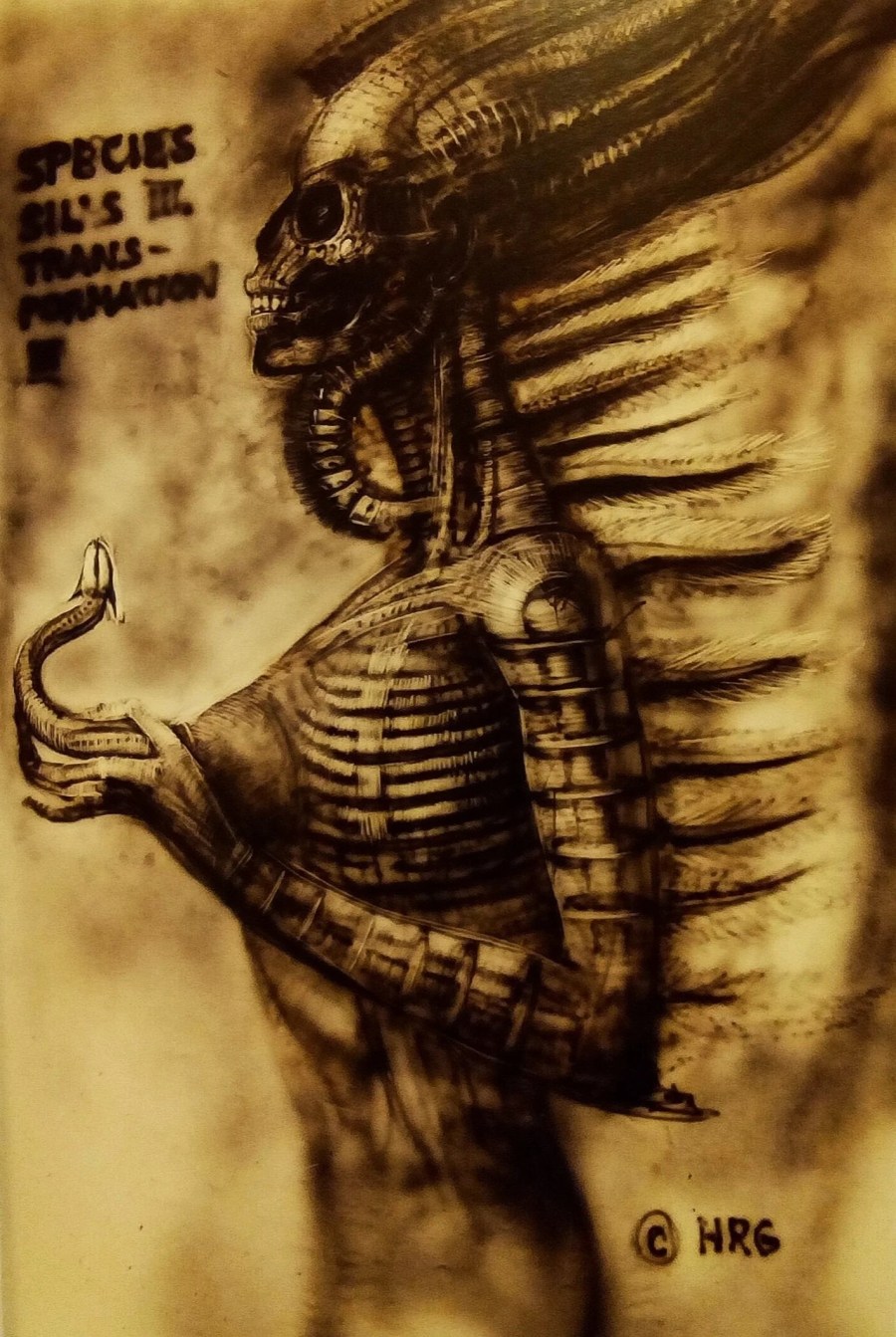
This combination of factors ultimately prevented the artist from physically being present for the building process. Giger related: “although I knew we lacked the kind of specialists who exist in Hollywood, for a certain period of time I had naively hoped we could fabricate the shooting version of Sil in Switzerland. I had worked on two films ‘long distance’, Poltergeist II and Alien3, where I had not been satisfied with my ability to effectively assert my influence in the interpretation of my one-dimensional drawings to the extent I wanted.”
Giger continues: “my own complex process of development requires that I have the freedom to evolve my concepts as I proceed with them. To better effect the end result, I delayed doing the kind of big, detailed paintings that the talented but overeager crew in Hollywood would easily finish fabricating before I had the chance to fully develop my idea. I believe Frank tried hard to accommodate me in this.”
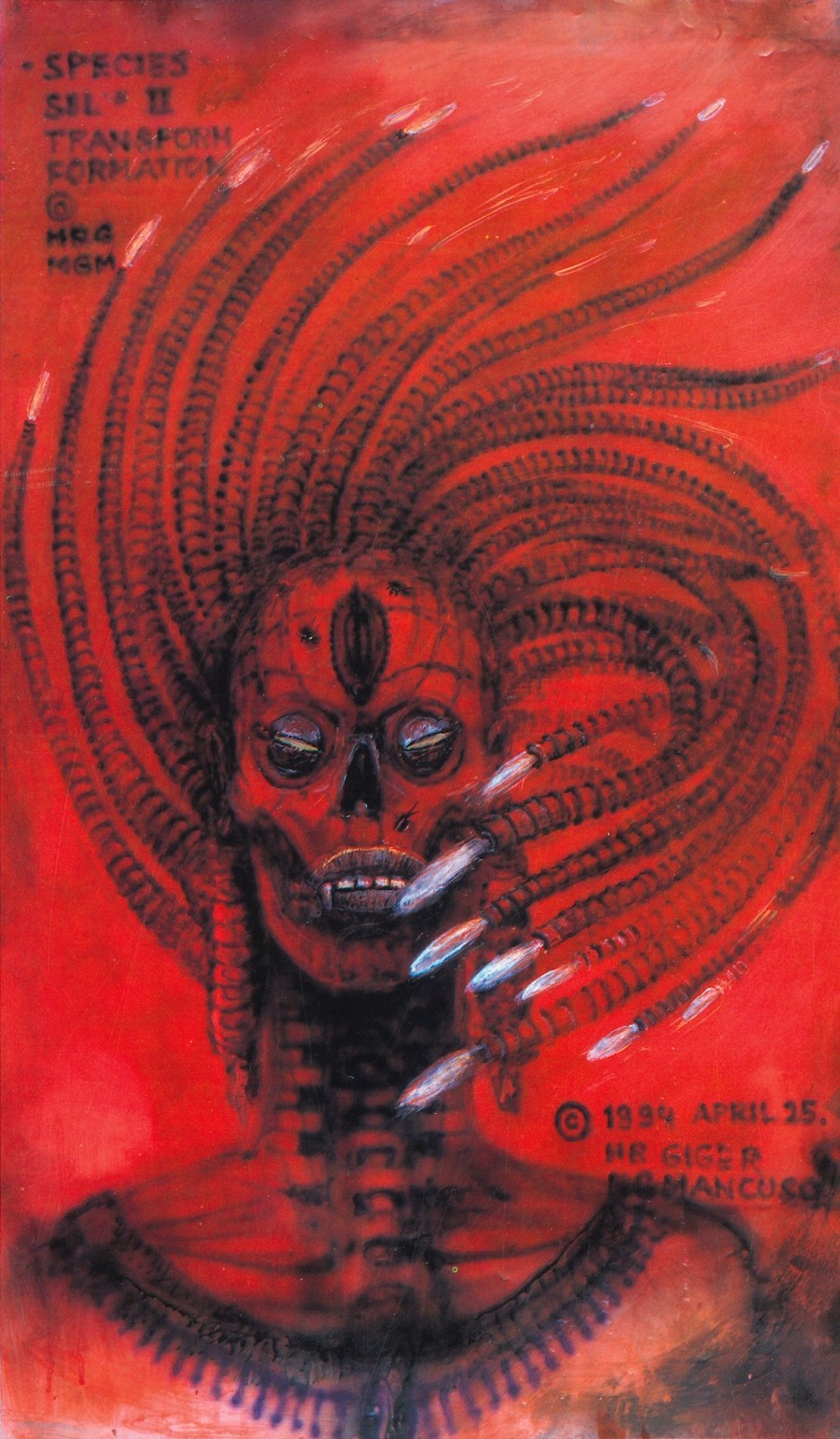
Regarding this conundrum, Johnson commented: “not understanding the film industry and not being over here when these films are being made put him in a quite difficult position, because he wants so badly to have control over it […] and concessions have to be made when you make a film, regarding budget and schedules, so I’m pretty sure it’s ultimately all incredibly frustrating for him.”
Giger ultimately had to surrender the construction of Sil to the crew in Los Angeles. “Personally, I was terribly disappointed,” he said. “By now the contract had been signed but much of the money it brought in ended up paying for my own expensive experiments in fabrication. My plan to complete a full-scale Sil in Switzerland was destroyed for many reasons, the strongest of which were the incomplete execution of my designs and the pressures of time and money.”
Next: Part 2
 Monster Legacy
Awesomeness!
Thank you!!!
Sorry, this comment could not be posted.
This article is absolutely amazing! It was well worth the long wait. I hope you’ll continue to introduce the second part—keep up the good work!
I’m shcsz. I don’t know what’s going on—my username just changed like this for no reason.
Glad you enjoyed it! The second part is linked at the bottom of the article, here it is as well: https://monsterlegacy.net/2026/03/07/species-giger-sil-xfx-pg2/
…unless you mean ‘Species II’ which I guess will be up later this year. I don’t have a plan for it at the moment, spent so long working on the first one I need to work on something else due to sheer Species fatigue 😛